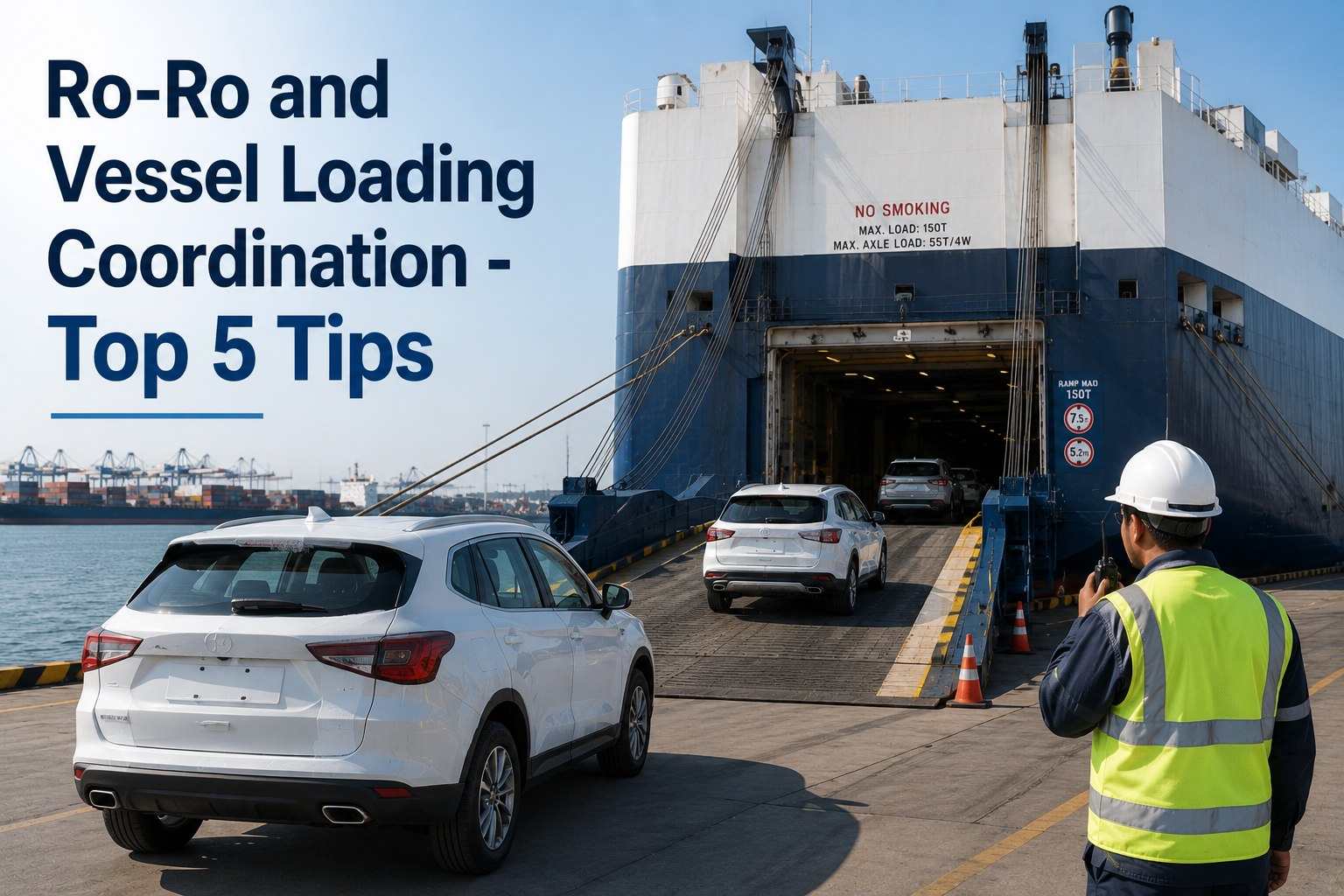
Ro-Ro is the mode where a plant's control ends most abruptly. A vehicle that has been tracked by VIN through a compound, verified at loading and evidenced at every handover reaches the quay and enters a process governed by the vessel's stowage plan, the terminal's cut-off, and a set of documents that must agree with each other exactly. Gate-in itself takes roughly ten to twenty minutes — provided every document is correct. Where they are not, errors in cargo identity or consignee details can delay or prevent loading even after vessel space has been reserved. And the question that decides who pays when something goes wrong at the quay is not operational at all: responsibility for lashing sits with the shipping company, the terminal or the shipper depending on the agreement, and it should be clearly regulated in the contract. Many shippers have never checked which applies to them. Book a 30-minute session and bring one recent port call's documentation — we'll walk it through Fleet Rabbit against the milestone chain and show where your evidence stops.
TOP 5 · RO-RO AND VESSEL LOADING
Ro-Ro and Vessel Loading Coordination
Port call planning that starts before the vessel does, gate-in evidence that survives a claim, stowage handover done properly, and a clear answer on who carries damage responsibility at the quay.
Deck allocation · PCTC
Deck 5Light vehicles
Deck 4Light vehicles
Deck 3Your allocation — slot, weight, ramp capacity, evacuation route
Deck 2Hoistable, adjustable height
Deck 1High and heavy, reinforced
▲ Stern ramp
Adjustable decks make a PCTC flexible and make your slot conditional. Deck allocation depends on the data in your booking — and incorrect weight or dimension information leads to stowage plan changes.
The Milestone Chain
Seven statuses from quay to release. Knowing them lets you spot a delay early rather than discovering it when a vehicle fails to appear at the far end.
1Gate InThe physical transfer of the cargo to the terminal at the port of loading. This is a custody boundary and should be treated as one.
2Document approvalTerminal acceptance and verification. Nothing loads until the paperwork clears, whatever the physical readiness of the unit.
3Loaded on BoardThe unit is aboard, lashed and chocked, with a final photograph and the electronic status issued. The most important confirmation you receive.
4Final stowage checkThe Chief Officer verifies lashing points, records coordinates in the logbook and updates the dangerous cargo manifest.
5DepartureActual against estimated. Deviations here propagate directly into terminal cut-off times for the next call.
6Arrival and dischargeUnloaded, checked and prepared for release at the port of destination.
7ReleaseOnly once a valid bill of lading and customs formalities are complete. Physical availability and commercial availability are different things.
Where visibility usually breaks
Most plant-side systems track a unit accurately up to gate-in and then resume at release, treating everything between as a black box. The middle five statuses are exactly where a delay becomes expensive and where a damage event becomes unattributable. Capture the Loaded on Board confirmation against the VIN — it is the single most useful ocean-leg milestone available to you, and it usually arrives by email or electronic message and gets filed nowhere.
Five Ways to Coordinate a Cleaner Call
Ordered by how much delay each one prevents. The first two happen days before the vessel is alongside.
01Get the booking data right, because it drives the stowage plan
Weight, dimensions, description, port of loading and destination all feed deck allocation. Unclear or incorrect information leads to changes in the stowage plan — and overheight units frequently attract charges. For anything unusual the carrier may also want photographs, ground clearance, axle load, towing and lashing points, and notes on removable parts, because those determine ramp limits, deck clearance and deck strength.
PreventsRe-planning at the quay, surcharges, and units that cannot be stowed as booked
02Make cargo genuinely terminal-ready before despatch
A running unit must be able to start, steer, brake, roll and drive under terminal control. Non-running units need an accepted handling method agreed in advance. Removable attachments and loose items must be dealt with before delivery, because the terminal can stop unsafe cargo at the gate — and the cargo must match the condition declared in the booking.
PreventsRejection at the gate after the unit has already travelled to the port
03Treat the terminal cut-off as the real deadline
Deviations in estimated departure have direct consequences for cut-off times, and late deliveries frequently result in rebooking onto a later sailing. Work backwards from the cut-off rather than from the departure, and build the compound release schedule around it — a vehicle arriving after cut-off has missed the vessel regardless of when it actually sails.
PreventsRebookings, and units stranded at a port waiting for the next call
04Settle lashing responsibility in the contract, not at the quay
Depending on the agreement, responsibility for securing sits with the shipping company, the terminal or the shipper — and it should be clearly regulated in the contract. The shipping company specifies minimum requirements, which vary by weight, route and ship type. Where this is unresolved, the consequences of inadequate securing are transport damage, delays, additional costs and liability claims, with nobody clearly holding them.
PreventsThe dispute that only surfaces after damage, when positions have hardened
05Capture condition at gate-in as a custody transfer
Gate-in is the physical transfer of cargo to the terminal, which makes it a boundary exactly like a carrier pickup or a dealer delivery. Condition captured on both sides is what separates quay damage from transit damage later. A survey is not mandatory for standard cars but is often required for high-value loads — and where it is optional, your own capture is what fills the gap.
PreventsDamage found at the destination with no way to place it in a segment
10–20
min gate-in
if the documents are correct
The whole delay risk is upstream of the gate.
Bring one port call's booking data, gate records and rejection list to a short call. We'll trace it in Fleet Rabbit from compound release to Loaded on Board, and show which document or readiness check is generating your gate delays. It is almost never the terminal — it is data that left the compound wrong.
Port Call Planning, Before the Vessel
The call is approved before it is planned, and both happen before anything of yours moves. Understanding the order helps you see where your own deadlines actually sit.
Step 1
Notification of expected arrivalThe shipping company informs the agent and the terminal that the vessel is expected, which starts every other clock in the sequence.
Step 2
Port entry approvalThe agent notifies the Port Authority, which assesses the vessel against its requirements using pre-arrival documentation — the Master's General Declaration, security forms, health declarations and ship certificates.
Step 3
Operational planningCoordinated between terminal and shipping company. This is where cut-offs, berth windows and handling arrangements are fixed, and where your delivery schedule has to fit.
Step 4
Stowage plan allocationDeck slot, weight, ramp capacity and evacuation routes assigned — increasingly held digitally in the port's community system. Your booking data is the input to this, which is why point one of the tips above matters as much as it does.
Stowage, and Why Rehandling Costs You
A concept worth understanding even though it is the carrier's problem, because it explains a great deal about how your cargo gets placed and why some ports are harder to serve.
The rehandling problem
On a voyage with sequential port calls, cargo due to discharge at one port may be blocked by cargo destined for a later one. Freeing it requires relocating other units — rehandling — which is unnecessary work that raises handling costs and extends the port stay.
Why it is hard to avoid
Optimising stowage across multiple ports, multiple decks and stability constraints is a genuinely difficult computational problem. Heterogeneous cargo sizes and weights make full deck utilisation harder still.
Why shifting is expensive
Because vehicles are securely fastened to the deck, moving one is time-consuming — it keeps the ship in port longer and increases the cost of the voyage. Which is why carriers care about accurate destination data at booking.
Stability is not negotiable
The loading plan must keep the vessel seaworthy — flotation, stability and structural strength assessed against it. Negligence of stability has produced serious casualties, including a car carrier heeling heavily shortly after departure in a well-documented incident.
The practical takeaway for a shipper is narrow but real: accurate destination, weight and dimension data reduces rehandling, and rehandling is what makes your units late and occasionally what makes them damaged. Booking accuracy is not an administrative courtesy — it is an input to a constrained optimisation that your cargo sits inside.
Damage Responsibility at the Quay
Four boundaries, each with a different party in control. The middle two are where most disputes live and where most contracts are least specific.
← Swipe to see all columns →
The clause worth reading this week
Securing responsibility is contractual rather than conventional. Depending on the agreement it rests with the shipping company, the terminal or the shipper, and the shipping company specifies minimum requirements that vary by weight, route and vessel. Where inadequate securing causes damage, the consequences are transport damage, delays, additional costs and liability claims — and the argument about who owns them is far easier before the incident than after it. Detailed securing instructions should be set out in writing.
Gate-In Evidence
Six things to have right before a unit leaves for the port. Each one is a reason the gate can stop it.
Documents matching the bookingErrors in cargo identity or consignee details can delay or prevent loading even after vessel space has been reserved. The documents must also match the customs record.
Condition matching the declarationThe cargo has to match what was declared in the booking. A discrepancy discovered at the gate is a rejection, not a correction.
Drivability confirmedStarts, steers, brakes, rolls and drives under terminal control — or an accepted handling method agreed in advance for anything that does not.
Fuel level within limitsTanks generally need not be empty, with filling up to around a quarter commonly permitted; above that a hazardous goods declaration may be required.
Loose items dealt withRemovable attachments and unsecured items handled before delivery, because the terminal can stop unsafe cargo at the gate.
Condition evidence capturedPhotographs tied to the VIN at the moment of transfer. Survey is often mandatory on high-value loads and optional on standard cars — where it is optional, this is your only record.
Twenty minutes on your last quarter's ocean rejections and rebookings
We'll take your gate records, booking data and rebooking list into Fleet Rabbit, sort the failures into document errors, readiness failures and cut-off misses, and show which compound decision is generating each. You keep the analysis either way — and for most teams it is the first time ocean-leg delays have been attributed to a specific upstream cause rather than to the port.
What to Measure
Six figures. The first two convert "the port was slow" into something actionable.
Gate rejection rate and causeUnits turned away, split into document errors, condition mismatches and readiness failures. Each cause maps to a different upstream owner.
Cut-off adherenceUnits delivered inside the terminal cut-off. Measured against cut-off rather than sailing, because that is the deadline that actually binds.
Rebooking rateUnits rolled to a later sailing, with the reason recorded. Late delivery is the usual cause and it is entirely upstream.
Loaded on Board confirmation captureShare of shipped units with the confirmation recorded against the VIN. Low capture means no ocean-leg milestone at all.
Terminal dwell before loadingGate-in to Loaded on Board. Long dwell is exposure — the unit is in someone else's custody in an open environment.
Damage attributed to the quay segmentRequires capture at gate-in. Without it, quay damage is indistinguishable from transit damage and both get argued together.
Frequently Asked Questions
How long does gate-in take?
Roughly ten to twenty minutes, provided all documents are correct — and that proviso carries most of the weight. Documents must match both the booking and the customs record, and errors in cargo identity or consignee details can delay or prevent loading even after vessel space has been reserved. The physical gate process is fast; the risk sits in what left your compound with the unit rather than in the terminal's throughput.
Who is responsible for lashing and securing?
It depends on the agreement — responsibility may rest with the shipping company, the terminal or the shipper, and it should be clearly regulated in the contract. The shipping company specifies minimum requirements, which vary by weight, route and vessel type. Where securing is inadequate the consequences are transport damage, delays, additional costs and liability claims, so the clause is worth locating and reading before you need it rather than after.
What can get a unit rejected at the gate?
Documents that do not match the booking or customs record; cargo whose condition differs from the declaration; a unit that cannot start, steer, brake, roll and drive under terminal control without an agreed handling method; unsecured or removable items still attached; and fuel above the permitted level, where a filling level up to around a quarter is commonly accepted and more may require a hazardous goods declaration. The terminal can stop unsafe cargo at the gate.
Why does booking data matter so much?
Because it feeds the stowage plan. Deck slot, weight, ramp capacity and evacuation routes are allocated from it, and unclear or incorrect information leads to stowage plan changes — with overheight units frequently attracting charges. For unusual cargo the carrier may also require photographs, ground clearance, axle load, towing and lashing points, and notes on removable parts, because these determine ramp limits, deck clearance, deck strength and terminal handling needs.
What is rehandling and why should we care?
On a voyage with sequential port calls, cargo due off at one port can be blocked by cargo for a later one, requiring other units to be relocated to free a path. That is unnecessary work which raises handling costs and lengthens the port stay — and because vehicles are securely fastened to the deck, shifting them is slow. Accurate destination and dimension data at booking is the main contribution a shipper can make to reducing it.
Which milestone should we capture if we only capture one?
Loaded on Board. It confirms the unit is aboard, lashed and chocked, is usually accompanied by a final photograph, and arrives by electronic message or email. Most plant systems track a unit to gate-in and resume at release, treating the ocean leg as a black box — recording that one confirmation against the VIN closes the largest visibility gap in the whole outbound chain for essentially no operational effort.
Where should we start?
By counting gate rejections and rebookings and attributing each to a cause — document error, readiness failure or cut-off miss. Almost all of them originate at the compound rather than at the port, and the list usually points at one or two fixable checks. Add condition capture at gate-in next, since it is the boundary that currently has no evidence on your side.
Book a working session with one port call's records and we'll build the attribution with you.
Fix It Before the Gate
Booking data accurate enough to drive a stowage plan, cargo genuinely terminal-ready, deliveries scheduled to the cut-off rather than the sailing, securing responsibility settled in contract, and condition captured at gate-in as the custody transfer it is.
Requirements vary by terminal, carrier and route — confirm current cut-offs, securing terms and documentary requirements for your own lanes · Bring one port call's records to the call