Traceability is usually sold as a compliance obligation and bought as one, which undersells it considerably. The commercial value shows up at a single moment: when a defect surfaces and someone has to decide how many vehicles are affected. Organisations working from date ranges and shipment batches contain a wide, precautionary population because that is all their records support. Organisations with identifier-linked history narrow it to exactly the units that passed through the specific window, lane or handling event concerned — and report materially smaller scopes as a result. The difference is not analytical skill. It is whether the identifier was captured at each handoff, and whether those captures assemble into a chain that can be queried under pressure. Talk to a solutions engineer about what your current capture points would let you scope.
BEST PRACTICES · VIN-LEVEL TRACEABILITY
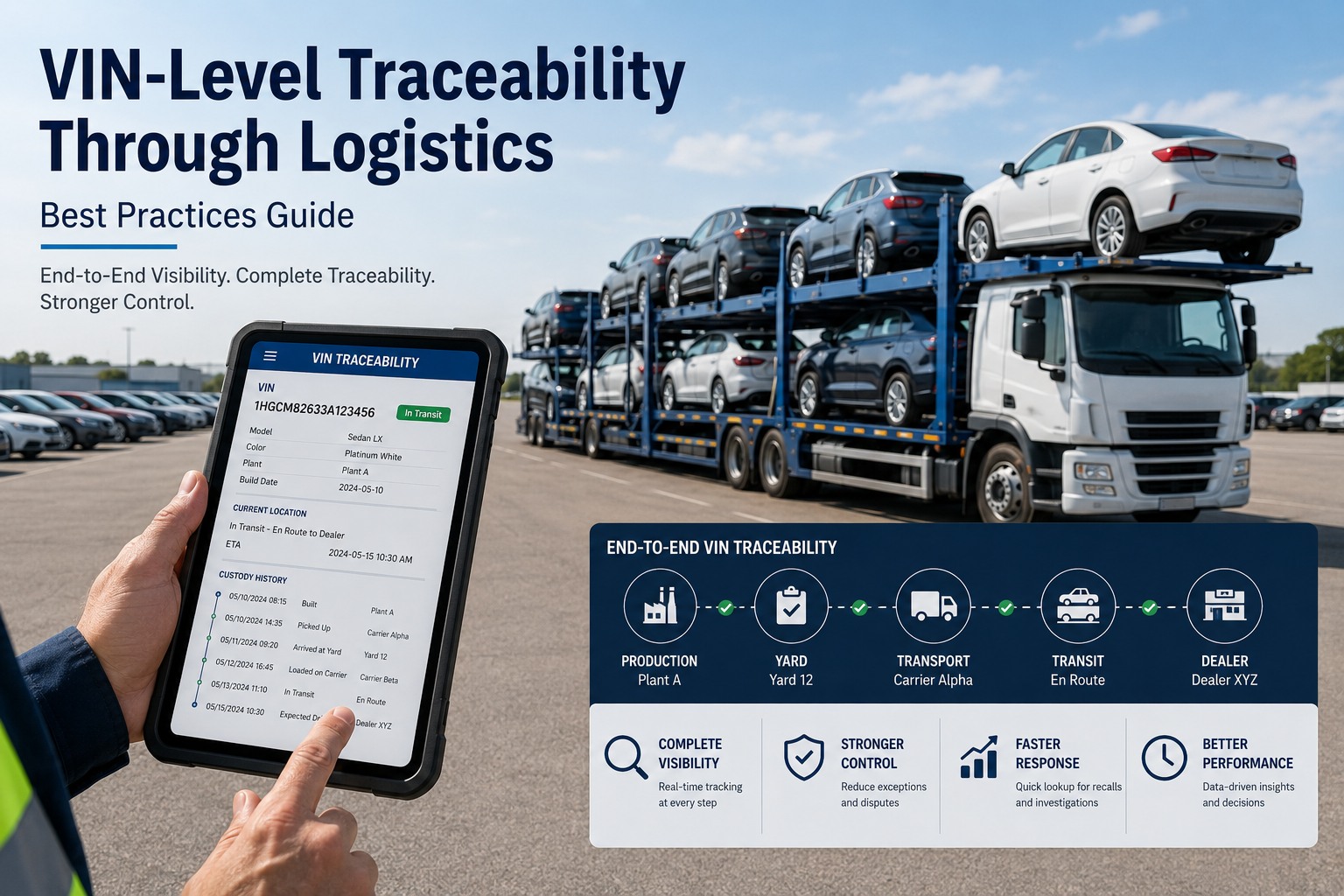
VIN-Level Traceability Through Logistics
Where the identifier has to be captured, how the custody chain assembles from those captures, and how fast the whole thing can answer a scoping question when one is asked.
Same defect, two record systems
Date-range containment
Every unit in the window
Identifier-linked scoping
Only the affected units
The defect is identical. The difference in population is entirely a function of what was captured, when — and every unit in the gap is a vehicle held, inspected or recovered for no reason.
Capture Granularity Sets the Floor
The governing principle, and it applies at every stage rather than only at the plant. Nothing downstream can be more precise than the record that entered it.
Whatever arrives sets the limit
If a movement is recorded as a load of forty units rather than forty identified units, every question asked afterwards resolves to that load. The granularity captured at the handoff is the finest resolution available for the rest of the vehicle's life.
Gaps propagate forward, not backward
A missing capture cannot be reconstructed later from surrounding events. It becomes a permanent widening of scope for anything that happened during that interval, on every unit that passed through it.
Internal and external chains both matter
Internal traceability covers your own operations; external extends across organisational boundaries, so one party can answer questions about what another handled. Investigations almost always need both, which makes the handoff the critical junction rather than the leg.
Identifiers must stay readable across parties
A code applied at one facility has to remain readable at the next and again at the one after. Label and identification standards exist precisely because a chain broken by an unreadable mark is a chain broken by anything else — and the party who cannot read it is rarely the party who applied it.
What the chain is proving
Not merely where a vehicle went. Verification means proving that a specific unit is the unit assigned to that record — enforced by reads at every handoff rather than inferred from paperwork. The trace has to be tamper-evident and time-stamped to serve that purpose, because a record that could have been edited afterwards proves the movement and not the identity.
Where the Identifier Has to Be Read
Eight capture points through a typical outbound chain. Each transition point should be time-stamped and recorded, and each one you skip widens every future query.
1Plant releaseBuy-off and dispatch. The first identified event, and the anchor everything downstream attaches to.
2Compound gate-inArrival at the yard, with slot assignment. Establishes custody and starts the dwell clock for that unit specifically.
3Every internal relocationThe capture most often skipped. Moves within the compound are where units become unfindable and where damage becomes unattributable.
4Loading, with positionOnto a car carrier or a railcar, recorded against the deck or slot position rather than the load as a whole.
5Every custody transferCompound to carrier, carrier to rail, rail to compound, terminal to vessel. These are the joins where responsibility changes hands, which makes them the events an investigation will ask about first.
6Condition capture eventsInspections and damage records tied to the identifier, because visibility that covers movement without condition answers only half of any dispute.
7Preparation and rectificationPre-delivery inspection, rework and any campaign work performed. What was done to this unit, by whom, when.
8Delivery confirmationHandover at the dealer with signatures and condition. The closing event, and the one that bounds the chain for warranty and dispute purposes.
4
hours
Pick a VIN. Produce its full chain. Time it.
Run the drill before someone runs it for you.
Choose a random unit delivered in the last quarter and produce its complete custody history — every capture, every custody transfer, every condition event. Bring the result to a 30-minute session and we'll show what a chain assembled in Fleet Rabbit looks like against it, and where your current gaps would widen a scope.
Capture Methods, and Why It Is Usually Both
Three mechanisms with different strengths. The common answer in mature operations is a combination rather than a choice.
← Swipe to see all columns →
The reason mature operations run both automated and readable methods is redundancy at the points that matter. Automatic capture builds the chain without depending on anyone remembering; a readable code gives a person a way to verify a specific unit when a question arises. The chain is built by the first and audited by the second, and losing either one degrades a different property of the record.
What Each Event Record Must Carry
Six fields. An event missing any of them still exists and cannot fully participate in a query.
The identifier itself, captured not typedRead from the vehicle rather than entered from a document, so the record attaches to the unit rather than to the paperwork about it.
Timestamp, applied automaticallySet by the system at the moment of capture. A hand-entered time is a claim about when something happened rather than a record of it.
Location, at usable resolutionSite and, where it matters, position within it. "At the compound" answers fewer questions than a slot reference, and slot references are what make search time short.
Event type, from a defined setGate-in, relocation, load, transfer, inspection, release. Free text cannot be queried consistently across parties, which is the whole purpose.
Responsible partyWhich organisation and which person or device. Custody questions are answered by this field and by nothing else.
ImmutabilityA record that can be amended silently after the fact will be challenged on exactly that basis. Tamper-evidence is what makes the chain evidence rather than documentation.
Condition belongs in the chain
Traceability that records movement without condition answers where a unit went and not what state it was in when it got there. Since most disputes are about condition rather than location, a movement-only chain solves the easier half of the problem. Capture condition at the custody boundaries and the same chain serves damage attribution, warranty questions and scoping simultaneously.
Query Performance Is the Real Test
A complete chain nobody can interrogate quickly is a compliance artefact rather than an operational capability. Five queries worth timing deliberately.
Give me everything about this one unit
Full custody chain, every event, every condition record, in order. The baseline query, and the one an audit sample uses.
Which units passed through this facility in this window
Forward scoping from a location and a time range — the query behind any handling or storage-related investigation.
Which units were handled by this party
Scoping by custodian rather than by place. Runs the moment a carrier, terminal or contractor is implicated in anything.
Which units travelled on this specific movement
A vessel, a rail cut, a load. Narrow, precise, and impossible if loading was recorded at load level rather than at unit level.
Where are all units matching this profile, right now
Forward trace to current position and status, across every stage of the network at once. The hardest query, the one a containment decision depends on, and the one worth practising before you need it.
Set a time target and test against it. The practice that transfers best from other regulated sectors is a periodic mock exercise: pick a real unit from a recent window at random and measure how long it takes to produce the complete chain, with a target commonly set in the range of a few hours. Failures in a drill are enormously cheaper than failures in the real thing — and the plan is only ever as good as the data it queries, which has to be complete before the event rather than assembled during it.
What an Audit Will Actually Ask For
Four things, drawn from how automotive quality audits approach traceability. The fourth is the one operations rarely prepare for.
01
A documented traceability map
Which records prove which requirement. Not a system description — a mapping from obligation to evidence, showing where each one is satisfied and by what.
02
Evidence of unbroken trace on a sample
A set of units picked by the auditor rather than by you, each traced end to end without gaps. This is where missing relocation captures surface.
03
Change-control history for the system itself
What changed in the traceability system, when, and who approved it. A chain of custody produced by a system with no change record invites the obvious question about the periods before the changes.
04
A demonstration of scoping effectiveness
Not evidence that records exist — evidence that they can narrow a population on demand. This is the drill above, performed in front of someone, and it is the item most operations discover they cannot pass.
Where traceability programmes quietly fail
Not usually at capture. They fail where data sits in separate systems that cannot be queried together, where movements are still confirmed by check calls and email, and where the resulting visibility remains observational rather than actionable. A chain assembled across four systems by a person is not a queryable chain — it is four datasets and an afternoon, and the afternoon is not available during a containment.
Building It in Order
Five steps. The sequence matters because each one determines what the next can achieve.
1Map your current capture points honestlyEvery place the identifier is genuinely read, and every interval where it is not. The gaps are the specification for everything that follows.
2Close the custody boundaries firstHandoffs before legs, because responsibility changes there and investigations start there. An internal relocation gap is expensive; a custody transfer gap is unanswerable.
3Standardise the event recordDefined event types, automatic timestamps, responsible party, location at usable resolution. Consistency is what makes cross-party queries possible at all.
4Bring condition into the same chainInspections and damage records against the identifier rather than in a separate claims system, so one query answers both movement and state.
5Drill it, then drill it againTime the five queries above at a set interval. A traceability programme that has never been tested under a clock has not been tested — and the first real test is always the worst possible moment to discover a gap.
Talk to a solutions engineer
The chain is built at the handoffs and judged at the query
Fleet Rabbit captures the identifier at every custody boundary with automatic timestamps and location, holds condition records against the same chain rather than in a separate system, and answers scoping queries by facility, party, movement or profile against one dataset — so a containment decision is a query rather than a reconstruction project.
Frequently Asked Questions
Why does capture precision affect recall cost?
Because it determines how narrowly the affected population can be defined. Working from date ranges and shipment batches produces a wide, precautionary containment, since that is all the records support. Identifier-linked history narrows it to exactly the units that passed through the specific window, lane or handling event concerned, and organisations with mature traceability report significantly reduced scope as a result. Every unit in the gap between those two populations is a vehicle held or inspected unnecessarily.
Where should we capture the identifier?
At every transition point, each one time-stamped and recorded: plant release, compound gate-in, every internal relocation, loading with position, every custody transfer, condition capture events, preparation and rectification work, and delivery confirmation. Internal relocations and custody transfers are the two most commonly skipped, and they are the two that matter most — the first is where units become unfindable, and the second is where responsibility changes hands.
Should we use codes or radio-frequency tags?
Usually both, at different points. Two-dimensional codes give a human-readable verification path alongside machine capture, which is what a person needs when checking a specific unit. Radio-frequency tags provide automatic capture at scale without requiring line of sight, which is what builds a complete chain without depending on anyone remembering to scan. The chain is built by automatic capture and audited by the readable one, and losing either degrades a different property of the record.
What makes a trace defensible rather than just complete?
Tamper-evidence and automatic time-stamping. Verification means proving that a specific unit is the unit assigned to a record, enforced by reads at each handoff rather than inferred from paperwork — and a record that could have been amended silently afterwards proves the movement without proving the identity. Add the responsible party to every event, since custody questions are answered by that field and by nothing else.
How fast should we be able to answer a scoping question?
Set a target and test it rather than assuming. The practice that transfers well from other regulated sectors is a periodic mock exercise: select a real unit from a recent window at random and measure how long producing its complete chain takes, against a target commonly set at a few hours. Run the same test for forward scoping by facility, by party and by specific movement. Failures in a drill are vastly cheaper than failures in the real event.
What will an audit ask for?
Typically four things: a documented traceability map showing which records prove which requirement, evidence of unbroken trace across a sample the auditor selects, change-control history for the traceability system itself, and a demonstration of scoping effectiveness. The last is the one operations rarely prepare for — it asks not whether records exist but whether they can narrow a population on demand, which is a different capability entirely.
Where should we start?
By mapping where the identifier is genuinely captured today and where the intervals of silence are, then closing the custody boundaries before anything else — handoffs before legs, because that is where responsibility changes and where investigations begin. Then standardise the event record and bring condition into the same chain.
Book a session with one delivered unit and we'll trace it end to end against your current records to find the gaps.
Capture at the Handoffs. Judge at the Query.
Nothing downstream can be more precise than the record that entered it — so close the custody boundaries first, standardise every event, keep condition in the same chain, make it tamper-evident, and put the whole thing under a clock before anyone else does.