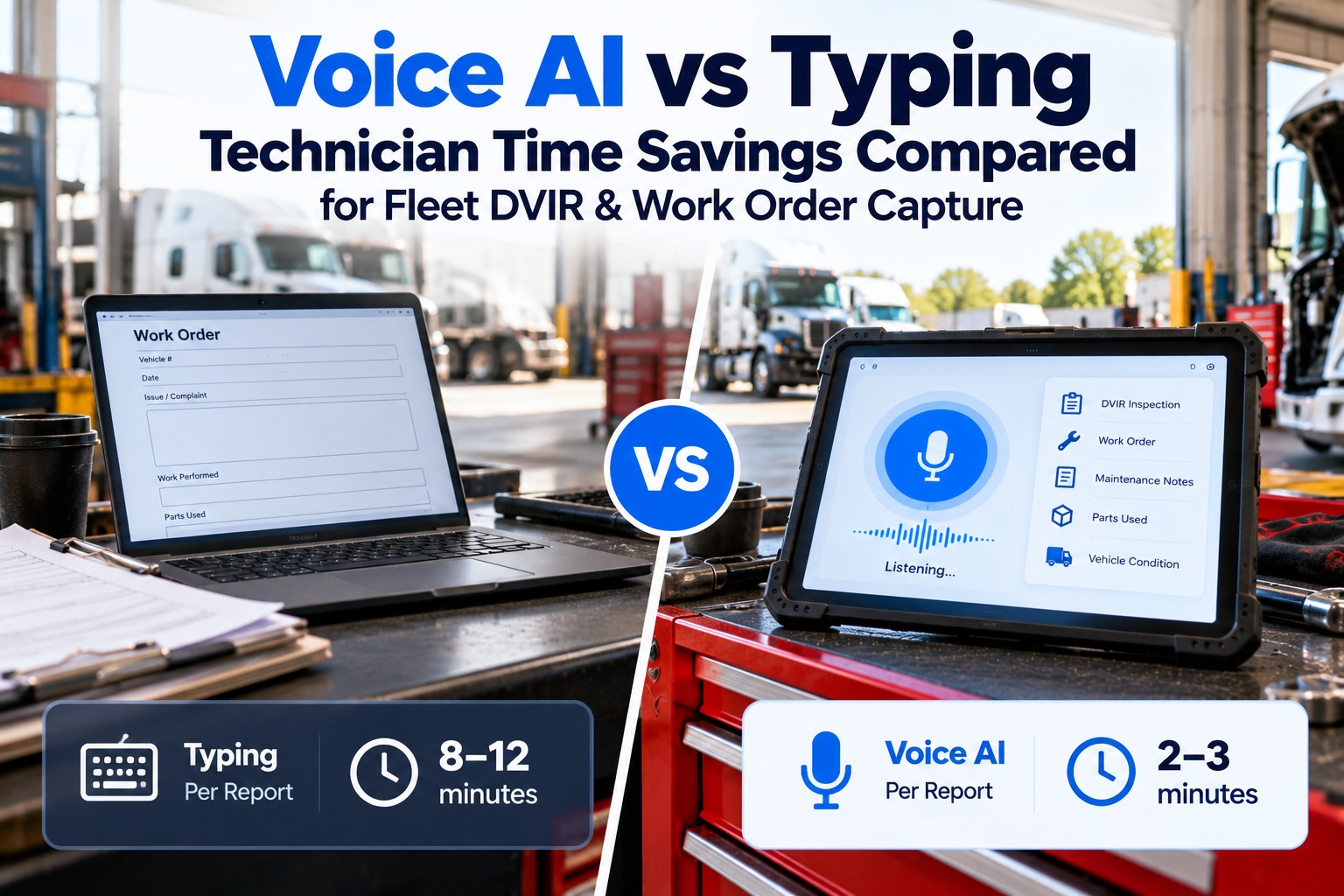
Voice capture is meant to save time on the part of an inspection or repair that happens after the technician finds the problem: writing it down. How much time that is depends on the job, the noise, the vocabulary and what happens to the record afterward. This page puts the published minute figures side by side, shows the one controlled study on speech versus typing and what it did not test, and gives you a simple way to time both methods on your own work. Schedule a call to set up a side-by-side time test in your shop.
The One Controlled Study on Speech vs Typing Speed, and What It Did Not Test
Stanford and Baidu researchers found speech about three times faster than typing on a phone, using text messages and not repair notes
A 2016 study by Stanford computer scientists with Baidu and University of Washington collaborators, reported by Stanford News, tested 32 frequent texters aged 19 to 32 on an iPhone. Speech input was about 3 times faster than typing in English and about 2.8 times faster in Mandarin, with 20.4 percent fewer errors in English and 63.4 percent fewer in Mandarin.
Minutes per Report: What Vendors Publish for Typing, Paper, Digital and Voice Capture
The published figures are modeled or claimed, and they describe different workflows, so they should not be compared line by line
Heavy Vehicle Inspection models a paper DVIR at 12 to 18 minutes including write-up, collection, office entry and filing, against 3 to 6 minutes for a guided mobile walk-around. It labels the figures illustrative and cites no study. FleetRabbit's voice guide claims manual stop-type-resume takes 8 to 12 minutes per job and a voice DVIR under four minutes, again with no method behind either. The two vendors are comparing different things, so we show them as ranges, not as a rate of saving.
Which Steps of a DVIR or Work Order Voice Can Shorten and Which It Cannot
Voice replaces the writing, and the walk-around, review and filing steps depend on how the record is saved
This table is our own reading of the steps in Heavy Vehicle Inspection's workflow model, not a measured result. It shows why a vendor's headline minutes can overstate what voice alone does.
| Step in a DVIR or work order | Does voice change it? | Why |
|---|---|---|
| Walk-around and finding the defect | No | The inspection itself still takes the same time |
| Writing or typing the note | Yes | Speaking replaces typing or handwriting |
| Collecting the form at end of shift | Only if the record is saved at capture | Depends on the workflow, not on voice itself |
| Office entry or scanning | Only if the record is saved at capture | Same |
| Reviewing and correcting the record | Adds a step | A spoken note still needs a check |
A Worked Example of the Arithmetic: Minutes Saved per Job Times Jobs per Day Times Labor Cost
Four technicians doing six jobs a day show how fast small time savings add up, and how little they matter if the minutes are not real
As an illustration only, take four technicians, six jobs each a day, 22 working days a month and a $32 hourly technician cost, which is the Fullbay survey median reported by Fleet Equipment. The minutes saved are assumptions, not findings.
Saved minutes only turn into money if they go to repair work, shorter queues or less overtime. FleetRabbit's guide also gives an illustrative 30 minutes saved per technician per day, which it labels as an assumption, not a measured result.
How to Run a Side-by-Side Voice vs Typing Time Test in Your Own Shop
Time twenty reports each way, count the corrections and record the noise, so the result reflects your bays and your vocabulary
Vendor pages claim voice accuracy of 94 percent in noisy diesel settings and 94 to 96 percent at 85 dB. None names a sample or an independent test, so your correction count is the number that matters.