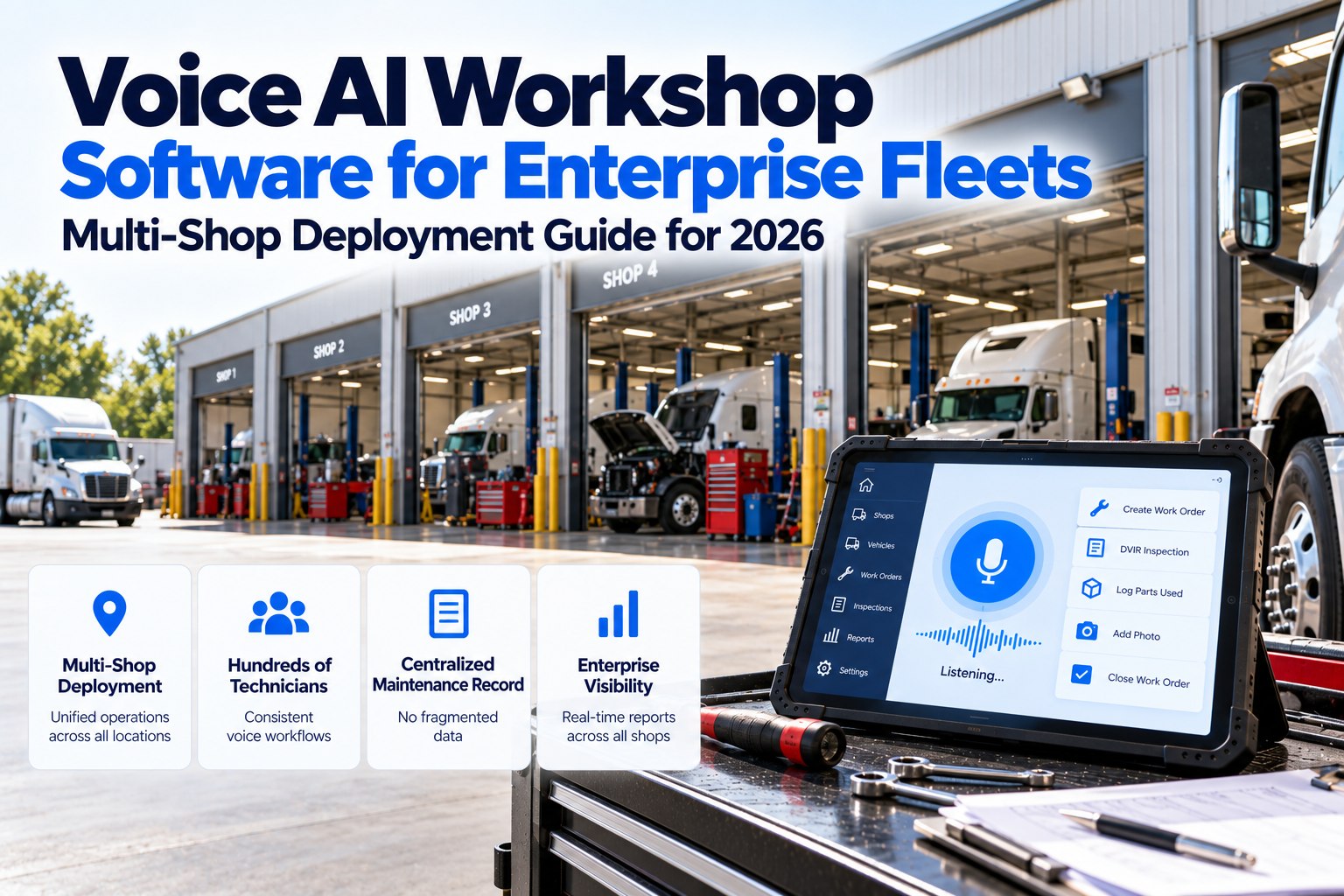
A voice workflow that works in one shop can fragment the maintenance record when it spreads to ten. Each site picks its own wording, codes and approvals, and the head office ends up with records it cannot compare. This page covers how enterprise fleets split decisions between head office and sites, why shared coding matters, how pilots are expanded in waves and what to test about voice at scale. Schedule a call to plan a multi-shop voice rollout.
What Head Office Should Standardize and What Each Shop Should Run Itself in a Multi-Location Fleet
Intervals, inspection forms and approval limits are set once, while day-to-day ownership of issues stays at the site
Simply Fleet's May 2026 governance guide, which is vendor content that cites no external data, lays out the split. The table below separates its five decisions, and the central-versus-local assignment is our reading, since the article does not draw the line explicitly.
| Decision | Set centrally | Run locally |
|---|---|---|
| PM intervals | Template per asset class, from OEM specs and service history | Applying them to each unit and reporting overdue work |
| Inspections | Standard forms, and the rule that a failed item becomes an issue | Drivers completing them; site manager converting defects to work orders |
| Repairs | Approval thresholds | Assigning and doing the work, recording parts and labor |
| Reporting | Structure for each leadership level | Daily site review |
| Vendors | Unclear in the source | Sites use different outside shops |
| Role | Job in a multi-shop setup |
|---|---|
| Central PM owner | Owns the schedule template for each asset class |
| Site manager | Single owner of issues and PM at a location |
| Technician | Performs repairs and records parts, labor and notes |
| Regional manager | Sees across sites and handles approvals |
| Leadership | Reviews roll-up reports and risk |
The guide suggests site managers review daily, regional managers weekly and executives monthly. Its examples of 50 assets across two sites and 150 across four are illustrative, not benchmarks.
Why a Shared Coding Standard Like VMRS Keeps Voice Notes Comparable Across Sites
Free spoken text varies by technician and shop, and shared codes for failure, work and component make records comparable
The American Trucking Associations' Technology and Maintenance Council manages the Vehicle Maintenance Reporting Standards, a coding system for maintenance work and costs. A 2016 Fleet Maintenance article by TMC's VMRS services manager says codes cover failure, work performed and component, replace free-text descriptions on repair orders and make data comparable across one shop or many. It does not discuss voice. Ask every vendor whether spoken notes are mapped to codes your fleet already uses, and test a sample of records from each site.
Rolling Voice Capture Out in Waves: Pilot One Shop, Set Expansion Criteria and Standardize First
Fiix's pilot guidance says to plan the rollout before the pilot starts and to expand only after the pilot report
Fiix, a CMMS vendor, says to plan the full rollout before the pilot starts, write a pilot report on what worked and failed, set criteria for expansion, share early wins and expand in small steps. It warns that momentum fades without a named champion and that clean data and consistent processes are needed before adding sites. It gives no pass or fail thresholds, so write yours before the pilot begins.
What to Test About Voice Capture at Enterprise Scale Before You Add the Second Shop
Noise, accents, vocabulary and review steps vary by shop, so results from one bay do not transfer automatically
Vendor pages claim voice accuracy of 94 to 96 percent at 85 dB without an independent test, and FleetRabbit's pages do not state which languages are supported. At enterprise scale the useful question is variance: whether accuracy, correction rates and record completeness hold up across sites, shifts and accents. Sample the same number of records from each site and compare.
The FMCSA Electronic DVIR Rule and What It Means for a Multi-Shop Fleet
The rule clarifies that DVIRs may be completed electronically, so a common digital record is permitted and not required
FMCSA's final rule, published February 19, 2026 and effective March 23, 2026, makes explicit that a DVIR may be completed electronically and says the agency wants to encourage cost-saving electronic methods. It responds to a comment from the National Tank Truck Carriers, and FMCSA's summary describes no mandate. For an enterprise fleet the value is practical, one retrievable record across sites. Confirm retention and signature requirements in 49 CFR Part 396.