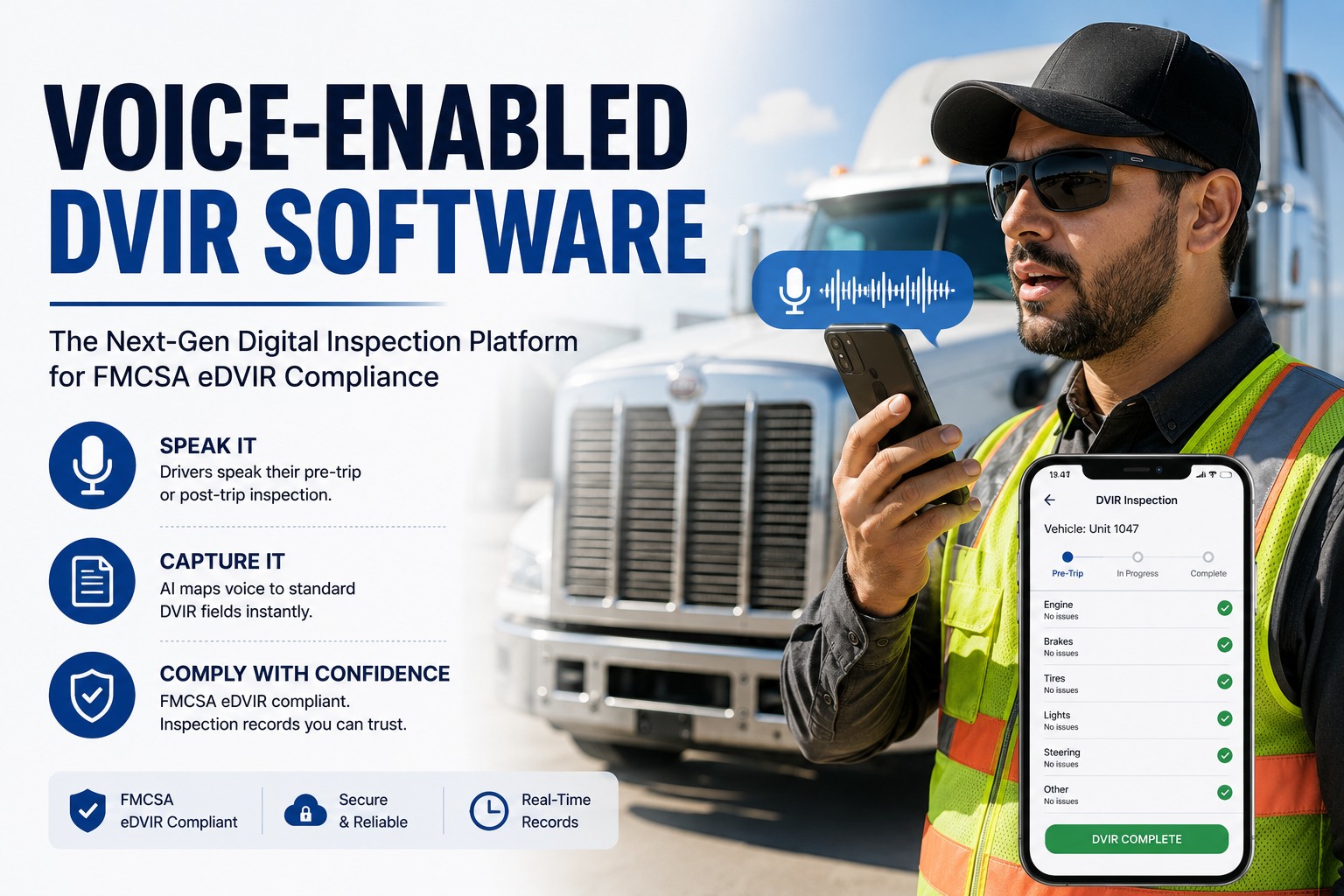
The driver vehicle inspection report just entered a new era. On February 19, 2026, FMCSA published a final rule — effective March 23, 2026 — that explicitly authorizes electronic DVIRs under 49 CFR 396.11 and 396.13, removing the last ambiguity about digital signatures, mobile submission, and cloud storage. Voice-enabled DVIR software is the next step past a digital form: instead of tapping through a checklist on a screen, the driver speaks the pre-trip or post-trip inspection as a natural narrative, and the software maps each spoken observation to the standard DVIR fields — the vehicle identifier, the defects found, the driver certification, and the signature. That matters for a workforce that is increasingly diverse: with 23.7% of U.S. truck drivers identifying as Hispanic and many bilingual or Spanish-dominant, a spoken interface meets drivers in how they naturally communicate rather than forcing them through dense form screens. This guide explains what the eDVIR rule now permits, how a spoken narrative becomes a compliant record field by field, and why voice is the next-generation digital inspection platform. Start a free trial or book a demo to see voice-enabled, eDVIR-compliant inspections on your fleet.
FMCSA eDVIR COMPLIANCE · NEXT-GEN INSPECTIONS
Voice-Enabled DVIR: The Next-Gen Digital Inspection Platform
The 2026 eDVIR final rule made electronic inspection reports unambiguously compliant. Voice takes the next step — the driver narrates the pre-trip or post-trip, and the software maps every spoken word to the standard DVIR fields, signed, timestamped, and cloud-stored.
NEW: FMCSA eDVIR FINAL RULE
Electronic DVIRs Are Now Explicitly Authorized
On February 19, 2026, FMCSA published a final rule (Docket FMCSA-2025-0115), effective March 23, 2026, adding explicit electronic-DVIR language to 49 CFR 396.11 and 396.13. Electronic DVIRs were already permissible under 390.32 since 2018 — this rule removes any remaining doubt, and it was supported by the American Trucking Associations, OOIDA, and NTTC.
What the rule did
Authorized electronic creation and maintenance of DVIRs under 396.11
Allowed electronic pre-trip review records under 396.13
Authorized electronic signatures for all three parties in the DVIR chain
What it did not change
The 11-item inspection minimum stayed the same
The 90-day retention requirement was unchanged
No-defect DVIR reporting was not reinstated for property carriers
From Spoken Narrative to Compliant DVIR Fields
The core of a voice-enabled DVIR is the mapping between how a driver naturally describes an inspection and the structured fields a compliant report requires. The driver speaks a walk-around narrative; the software resolves it into the record.
Driver's spoken pre-trip narrative
"Unit 218, pre-trip. Brakes good, lights all good, tires good, mirrors good. Coupling's good. Found an air leak at the left rear brake chamber. Everything else good. This is Miguel."
Vehicle identifier
Unit 218
Defect logged
Air leak, left rear brake chamber
Components cleared
Brakes, lights, tires, mirrors, coupling
Driver identification
Miguel (signed & timestamped)
Routing
Defect → priority work order
i
Why a spoken interface is the right next step: the U.S. driver workforce is more diverse than ever — 23.7% of truck drivers identify as Hispanic, of whom the majority are of Mexican origin, and many are bilingual or Spanish-dominant. A voice narrative lets a driver describe an inspection the way they'd say it out loud rather than parsing dense English form screens, which reduces the friction that leads to skipped or rushed reports. A more accessible inspection is a more complete inspection, and completeness is exactly what an auditor checks.
See how voice lowers the barrier to a full DVIR.
The 11 Inspection Components, Captured by Voice
The eDVIR rule left the inspection minimum unchanged — a DVIR must still address the same harmonized components for both pre-trip and post-trip. Voice captures each one as the driver calls it out. Swipe the table horizontally on mobile.
← Swipe to see all columns →
The rule closed the paperwork loophole. Voice closes the completeness gap.
Fleet Rabbit captures every required component by voice, files the eDVIR with electronic signature and timestamp, and routes each defect straight to a work order — the full chain, hands-free.
Closing the Three-Signature Chain, Automatically
Under 396.13, the compliance failure auditors find most often isn't a missing inspection — it's a broken handoff. Voice-enabled eDVIR keeps the whole chain intact without anyone chasing paper.
1
Driver Reports the Defect
The driver speaks the defect during the post-trip; it's logged, timestamped, driver-identified, and the vehicle is flagged. A defect affecting safe operation means the truck can't be dispatched until it's addressed.
2
Mechanic Certifies the Repair
The defect routes straight to a work order. Once repaired, the mechanic certifies the fix electronically, and the certification attaches to the same DVIR record — no separate paper to misfile.
3
Next Driver Acknowledges
Before the next driver can start, the system presents the prior DVIR and repair status for electronic acknowledgment — closing the 396.13 custody chain that a paper handoff so often breaks.
Why Voice Is the Next Generation, Not Just Digital
Going from paper to a digital form is one leap; going from a form to a spoken narrative is the next. Here's what voice adds on top of a compliant eDVIR.
01
Faster, Fuller Inspections
A complete voice DVIR takes under four minutes with zero screen taps, so drivers are less tempted to rush or skip items to get moving.
02
More Accessible to Every Driver
Speaking a narrative meets a diverse, often bilingual workforce where they are, lowering the form-literacy barrier that leads to incomplete reports.
03
Automatic Compliance Trail
Electronic signature, timestamp, and cloud storage are captured by default, satisfying the eDVIR rule and the 90-day retention minimum without a filing cabinet.
04
Defects Become Work Orders
Every spoken defect creates a routed work order instantly, so the finding reaches the shop the moment it's said instead of waiting on transcription.
05
Records Producible in Seconds
When FMCSA requests records — sometimes with as little as 48 hours notice — cloud-stored eDVIRs are retrieved instantly instead of hunted through paper.
06
Works Over Engine Noise
Noise-cancelling recognition tuned for diesel and highway noise keeps accuracy high, so the walk-around narrative captures cleanly in the real world.
Next-Gen eDVIR Compliance, Captured by Voice
Fleet Rabbit turns a spoken pre-trip or post-trip narrative into a fully eDVIR-compliant record — mapped to every required field, electronically signed and timestamped, cloud-stored for the 90-day minimum, with defects routed straight to work orders and the three-signature chain closed automatically. Deploy at $5/vehicle/month, no hardware, live within 72 hours.
eDVIR-compliant records
Voice pre-trip & post-trip
Auto defect routing
Cloud-stored retention
Voice-Enabled eDVIR vs. Paper and Basic Digital Forms
Where a voice-enabled platform sits against the alternatives, across the things that actually get cited in an audit. Swipe the table horizontally on mobile.
← Swipe to see all columns →
Frequently Asked Questions
Are electronic DVIRs actually compliant now?
Yes, unambiguously. Electronic DVIRs had been permissible under 49 CFR 390.32 since 2018, and on February 19, 2026, FMCSA published a final rule effective March 23, 2026 that added explicit electronic-DVIR language to 49 CFR 396.11 and 396.13. That removed any remaining doubt: electronic signatures, mobile submission, and cloud storage are fully compliant, and the rule was supported by the American Trucking Associations, OOIDA, and NTTC. Seeing an eDVIR-compliant voice workflow on your own fleet is exactly what you can
book a demo to review.
How does a spoken narrative become a compliant DVIR?
The driver speaks the pre-trip or post-trip as a natural walk-around narrative, and the software maps each element to the required fields — the vehicle identifier, the inspection type, each component result, any defects, and the driver's identification and signature. Defects are logged separately and routed to a work order, while the whole record is timestamped and cloud-stored. It's the same compliant document a form produces, just captured by speaking instead of tapping, and watching that mapping happen live is something you can
book a demo to see.
Did the 2026 rule change what a DVIR must contain?
No. The final rule authorized electronic creation, maintenance, and signatures, but it did not change the substance of the inspection. The 11-item inspection minimum stayed the same, the 90-day retention requirement was unchanged, and no-defect DVIR reporting was not reinstated for property-carrying vehicles. In other words, the rule made the format easier without lowering the bar on content, so a voice-enabled system still has to capture every required component — which is exactly what you can
book a demo to confirm it does.
How does voice help a diverse or bilingual driver workforce?
By meeting drivers in how they naturally communicate. With 23.7% of U.S. truck drivers identifying as Hispanic and many bilingual or Spanish-dominant, a spoken narrative lowers the form-literacy barrier that dense English inspection screens can create. When describing an inspection is as simple as saying it out loud, drivers are less likely to rush or skip items, which makes reports more complete — and completeness is what protects the carrier in an audit. Exploring how that accessibility plays out for your drivers is something you can
book a demo to discuss.
What about the three-signature chain under 396.13?
That broken handoff is one of the most common audit findings, and voice-enabled eDVIR closes it automatically. When a driver reports a defect, it routes to a work order; the mechanic certifies the repair electronically against the same record; and before the next driver can start, the system presents the prior DVIR and repair status for electronic acknowledgment. The custody chain closes itself instead of relying on someone remembering to sign a piece of paper, and seeing that automated handoff is exactly what you can
book a demo to watch.
How long do we have to keep eDVIRs?
The retention minimum is three months — 90 days — from the date the report was prepared, and that includes the DVIR itself, the repair certification, and the next driver's acknowledgment. The 2026 rule did not change this. The advantage of a cloud-stored eDVIR is that extended retention becomes effectively free, so many carriers keep records well beyond the minimum for stronger audit and litigation defense. Setting up retention that produces records in seconds on request is something you can
book a demo to see configured.
Does the voice inspection work over engine and road noise?
Yes, because it's built for the vehicle environment rather than a quiet room. Noise-cancelling recognition tuned for diesel engine noise, HVAC fans, and highway-speed road noise keeps the walk-around narrative capturing accurately where consumer voice tools would struggle. That reliability is what makes a hands-free inspection practical in the yard and on the road, and testing it in your own conditions is something you can
book a demo to do.
What does it cost to switch to voice-enabled eDVIR?
Less than most fleets expect, because there's no hardware involved. Fleet Rabbit runs on the devices your drivers already carry at $5 per vehicle per month, with a free tier for up to three vehicles and deployment live within 72 hours. You can compare pricing and start free without a contract or setup fee, which is exactly what you can
book a demo to walk through for your fleet size.
Bring Your DVIRs Into the Next Generation
Fleet Rabbit is a voice-enabled, eDVIR-compliant inspection platform — drivers narrate the pre-trip and post-trip, every field is captured and electronically signed, defects route to work orders, and the three-signature chain closes itself. Fully aligned with the 2026 eDVIR final rule, integrated in 5–7 working days, at $5/vehicle/month, with no hardware required.
Free tier for up to 3 vehicles · No credit card required · No hardware installation
July 29, 2026
By Derek Goes
All Articles