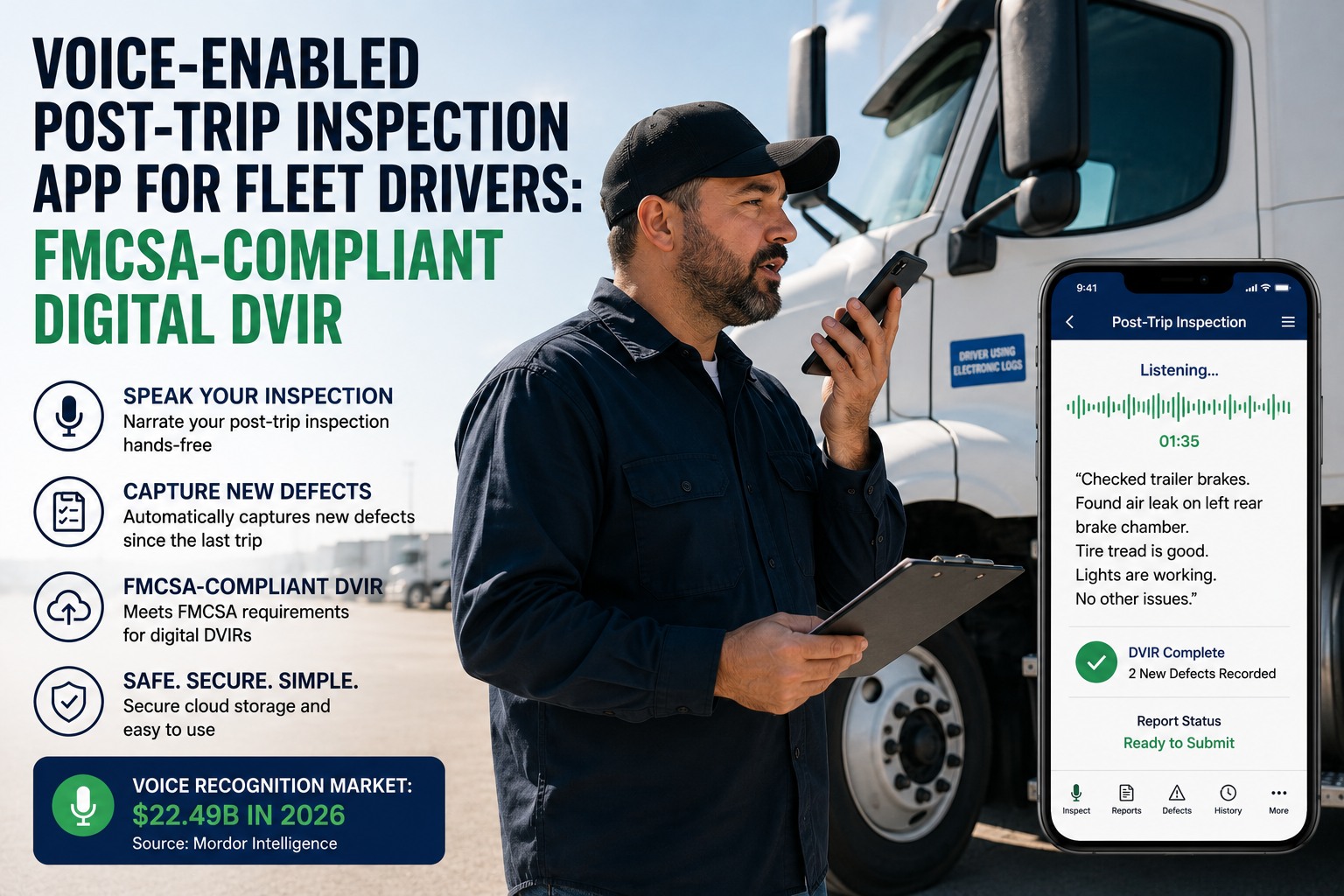
The post-trip inspection exists to answer one question: what changed on this truck since it left this morning? A day of driving works loose what was tight, cracks what was whole, and wears down what was fine at dawn — and under 49 CFR 396.11, the driver has to document those new defects in a written DVIR at the end of the workday. That report is not busywork: it's the first link in the chain of custody that gets the defect repaired, certified, and cleared before the next driver takes the wheel. A voice-enabled post-trip app makes that end-of-shift report something a tired driver will actually complete well — they walk the truck, speak what's changed, and a compliant, timestamped DVIR builds itself, hands free, with every new defect routed straight to the shop. This guide covers what a post-trip is really for, how a spoken report satisfies 396.11 and feeds the custody chain, and why voice — riding a voice recognition market worth $22.49 billion in 2026 — is the right tool for the most-skipped inspection of the day. Start a free trial or book a demo to put a voice-enabled post-trip app in your drivers' hands.
POST-TRIP INSPECTION · FMCSA-COMPLIANT DVIR
Voice-Enabled Post-Trip Inspection App for Fleet Drivers
At the end of the shift, the driver walks the truck and speaks what changed during the day — and a written, FMCSA-compliant DVIR builds itself, with every new defect routed to the shop and the chain of custody opened for the next driver. No clipboard, no forgotten form, no defect that goes undocumented until it fails on the road.
No contracts
No setup fees
49 CFR 396.11
No hardware
A Post-Trip Isn't a Second Pre-Trip — It's a Change Report
The pre-trip confirms the truck is safe to leave. The post-trip captures what a day of operation did to it. Its whole value is documenting defects that developed during the trip — a wheel seal that started weeping, a light that failed, a brake that got soft — so they're fixed before the truck rolls again. For property-carrying vehicles, a written DVIR is required whenever those defects are found, and it's the record that starts the repair-and-certify chain.
The Defect Lifecycle a Post-Trip Starts
A post-trip DVIR isn't the end of the day's paperwork — it's the beginning of a four-stage custody chain that FMCSA auditors trace defect by defect. Voice captures the first link cleanly so the rest can follow.
Stage 1
Driver Reports
At end of shift the driver speaks each new defect found during the day. It's logged, timestamped, and driver-identified into a written DVIR under 396.11.
→
Stage 2
Carrier Repairs
Each defect routes straight to a work order. The carrier must repair it — or determine it doesn't affect safe operation — before the vehicle is dispatched again.
→
Stage 3
Mechanic Certifies
A qualified mechanic certifies the repair electronically against the same DVIR record, creating the linked defect-to-repair evidence auditors look for.
→
Stage 4
Next Driver Signs
Before operating, the next driver reviews the prior DVIR and repair status and acknowledges it under 396.13 — closing the custody chain.
!
The gap auditors hunt for: a DVIR that notes a defect with no linked repair record is a violation — even if the defect was actually fixed. It's one reason only about 7% of carriers pass a focused compliance review without a single finding, and DVIR-related violations can run from roughly $1,270 to over $16,000 per occurrence. A voice post-trip that turns each spoken defect into a routed, trackable work order is how that defect-to-repair link stops breaking.
See the custody chain close automatically.
What a Post-Trip Captures That a Pre-Trip Can't
Because it happens after a day of operation, the post-trip catches a distinct class of problems — the ones that develop under load, heat, and miles. Swipe the table horizontally on mobile.
← Swipe to see all columns →
The most-skipped inspection of the day is the one that catches what broke today.
Fleet Rabbit makes the end-of-shift DVIR a 3-minute spoken task, so a tired driver documents the day's new defects instead of skipping the form — and the shop knows before morning.
How a Spoken DVIR Satisfies 396.11
A voice post-trip produces the same legal document a paper DVIR does — arguably a stronger one, because the metadata is automatic. Here's what the spoken report captures.
Defect Documentation
Each new defect is captured as a discrete, described item — or the DVIR records "no defects," which for property carriers is the trigger that no written report is required.
Vehicle Identification
The record is anchored to the specific unit, so the DVIR ties to the right asset's history and its open work orders without a driver keying in a number.
Driver ID & Timestamp
The report is automatically identified to the driver and timestamped at the moment of the walk-around — metadata paper relies on the driver to add by hand.
Retained & Retrievable
The DVIR is cloud-stored for the required three-month minimum and producible in seconds on request — where the 2026 eDVIR standard rewards digital records over paper.
Make the End-of-Shift DVIR a Three-Minute Spoken Task
Fleet Rabbit turns the post-trip into a voice workflow — the driver speaks the day's new defects, a written 49 CFR 396.11 DVIR builds itself, every defect routes to the shop, and the custody chain opens for the next driver. No contracts, no setup fees, no hardware, at $5/vehicle/month with a free tier for up to three vehicles.
Spoken end-of-shift DVIR
396.11 compliant
Defects routed to shop
Custody chain opened
Voice Post-Trip vs. the Ways It's Done Now
The end-of-shift DVIR is the inspection most likely to be rushed or skipped — which is exactly where voice changes the outcome. Swipe the table horizontally on mobile.
← Swipe to see all columns →
Frequently Asked Questions
What's the difference between a post-trip and a pre-trip inspection?
A pre-trip under 49 CFR 392.7 confirms the vehicle is safe to operate before the driver leaves, while a post-trip under 396.11 documents the vehicle's condition at the end of the workday — specifically the defects that developed during the day's operation. They cover the same components but serve opposite purposes: one clears the truck to go, the other records what the trip did to it, and comparing the two workflows side by side is something you can
book a demo to see. The post-trip's real job is catching new problems before the next driver inherits them.
Is a written post-trip DVIR always required?
For property-carrying commercial vehicles, a written DVIR has been required only when defects are found since a 2014 rule change — so a clean post-trip with no new defects doesn't mandate a written report. But when the driver does find something, the written DVIR is required, and a voice app makes producing it effortless whether the answer is "no defects" or a detailed list. Understanding how that conditional requirement plays out for your operation is something you can
book a demo to walk through, so nothing that should be documented slips by.
How does the post-trip feed the chain of custody?
It starts it. When a driver reports a defect on the post-trip DVIR, that opens a four-stage chain: the carrier must repair it or deem it non-safety-affecting, a qualified mechanic certifies the repair against the same record, and the next driver reviews and acknowledges it under 396.13 before operating. Auditors trace that chain defect by defect, and a broken link — a reported defect with no linked repair — is a violation, which is exactly the failure a voice workflow prevents and what you can
book a demo to see closed automatically.
Why is the post-trip the inspection most worth automating?
Because it's the one most likely to be rushed or skipped — it lands at the end of a long shift when a tired driver just wants to go home, so a clumsy paper form or tap-through screen invites a shortcut. Making it a three-minute spoken task removes that friction, which means the day's new defects actually get documented and reach the shop before morning instead of failing on the road, and feeling that difference is something you can
book a demo to try. The easiest inspection to skip becomes one that consistently gets done.
Is a voice-generated DVIR FMCSA-compliant?
Yes. A spoken post-trip produces the same written DVIR a paper form does under 396.11 — defect documentation, vehicle identification, driver identification, and signature — with the timestamp and driver ID captured automatically rather than added by hand. That automatic metadata arguably makes it a stronger record, and it aligns with the eDVIR final rule that took effect March 23, 2026, making electronic reports the audit-ready standard. Reviewing that compliance fit against your own requirements is something you can
book a demo to do in detail.
How long are post-trip DVIRs retained?
The federal minimum is three months from the date the report was prepared, covering the DVIR, the repair certification, and the next driver's acknowledgment. A cloud-stored digital DVIR makes keeping records well beyond that minimum effectively free, which many carriers do for stronger audit and litigation defense — and it means any record is producible in seconds on request rather than hunted through a filing cabinet. Setting up that retention so it's automatic is something you can
book a demo to configure for your fleet.
Are there really no contracts or setup fees?
Correct. You can start on a free tier for up to three vehicles with no credit card, then pay a low per-vehicle rate as you scale, with no long-term contract, no implementation invoice, and no hardware to buy. That low barrier is intentional — a post-trip tool should prove itself with your drivers rather than lock you into a commitment first — and setting up that no-risk trial is exactly what you can
book a demo to do for your fleet size.
Does it need special hardware or a long rollout?
No. The app runs on the smartphones your drivers already carry, so there's nothing to buy or install, and it deploys live within 72 hours rather than the quarters a hardware project takes. Because there's no equipment to distribute or maintain, rolling it out to a whole driver pool is straightforward, and mapping that rollout is something you can
book a demo to plan. The no-hardware design is also what keeps it a low-risk addition rather than a capital project.
Document What Broke Today, Before It Fails Tomorrow
Fleet Rabbit is a voice-enabled post-trip inspection app — the end-of-shift walk-around narrated aloud, a written 49 CFR 396.11 DVIR built automatically, every new defect routed to the shop, and the custody chain opened for the next driver. No contracts, no setup fees, no hardware, integrated in 5–7 working days, at $5/vehicle/month, free for up to three vehicles.
Free tier for up to 3 vehicles · No credit card required · No hardware installation
July 30, 2026
By Derek Goes
All Articles