When a diesel technician spots a defect, the fix is the easy part — it's the paperwork that steals the day. Sliding out from under a truck, peeling off a glove, unlocking a phone, and thumb-typing "left rear brake chamber leaking air, needs replacement" into a form is friction that adds up across every repair, every shift. A voice-to-text defect reporting app removes it: the technician describes the defect out loud in plain language, and the words become a structured, trackable defect record that flows straight into a work order. That speed isn't a luxury right now — with 65.5% of diesel shops understaffed in 2025, the capacity you recover from faster reporting is capacity you cannot hire. This guide shows how spoken defect reporting works, what it captures, and why it's one of the highest-leverage tools a short-handed shop can put in a technician's hand. Start a free trial or book a demo to see voice-to-text defect reporting on your fleet.
DEFECT REPORTING · VOICE-TO-TEXT
Voice-to-Text Defect Reporting for Diesel Technicians
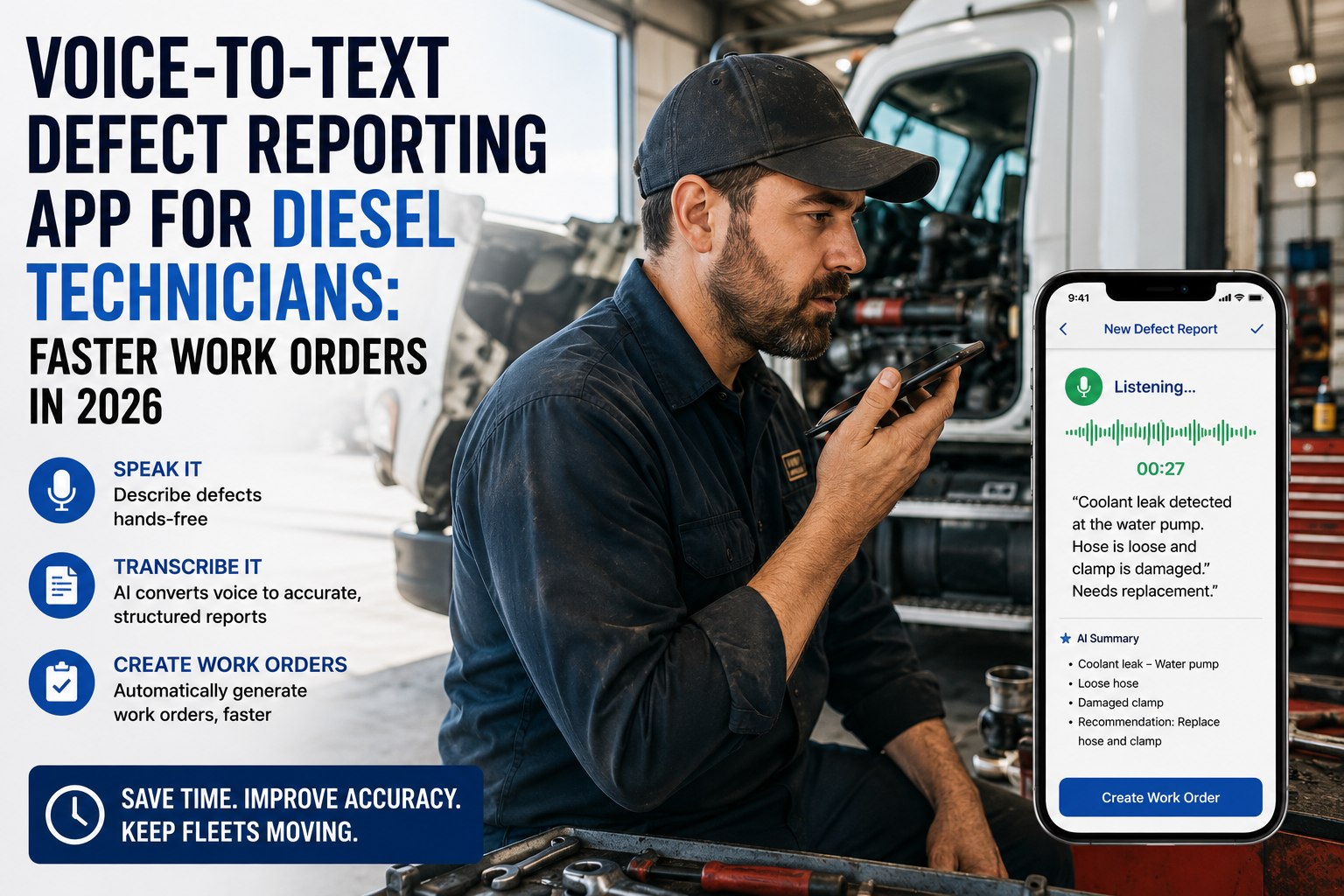
The technician describes the defect out loud — "left rear brake chamber leaking, needs replacement" — and it becomes a structured, trackable record that flows straight into a work order. No glove off, no phone out, no form. Just say it and keep working.
"Left rear brake chamber leaking air, needs replacement, safety priority"
becomes
ComponentBrake chamber, LR
DefectAir leak
ActionReplace
PrioritySafety
65.5%
of diesel shops understaffed in 2025 — ATRI
You can't hire your way out. You can report faster.
With nearly one in five technician positions unfilled and 44% of techs considering leaving the trade, the hours your existing crew loses to defect paperwork are hours you can't replace on the labor market. Voice-to-text reporting gives that time back — it's one of the few capacity levers a short-handed shop actually controls.
19.3% average vacancy rate
44% considering leaving
$2.4B lost industry-wide
From Spoken Defect to Trackable Record
The whole point is that reporting takes seconds and happens at the moment of the finding — not at the end of the shift from memory. Here's what happens between the technician speaking and the shop knowing.
1
Speak It
Hands still on the truck, the technician describes the defect in natural language — no menus, no typing.
2
Structure It
Speech recognition and NLP sort the words into component, defect, action, and priority fields automatically.
3
Route It
The record becomes a work order carrying vehicle info, priority, and repair history — no admin time wasted.
4
Track It
The defect is trackable from report to repair, so nothing slips and the defect-to-fix chain stays intact.
i
Why capturing it live matters: a defect described at the moment it's found carries detail — which side, what it sounds like, how bad — that end-of-shift recall quietly loses. Thin, late defect notes are what break the defect-to-repair chain auditors trace and what let a small problem ride until it becomes a roadside breakdown. Speaking the defect on the spot keeps the record complete and the shop informed before the technician even moves to the next bay.
See live defect capture on your fleet.
What a Voice Defect Report Captures
A proper defect report is more than a sentence — it's a set of fields the shop can act on and audit against. Voice pulls each from natural speech. Swipe the table horizontally on mobile.
← Swipe to see all columns →
Every minute a technician spends typing a defect is a minute they're not turning a wrench — and right now you can't spare either.
Why Short-Handed Shops See the Biggest Gain
Voice-to-text defect reporting helps any shop, but its value multiplies exactly where the staffing crisis bites hardest.
Recovered Wrench Time
The minutes each defect used to cost in typing go back to billable repair work — capacity you already pay for but were losing to admin.
Nothing Falls Through
Every spoken defect becomes a tracked record, so in a busy, understaffed shop no finding gets forgotten between the bay and the office.
Easy for Green Techs
With most new techs entering without formal training, describing a defect out loud is far easier to master than navigating a reporting form.
Faster Truck Turnaround
Defects reach the shop queue the instant they're spoken, so repairs start sooner and trucks spend less time waiting on documentation.
Put Voice Defect Reporting in Every Technician's Pocket
Fleet Rabbit lets diesel techs report defects by voice — described in plain language, structured into component, defect, action, and priority, and routed straight to a work order with vehicle history attached. Recover the capacity a short-handed shop can't hire, at $5/vehicle/month, no hardware, free for up to three vehicles.
Voice Defect Reporting vs. the Old Ways
Set against how defects get reported in most shops today, the difference is time, completeness, and whether the report happens at all. Swipe the table horizontally on mobile.
← Swipe to see all columns →
Frequently Asked Questions
What is voice-to-text defect reporting?
It's a way for a technician to report a vehicle defect by describing it out loud instead of typing it into a form. Speech recognition transcribes the description and natural language processing sorts it into structured fields — component, defect, action, and priority — which then flow into a work order. The technician keeps their hands on the truck and their eyes on the problem, and seeing that spoken-to-structured capture on real defects is exactly what you can
book a demo to watch. It replaces the friction of gloves-off, phone-out typing with a few spoken seconds.
How does it help with the technician shortage?
Directly, because you can't hire your way out of it right now — 65.5% of diesel shops were understaffed in 2025 with nearly one in five positions unfilled. The time your existing technicians lose to defect paperwork is capacity you can't buy on the labor market, so removing that friction recovers hours you already pay for. It also lowers the barrier for the many new techs entering without formal training, since talking is easier than learning a form, and quantifying that recovered capacity for your shop is something you can
book a demo to do.
Does the defect report turn into a work order automatically?
Yes. Once the spoken defect is structured, it flows straight into a work order carrying the vehicle's info, the priority the technician set, and the asset's repair history — no separate admin step to re-key it. A safety-priority defect also flags the truck so it isn't dispatched until addressed. That instant routing is what closes the gap between finding a problem and starting the repair, and watching a spoken defect become a routed work order is something you can
book a demo to see end to end.
Is it accurate in a loud shop?
Yes, because it's built for the environment rather than adapted from a consumer app. Noise-cancelling recognition tuned for engine, tool, and compressor noise isolates the technician's speech, and the language model is trained on maintenance vocabulary so it recognizes component and part names rather than guessing. That combination keeps the structured fields accurate on a real shop floor, and testing it in your own bays is something you can
book a demo to do firsthand. Accuracy where the work actually happens is the whole point.
Do we need special hardware?
No. Voice defect reporting runs on the smartphones and Bluetooth headsets your technicians already carry, so there's nothing to buy, install, or keep charged. That's what lets it deploy fast — live within 72 hours rather than the weeks a hardware rollout would take — and keeps it a low-risk addition to the shop. Confirming it works with your current devices is something you can
book a demo to check before rolling it out to the whole crew.
How is this different from a full DVIR app?
A DVIR app walks a driver through a structured inspection checklist, while voice defect reporting is the faster, focused act of logging a single defect the moment a technician finds it — mid-repair, not during a formal inspection round. The two complement each other: defects found during a DVIR can feed the same system, but voice defect reporting shines for the ad-hoc findings that happen throughout a shift. Seeing how both fit together in one platform is something you can
book a demo to explore for your workflow.
What does it cost, and is there a free option?
It's free for up to three vehicles with no credit card, then $5 per vehicle per month with no hardware and no setup fee, so you can prove the time savings with your own technicians before committing anything. The low barrier is deliberate — a defect-reporting tool should earn its place in the bays, not in a sales pitch — and setting up that trial for your fleet size is exactly what you can
book a demo to do.
How quickly can technicians start using it?
Almost immediately, because describing a defect out loud is close to how technicians already talk about their work. There are no rigid commands to memorize — the tech speaks naturally and the system does the structuring — so there's very little to learn and new hires can be productive on day one. The app itself deploys live within 72 hours with no hardware, and planning that quick rollout is something you can
book a demo to map out for your team.
Stop Losing Wrench Time to Defect Paperwork
Fleet Rabbit turns spoken defects into structured, trackable records that route straight to work orders — so your short-handed shop recovers the hours it can't hire and no finding ever slips through the cracks. Live within 72 hours, integrated in 5–7 working days, at $5/vehicle/month, free for up to three vehicles, with no hardware required.
Free tier for up to 3 vehicles · No credit card required · No hardware installation
July 30, 2026
By Emily Parker
All Articles