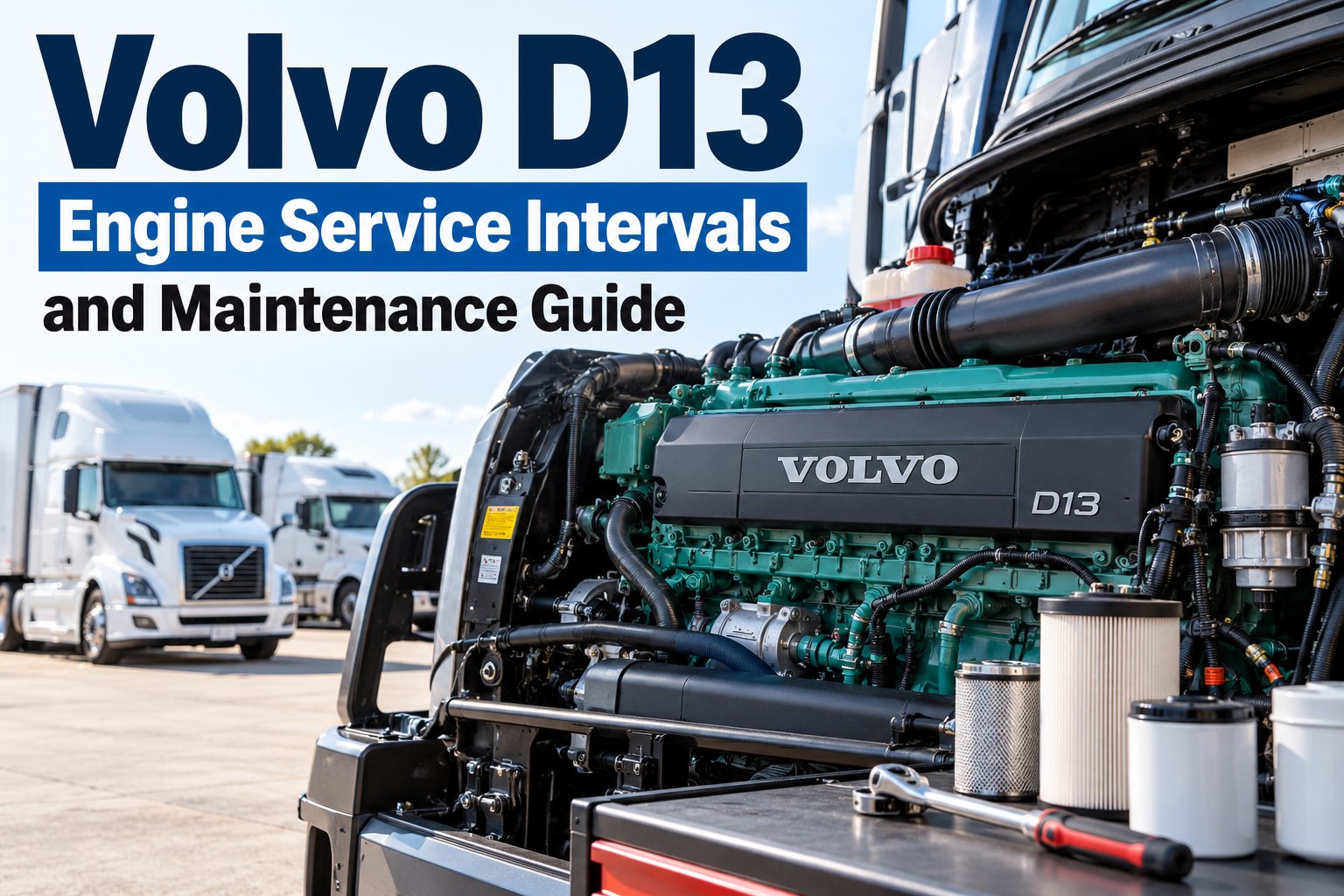
Most OEM schedules are a table of mileages. The Volvo D13 schedule is a table of mileages with three holes in it, and the holes are the interesting part. The air filter has no mileage figure at all — it is replaced at maximum restriction as shown on a gauge, or on the calendar. The rear axle interval is given as "see axle manufacturer guidelines," so Volvo deliberately does not supply it. And the oil interval itself depends on which Volvo oil specification is in the sump. A schedule built only from the mileage column will be missing all three — and that is before the two published clocks, because Volvo gives a mileage and an hour figure for almost every line, and on slower work the hours are what actually fall due. Book a Volvo D13 PM review.
Three Lines on This Schedule Are Not Mileages
Where Volvo's duty classifications sit, which of the two published clocks actually governs on your operation, and the three items a mileage-only PM programme has nowhere to put.
The Three Duty Classifications
Volvo keys these to fuel economy, and the middle one is worded in a way worth reading twice.
The document gives normal as greater than 6 mpg, heavy as greater than 5 mpg, and severe as less than 5. Taken literally the heavy and normal definitions overlap, so the sensible reading — and the one the interval figures support — is that heavy duty is the band between 5 and 6 mpg. If a truck sits near either boundary it is worth confirming with your dealer rather than rounding in your own favour.
Which of the Two Clocks Governs
Volvo publishes a mileage and an hour figure for nearly every item. Which one you actually meet depends on how fast the truck moves.
Each point is one interval, placed by its mileage limit along the bottom and its hour limit up the side. The dashed rays are average speeds. A point sitting above a ray means that, at that speed, you reach the mileage before the hours — so mileage governs. A point below it means the hour limit arrives first. The severe-duty oil change is the clear case: its 825-hour limit works out to roughly 33,000 miles at 40 mph, so the 35,000-mile figure is never reached and the hours are what actually fall due.
This is why mileage-only scheduling drifts on anything slow. A regional unit averaging 30 mph, a construction truck, or a yard shunter will meet the hour limit on almost every line well before the odometer gets there — and the gap widens as the average speed falls.
The Three Items With No Mileage
Each one needs something a mileage table cannot hold, and each is a specific reason a hand-kept schedule comes up short.
Volvo specifies replacement “at max restrictions as indicated on gauge, or 12 months” on normal duty, and 6 months on severe. So it is triggered by a reading somebody has to take, or by the calendar — and a mileage-only schedule has nowhere to put it.
The published interval for rear axle oil is “See axle manufacturer guidelines.” The schedule is deliberately incomplete here, which means somebody has to go and get the missing number from the axle maker before the PM programme is whole.
The figures are for oil meeting Volvo’s own VDS-4.5 specification. The document notes that VDS-4 Premium intervals are shorter. Volvo sets its own drain specification rather than relying on API categories alone, so the product decides the interval.
The rear axle one deserves a moment. It is not an oversight — Volvo fits axles it does not manufacture, so pointing at the axle maker is the correct thing for the document to do. But it leaves the fleet holding an unanswered question, and an unanswered question in a maintenance programme tends to become an unscheduled item rather than a researched one.
A line with no number usually becomes a line with no service
An air filter triggered by a gauge reading, a rear axle deferred to another manufacturer, and an oil interval that depends on the specification in the barrel. None of the three fits a mileage field, which is exactly why they go missing. In thirty minutes we will set all three up properly against your units.
Every Line, All Three Classifications
The published set in full, including the lines that are not mileages. Swipe the table sideways on mobile.
| Item | Normal duty | Heavy duty | Severe duty |
|---|---|---|---|
| Engine oil and filter | 60,000 mi / 1,700 hrs | 45,000 mi / 1,300 hrs | 35,000 mi / 825 hrs |
| Fuel filter | At the oil change | At the oil change | At the oil change |
| Air filter | At max gauge restriction, or 12 months | At max gauge restriction, or 12 months | At max gauge restriction, or 6 months |
| DPF ash cleaning | 400,000 mi / 10,000 hrs | 400,000 mi / 10,000 hrs | 250,000 mi / 4,500 hrs |
| DEF filter | 150,000 mi / 4,500 hrs | 150,000 mi / 4,500 hrs | 150,000 mi / 4,500 hrs |
| Valve adjustment | 150,000 mi then every 300,000; 12 months then every 24 | Same | Same |
| Coolant, long life | 750,000 mi / 96 months | 750,000 mi / 96 months | 750,000 mi / 96 months |
| I-Shift transmission oil | 500,000 mi / 60 months | 250,000 mi | 250,000 mi |
| Rear axle oil | See axle manufacturer | See axle manufacturer | See axle manufacturer |
Two figures stand out against the rest of the industry. The long-life coolant at 750,000 miles or 96 months is unusually long — eight years, which on most fleets means the calendar will arrive first and it will arrive after the truck has changed hands. And the I-Shift transmission oil halves from 500,000 miles to 250,000 the moment a unit leaves normal duty, which is a large move on an item that sits outside the engine schedule.
Where the Oil Specification Comes In
Volvo runs its own drain specification rather than relying on API categories alone, and the version matters.
The intervals above apply to oil meeting VDS-4.5. The same document notes that VDS-4 Premium carries shorter intervals. So on a Volvo the question "what oil is in it" has a direct consequence for the next due date, in a way that a schedule storing a single mileage cannot express. If the shop changes product and nobody records which specification went in, the due point on the schedule is no longer the due point for the engine.
The oil pan is a second hardware variable in the same table. The D11, D13 and the D16 fitted with the 42-litre pan share one set of figures, while a D16 on the larger 52-litre pan is published with longer ones — 65,000 miles on normal duty against 60,000. For a D13 fleet that is academic, but it does establish the principle: the interval is a property of the specific engine and its fill, not of the model name.
The figures on this page are drawn from Volvo's published maintenance intervals for the 2010 to 2016 model range. Later D13s, including current VNL and VNR trucks, have their own published intervals which differ, and a figure carried across model years is one of the more common ways these schedules go wrong. For your own trucks the operator's manual for that model year is the authority, and a Volvo dealer can confirm what applies to a given VIN.
The Valve Adjustment Runs on Four Numbers
One more line worth isolating, because it carries two clocks and a different first interval, which is three ways to get it wrong.
Volvo publishes the valve adjustment as 150,000 miles and then every 300,000, alongside 12 months initially and then every 24. So a new D13 has its first adjustment due at 150,000 miles or 12 months, whichever arrives first, and thereafter at 300,000 miles or 24 months. Four figures governing one job.
For a highway truck the mileage legs govern comfortably and the calendar never enters it. For anything slower the picture inverts: a unit covering 40,000 miles a year reaches 12 months long before 150,000 miles, so its first valve adjustment is a calendar event at the end of year one — and its second is due at the end of year three rather than somewhere past 300,000 miles it may never reach.
That pattern — a shorter first interval followed by a longer repeating one, each with its own calendar limit — is the shape most likely to be entered into a system as a single number. Entered as 300,000 miles, the first adjustment is missed by 150,000. Entered as 150,000, the truck gets adjusted twice as often as Volvo asks for the rest of its life.
How FleetRabbit Handles This
Four things, aimed at the parts of this schedule that are not a number in a mileage column.
The air filter has no mileage. It sits on the schedule as a gauge reading to take plus a calendar limit, so it is inspected and recorded rather than quietly dropped for having no number.
Volvo publishes a mileage and an hour figure for almost everything. Running them together is what catches the severe-duty oil change, where hours arrive first on most operations.
VDS-4.5 and VDS-4 Premium carry different intervals. Logging which was used means the next due point is calculated from the oil that is actually in the engine.
Where Volvo points at the axle manufacturer, the line stays on the schedule as an open item until the real figure is entered, instead of being absent and forgotten.
Questions Volvo D13 Operators Ask
What is the oil change interval on a Volvo D13?
On the published intervals for the 2010 to 2016 range, with VDS-4.5 oil, it is 60,000 miles or 1,700 hours on normal duty above 6 mpg, 45,000 miles or 1,300 hours on heavy duty, and 35,000 miles or 825 hours on severe duty below 5 mpg. Later model years have their own figures. Confirm by model year.
Do the hours or the miles come first?
It depends on your average speed, and on severe duty the hours usually win. An 825-hour limit works out to about 33,000 miles at 40 mph, so the 35,000-mile figure is never reached. The slower the operation, the more lines are governed by hours. See Which Clock Binds.
When does the air filter need replacing?
There is no mileage for it. Volvo specifies maximum restriction as shown on the gauge, or 12 months on normal duty and 6 months on severe. It is a reading plus a calendar limit, which means somebody has to be scheduled to take the reading. Schedule the check.
What is the rear axle oil interval?
Volvo does not publish one — the entry reads "see axle manufacturer guidelines." You need the figure from whoever made the axle fitted to that truck, and until it is entered the line is an open item rather than a scheduled one. Close the Schedule Gaps.
Does the oil brand change the interval?
The specification does. The published figures are for VDS-4.5, and the document notes VDS-4 Premium intervals are shorter. Volvo sets its own drain specification, so recording what actually went in is what keeps the next due date honest. Log it per service.
Is the coolant really 750,000 miles?
For long-life coolant the published figure is 750,000 miles or 96 months. On almost any fleet the 96 months arrives first, and eight years is long enough that the truck may well have changed hands before it falls due — which makes it worth verifying on any used unit rather than assuming. Check incoming trucks.
What changes most when a truck leaves normal duty?
The I-Shift transmission oil, which halves from 500,000 miles to 250,000, and the DPF cleaning, from 400,000 miles down to 250,000 on severe duty. Both sit outside the engine schedule where they are easy to leave on the old figure. Apply the full change.
Can Volvo units run alongside other makes?
Yes, and this schedule shows why per-unit intervals matter — Volvo uses its own oil specification, publishes hours beside every mileage, and leaves one line to another manufacturer. All of it belongs on one maintenance record rather than in a shared mileage field. Start Free on Three Trucks.
Put the Awkward Lines on the Schedule Too
FleetRabbit runs mileage and engine hours together, holds gauge-triggered and calendar items as real scheduled work, records the oil specification against each service, and keeps deferred lines visible until the figure is filled in — so the whole schedule is on the truck, not just the parts that fit a mileage field.
Free for 3 vehicles · no credit card required