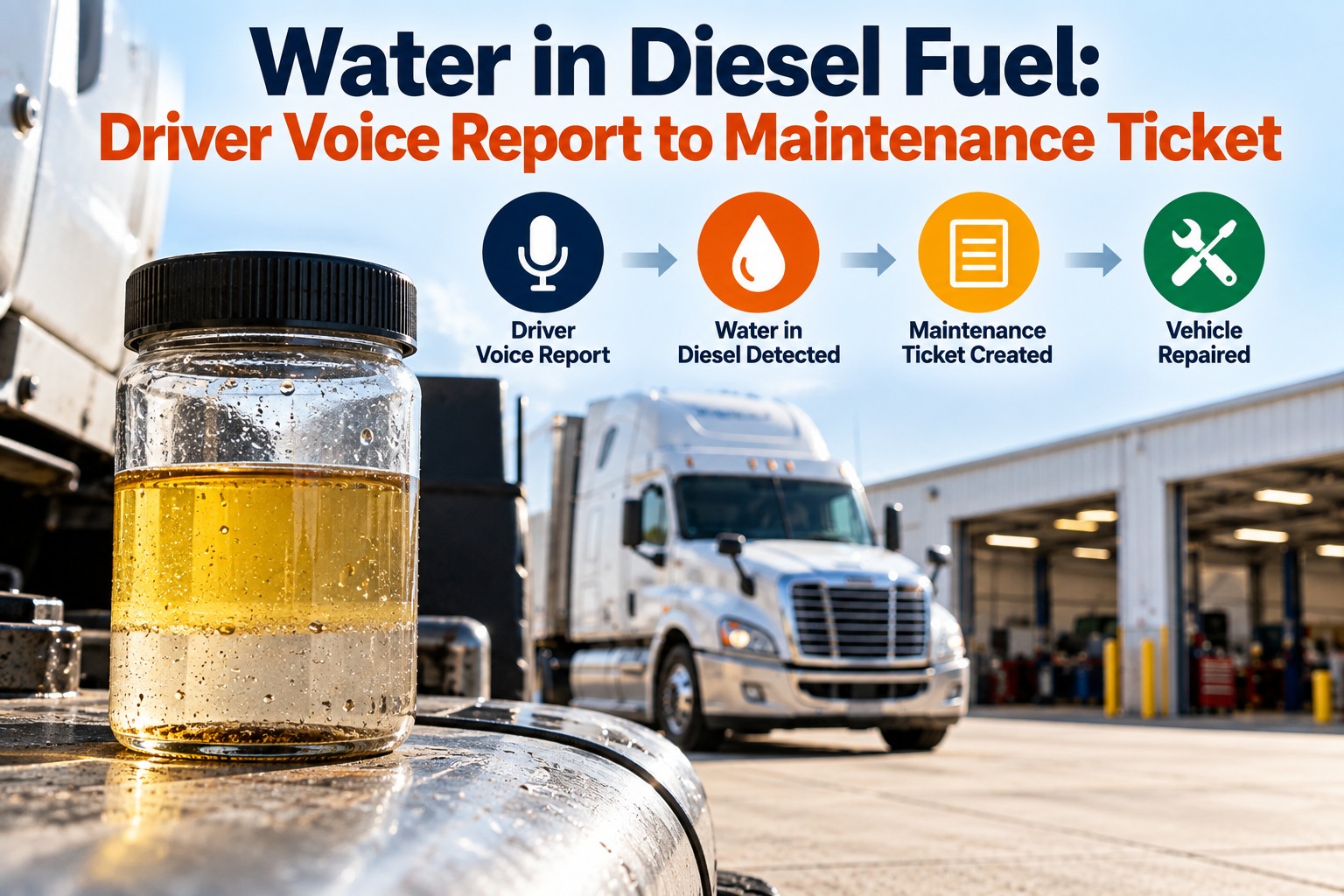
Water is the contaminant most likely to take a modern diesel truck out of service, and the driver is usually the first to know — a water-in-fuel lamp, a truck that stumbles under load, or fuel that looks wrong in the separator bowl. The stakes are higher than they used to be: engine makers generally require that no free water reaches the high-pressure common-rail system, and Heavy Duty Trucking quotes Donaldson's Scott Grossbauer calling free water probably the single biggest cause of fuel system failure, with water in an injector tip able to flash to steam and damage the injector. A GM service bulletin filed with NHTSA puts it plainly too: water or similar contaminants mean the fuel cannot cool and lubricate components properly, causing overheating, rust, corrosion and component failure. This guide covers where water gets in, how to tell free water from emulsified, the six questions a driver should answer when reporting it, the stop-or-drive decision, what the shop does next, and the schedule that keeps it from recurring. Book a 30-minute demo to see a fuel report become a work order, or start free with 3 vehicles.
Water Doesn't Announce Itself as Water. It Shows Up as a Lamp, a Stumble, or a Filter That Plugs Twice in a Month.
For maintenance managers, shop leads and drivers: how to turn a roadside suspicion of water in the fuel into a documented ticket, a safe decision and a repair that finds the source.
HOW IT GETS IN
Where Water Comes From Before It Ever Reaches the Injector
Water is rarely one dramatic event. It arrives through condensation, storage and delivery — which is why a single bad source can affect every truck that fuels from it. You can track which units report water by fueling location on a free account.
Warm days and cold nights pull moist air in and leave water behind on the tank walls.
Water in a bulk or underground tank travels straight into everything that fuels there.
A damaged cap or vent lets weather in at the top of the tank.
Fuel that sits gives water time to settle and microbes time to grow at the fuel-water line.
THE DAMAGE PATH
What Water Actually Does Between the Tank and a Failed Injector
Understanding the sequence is what makes the urgency obvious to a driver and a dispatcher. Each stage is cheaper than the one after it, and the last two are where warranty conversations start. We'll map your own fuel-related repairs against this in a demo.
Free water at the pickup, or emulsified droplets carried in suspension.
Fuel can no longer cool and lubricate components properly, which brings overheating, rust and corrosion.
Bacteria and fungi live at the fuel-water interface and produce sludge and acids that block filters fast.
Restricted flow and poor spray patterns show up as stumbling, smoke and derates.
Water at an injector tip can flash to steam under combustion heat and damage the tip outright.
Sources: Heavy Duty Trucking interviews with Donaldson and Ryder Fuel Services on fuel cleanliness; GM service bulletin on fuel and water filter service filed with NHTSA; industry guidance on microbial contamination in fuel systems, including ASTM D6469.
TWO KINDS OF WATER
Free Water and Emulsified Water Behave Differently, and Only One Drains Out
The separator catches what settles. What stays suspended in the fuel is the part that reaches the pump — which is why "I drained it and it was fine" is not the end of the diagnosis. Record both findings on the unit's history free.
Visible as a clear layer under the fuel. Drains out, and is what the driver can act on at the roadside.
Often invisible, harder for a separator to remove, and the reason a clean-looking sample doesn't clear a truck.
THE FIELD READ
The Jar Test a Technician Can Do in Two Minutes Before Any Lab Work
A representative sample in a clean glass jar, held in natural light, tells you most of what you need before anything goes to a lab. Appearance is a warning sign rather than a diagnosis — dark fuel is not automatically microbial growth — so treat it as the trigger for testing, not the conclusion. We'll add sample results to your work order template in a demo.
No haze, no layer, no odor. Record it and look elsewhere for the fault.
Suggests suspended water. Send for testing rather than guessing at the cause.
A distinct water layer under the fuel. Stop adding hours until the system is dealt with.
Points to microbial growth at the fuel-water line. Filters will plug again until it's removed.
ASTM D975 limits water and sediment in diesel to 0.05% by volume, and ASTM D6469 covers microbial contamination in fuels and fuel systems. Use the jar as a first read, then test.
DRIVER INTAKE
Six Questions That Turn "I Think There's Water in the Fuel" Into a Usable Ticket
Whether the report comes by voice or on the inspection app, these six answers are what the shop needs to act without a second phone call. Ask them in this order so the safety decision can be made before the call ends. Set this as your intake script free on 3 vehicles.
Bring Your Last Six Fuel-Related Repairs. We'll Show You What They Had in Common.
Filter changes, injector jobs, no-starts. In the demo we'll put them on one timeline with fueling locations and units, open the work orders they should have produced, and show which ones were a repeat of the same source.
THE DECISION
Keep Driving, Drain and Monitor, or Stop Where You Are
Write the rule down so the answer is the same at 2 a.m. as it is at noon, and so no driver is deciding alone under load pressure. We can turn this into triage rules for your fleet.
Every mile after this point risks the high-pressure pump and injectors. Park safely and arrange help.
The truck moves, but only to the next qualified shop. Drain the separator first if it is safe to do so.
Record what was drained, finish the run if policy allows, and book the fuel system check before the next dispatch.
IN THE SHOP
What the Shop Should Do Before Deciding the Fuel Was the Problem
The point of the shop visit is finding the source, not just changing filters. A truck that keeps plugging filters after a filter change is telling you the water is still arriving from somewhere. Log each step on the work order so a repeat visit starts where this one ended. Add these steps to your template free.
Volume and appearance of water, and whether it was clear or dirty.
A sample from the low point tells you what the engine is actually being fed.
What the element caught — rust, slime, sediment — narrows the source fast.
Weather entering the top of the tank is a cheap fix that stops the repeat.
Heavily contaminated fuel may need removal or polishing rather than another filter.
The pattern across units is what identifies a bad bulk tank or a bad stop.
PREVENTION
The Schedule That Keeps Water Out of Your Fuel System
Almost all of this is routine work that already belongs to someone. Put it into preventive maintenance and onto the daily inspection report so it is recorded rather than remembered. See it scheduled automatically in a demo. Swipe the table on mobile.
| When | Task | Owner |
|---|---|---|
| Every trip | Driver drains the water separator and reports any water found | Driver |
| Every trip | Check the water-in-fuel lamp at key-on with the rest of the dash | Driver |
| Every PM | Replace fuel filters on the maker's interval; inspect the separator bowl | Technician |
| Every PM | Pull a sample from the tank low point on units with repeat filter plugging | Technician |
| Monthly | Review which units report water, grouped by fueling location | Maintenance planner |
| Quarterly | Check bulk tank water level and housekeeping if you store fuel | Facility owner |
THE STAKES
What a Water Event Costs Compared With Draining a Separator
The cheapest version of this repair is a driver with a drain valve and two minutes. The most expensive is a set of injectors, a high-pressure pump and a tow — and possibly a warranty conversation, since engine makers generally expect no free water to reach the common-rail system. Industry benchmarking puts unplanned downtime at roughly $448 to $760 per truck per day before towing and repair, and ATRI puts 2025 repair and maintenance cost at $0.215 per mile. Estimate your own exposure with our team.
Relative cost, illustrative — not prices. Downtime benchmark: FleetNet America and TMC via industry reporting.
QUESTIONS
Water in Diesel Fuel Questions Drivers and Maintenance Managers Ask
What are the symptoms of water in diesel fuel?
A water-in-fuel warning lamp, hard starting, rough running or misfire, loss of power, smoke, and fuel filters that plug far sooner than their interval. Severe cases stall the engine. See how these get reported and tracked.
Can I keep driving with the water-in-fuel light on?
If the truck runs normally and a small amount drains out, many fleets allow the run to finish with a fuel system check booked before the next dispatch. Stalling, heavy power loss or repeat filter plugging means stop or head straight to a shop. Set the rule for your fleet free.
How much water is too much?
ASTM D975 limits water and sediment in diesel to 0.05% by volume, and engine makers generally expect no free water to reach the high-pressure system at all. Treat any free water in the separator as a finding worth recording. Review your fuel standards with us.
Why do my filters keep plugging after a filter change?
Because the source is still there — water in the tank, microbial growth at the fuel-water line, or a bad fueling location. Sample the tank and check where the truck fuels rather than fitting a third filter. Track repeat filter jobs per unit free.
Is "diesel algae" really algae?
No. It is bacterial and fungal growth living at the interface between water and fuel, producing sludge and acids that plug filters and corrode components. Removing the water is what removes the habitat. Plan the remediation with our team.
How do drivers report suspected water quickly?
By voice or on the inspection app, answering six questions: unit and location, what they saw, lamp status, where they last fueled, whether power dropped, and whether they can safely drain the separator. Use the intake script free.
Catch Water at the Separator, Not at the Injector
FleetRabbit captures the driver's report with the unit, location and lamp status, opens a work order with the fuel checks attached, and keeps every drain, sample and filter change on the truck's history — so a repeat points at the fueling source instead of another filter.
Voice or app, six answers, no second phone call needed.
Unit, location, lamp status and the shop checklist already attached.
Repeat reports grouped by unit and fueling location, not lost in history.
No credit card required. Works with the phones and inspection app your drivers already use.