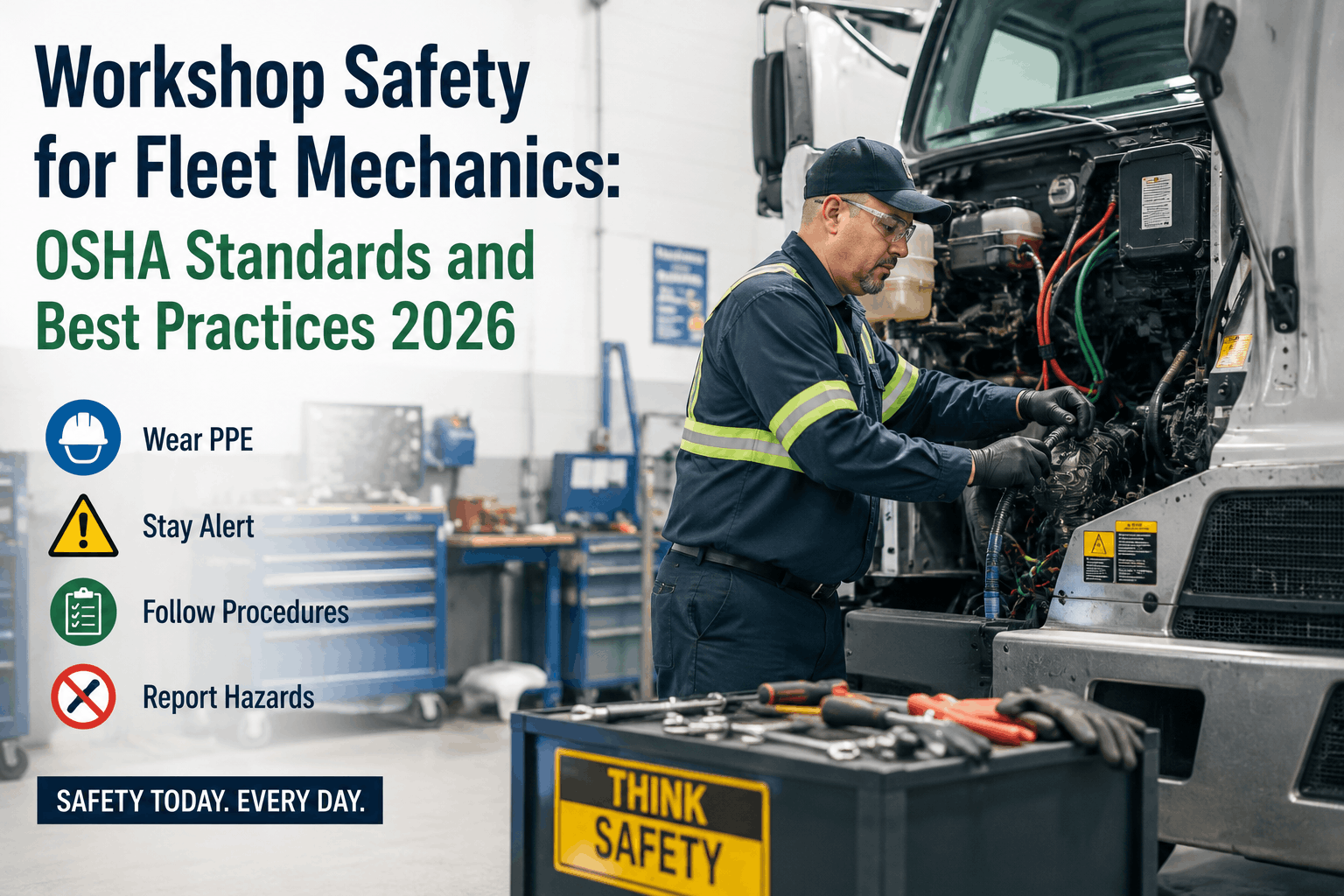
A fleet workshop is a high-risk environment. Every day, mechanics work with heavy equipment, toxic substances, high-voltage systems, and moving vehicles. Yet many fleet operations treat shop safety as an afterthought — until an injury occurs. The reality is that workplace injuries in fleet maintenance facilities are not just a safety issue; they're a business liability. According to the Bureau of Labor Statistics, fleet mechanics experience injury rates significantly higher than the national average for all occupations. And with OSHA updating its standards for 2026, the compliance landscape is becoming more demanding than ever. This isn't just about avoiding fines — it's about protecting the people who keep your fleet moving.
Workshop Safety for Fleet Mechanics: OSHA Standards and Best Practices for 2026
Understanding OSHA's 2026 Standards for Fleet Workshops
The Occupational Safety and Health Administration (OSHA) has introduced significant updates to its General Industry Standards that directly affect fleet maintenance facilities. The 2026 revisions focus on three critical areas: chemical exposure limits, ergonomic protection, and emergency response protocols. OSHA's updated permissible exposure limits (PELs) for common workshop chemicals — including brake cleaner, solvent degreasers, and diesel exhaust — are now 30% lower than previous thresholds, requiring enhanced ventilation and personal protective equipment (PPE) in many shops.
Additionally, the new standards mandate documented ergonomic assessments for all workstations, particularly those involving repetitive motions like tire mounting, brake work, and under-vehicle inspections. OSHA also requires annual emergency drill documentation for chemical spills and fire incidents, with specific focus on evacuation routes and first-response equipment accessibility. Fleet operators who fail to meet these standards face fines ranging from $5,000 to $70,000 per violation, depending on severity and recurrence. To stay ahead of these requirements, sign up with FleetRabbit and access our compliance tracking tools designed specifically for fleet maintenance facilities.
The Hidden Costs of Unsafe Workshops
The financial impact of workshop injuries extends far beyond medical expenses and insurance claims. When a mechanic is injured, the immediate costs include medical treatment, workers' compensation, and potential OSHA fines. But the indirect costs are often much larger: lost productivity, overtime for replacement workers, training for temporary staff, damage to equipment or vehicles, and the administrative burden of accident investigation and reporting. Industry estimates suggest that indirect costs of workplace injuries are typically 4 to 10 times the direct costs.
For a fleet workshop with 10 mechanics, a single serious injury can cost over $100,000 when all factors are considered. And that doesn't account for the intangible costs: reduced morale, increased turnover, and potential damage to the company's reputation as an employer. Fleet managers who invest in comprehensive safety programs consistently report lower injury rates, reduced turnover, and improved productivity. To see how your workshop's safety metrics compare to industry benchmarks, book a demo with FleetRabbit and let our team provide a customized compliance assessment.
OSHA 2026 Key Changes at a Glance
- → Chemical PELs reduced by 30% for brake dust and solvents
- → Mandatory ergonomic assessments for all workstations
- → Annual documented emergency response drills
- → Enhanced PPE requirements for battery and EV maintenance
- → New reporting timelines for workplace injuries (24-hour window)
Critical Safety Areas for Fleet Workshops
Fleet maintenance facilities face a unique combination of hazards that require targeted safety protocols. Understanding these risk areas is the first step toward building an effective safety program. The following categories represent the most common sources of injury in fleet workshops, along with the OSHA standards that govern each area.
OSHA 1910.179 requires annual inspection of all lifting equipment, documented load testing, and clear weight capacity signage.
OSHA 1910.1200 mandates updated Safety Data Sheets (SDS) for all chemicals, secondary containment, and documented PPE protocols.
New 2026 standard requires certified training for high-voltage system work, insulated tools, and emergency battery disconnection protocols.
OSHA 1910.157 requires monthly fire extinguisher inspections, annual fire drills, and clear evacuation routes posted in all work areas.
Building a Culture of Safety in Your Workshop
Compliance with OSHA standards is the minimum requirement, not the goal. The most successful fleet workshops build safety into their culture — where every mechanic feels empowered to identify hazards, report concerns, and suggest improvements. This culture shift requires leadership commitment, consistent communication, and systems that make safety easy to practice.
Regular safety briefings are essential. These should not be generic lectures but focused sessions that address specific workshop risks, review recent incidents (or near-misses), and provide hands-on demonstrations of proper procedures. Involving mechanics in safety committee discussions also improves engagement — those who feel heard are more likely to follow protocols and advocate for safety among their peers. Technology can also support this culture: digital checklists, safety audit tools, and incident reporting systems streamline the process and provide valuable data for continuous improvement. To bring these tools into your workshop, sign up with FleetRabbit and access our workshop safety management modules.
10-minute inspection of lifts, extinguishers, chemical storage, and PPE compliance before workshop opens.
Documented inspection of all powered tools, hoists, jack stands, and diagnostic equipment for damage or wear.
Focused training on specific hazards — EV safety, chemical handling, lift operations — with documented attendance.
The Business Case for Safety Investment
Some fleet managers view safety investments as an expense. The reality is that safety programs are an investment that delivers measurable returns. Data from the National Safety Council shows that for every dollar invested in workplace safety programs, organizations save an average of $4 in reduced injury costs. For fleet workshops, the ROI can be even higher due to the high-risk nature of the work environment.
Beyond direct cost savings, safety investments improve operational efficiency. Mechanics who feel safe are more productive, take fewer sick days, and stay with their employer longer — reducing the significant costs associated with recruiting and training replacement staff. Additionally, a strong safety record enhances your ability to attract and retain skilled mechanics in a competitive labor market. Experienced technicians seek employers who prioritize their wellbeing. To calculate the ROI of safety investments for your workshop, book a demo with FleetRabbit and access our safety investment modeling tools.
FleetRabbit's workshop safety platform helps you track compliance, manage inspections, and document training — all in one place.
Essential PPE and Equipment Updates for 2026
The 2026 OSHA standards include enhanced PPE requirements that every fleet workshop should be aware of. For mechanics working on electric vehicles, new insulation and voltage-rated gloves are mandatory, along with face shields rated for arc flash protection. For traditional internal combustion vehicle work, upgraded respiratory protection is required due to tightened diesel particulate matter limits. Eye protection remains critical, with new standards recommending anti-fog coatings and side shields for all safety glasses used in workshop environments.
Beyond PPE, the new standards require documented equipment maintenance logs for all powered tools, lifts, and diagnostic equipment. This includes calibration records for torque wrenches, diagnostic scanners, and alignment equipment. Workshops that maintain meticulous equipment records not only comply with OSHA requirements but also extend the life of their tools and reduce the risk of equipment-related injuries. To track your PPE and equipment maintenance schedules efficiently, sign up with FleetRabbit and use our automated maintenance logging system.
Building a Safety-First Workshop Culture
Creating a genuinely safe workshop requires more than policies — it requires leadership commitment and active employee engagement. Fleet managers should model safe behavior, openly discuss safety concerns, and recognize mechanics who consistently follow safety protocols. Regular safety audits that involve mechanics in the review process help identify hazards that may be overlooked by management and demonstrate that safety is a shared responsibility.
Incentive programs can also reinforce safe behavior. Fleets that have implemented safety bonus programs — where teams receive rewards for incident-free periods or for achieving safety inspection scores — report stronger safety cultures and fewer accidents. The key is to keep the program focused on behaviors, not just outcomes, so that near-misses and preventative measures are recognized alongside perfect safety records. To learn more about building effective workshop safety programs, book a demo with FleetRabbit and speak with our safety compliance specialists.
Frequently Asked Questions
What are the key changes in OSHA's 2026 standards for fleet workshops?
The 2026 updates include stricter chemical exposure limits (30% reduction for brake dust and solvents), mandatory ergonomic assessments for all workstations, annual documented emergency response drills, enhanced PPE requirements for EV maintenance, and a 24-hour injury reporting window.
How often should vehicle lifts be inspected?
OSHA 1910.179 requires annual inspections of all lifting equipment, including documented load testing and clear weight capacity signage. Monthly visual inspections are also recommended to check for structural damage, hydraulic leaks, or worn components.
What PPE is required for fleet mechanics working on electric vehicles?
For EV work, mechanics need insulated gloves rated for the vehicle's voltage, face shields with arc flash protection, voltage-rated tools, and documented training on high-voltage system safety protocols, as mandated by OSHA's 2026 standards.
What are the financial penalties for OSHA violations in fleet workshops?
OSHA penalties range from $5,000 to $70,000 per violation, depending on severity and recurrence. Willful or repeated violations can result in penalties up to $145,000 per violation. These amounts are adjusted annually for inflation.
How can I track workshop safety compliance efficiently?
Digital compliance platforms like FleetRabbit offer automated inspection checklists, equipment maintenance logging, training documentation, and incident reporting tools that centralize all safety records and provide real-time visibility into your workshop's compliance status.
What is the ROI of investing in workshop safety programs?
Studies show that every dollar invested in workplace safety programs returns an average of $4 in reduced injury costs. For fleet workshops, the ROI can be significantly higher due to the high-risk nature of the work and the substantial costs associated with vehicle-related injuries.
FleetRabbit's workshop safety solution helps you track inspections, manage training records, and document compliance — all from a single dashboard.