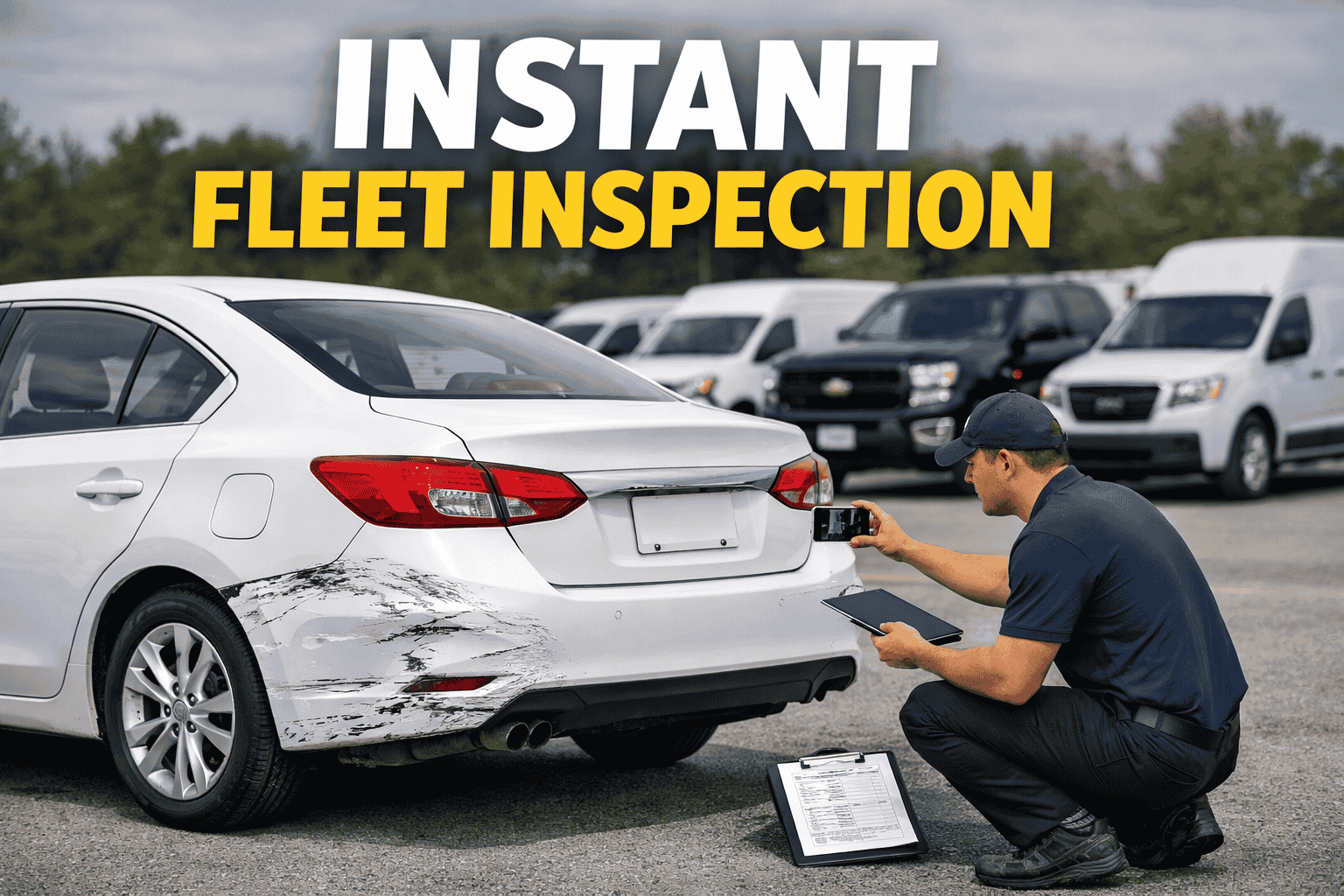
You snap a photo of your fleet vehicle. Thirty seconds later, you're looking at a detailed damage report with severity ratings, repair estimates, and work order recommendations. What happened in those 30 seconds? Understanding how AI processes your vehicle photos transforms how you think about fleet inspections,and why smartphone-based AI is replacing clipboard inspections, across the industry. Book a demo to see AI inspection in action, or try it free on your first 3 vehicles.
From Photo to Report in Seconds
When you upload a fleet vehicle photo, AI doesn't just "look" at the image the way you do. It breaks the photo into millions of pixels, compares patterns against databases of 30+ million real damage images, and makes thousands of calculations to determine exactly what it's seeing—and how serious it is.
The result? AI catches micro-damages that human inspectors miss 40% of the time, delivers consistent results regardless of inspector fatigue, and creates timestamped documentation that holds up in disputes.
Step 1: Image Capture and Validation
Before AI analysis even begins, the system validates your photo to ensure it can deliver accurate results. This happens instantly as you capture each image. The AI checks for proper lighting conditions, correct angle and distance from the vehicle, image resolution and clarity, and whether the full target area is visible. If something's off, you get real-time feedback to retake the shot—saving you from submitting unusable images that would delay your inspection.
Good Image
Clear lighting, correct angle, full panel visible, high resolution
Rejected
Blurry, poor lighting, obstructed view, wrong distance
Warning
Shadows present, slight angle issue—usable but may flag for review
Modern systems guide you through a standardized photo sequence—front, back, sides, wheels, interior—ensuring complete coverage. This guided capture is why AI inspections deliver consistent results regardless of who's holding the phone. Learn how this connects to your DVIR compliance process for DOT-ready documentation.
Step 2: Computer Vision Analysis
Once validated, your photo enters the AI processing pipeline. This is where the real magic happens. The system uses multiple specialized algorithms working together:
Object Detection
AI identifies what's in the image—is this a bumper, door, hood, mirror? It maps 163+ vehicle parts and creates a structural understanding of what it's looking at.
Anomaly Detection
The system scans for visual anomalies—areas where texture, color, or surface patterns differ from what a healthy vehicle looks like. These become damage candidates.
Damage Classification
Each anomaly is classified: scratch, dent, crack, rust, broken light, tire damage. The AI distinguishes between 21+ damage types with trained precision.
Severity Scoring
Every identified damage gets a severity rating—minor, moderate, critical—based on size, depth, and location. Safety-critical items get automatically flagged.
See AI Analysis on Your Fleet
Upload a photo and watch AI identify damage in real-time. No training needed—the system guides you through each step automatically.
Step 3: Pattern Matching Against Millions of Images
Here's what separates AI inspection from simple photo documentation: pattern matching at scale. When AI examines your vehicle photo, it's comparing what it sees against databases containing 10-30 million labeled damage images. This massive training dataset includes every lighting condition from harsh sunlight to dim garage lighting, every vehicle make and model covering 1,200+ configurations, every damage type from hairline scratches to major collision damage, and every angle variation that real-world inspections encounter.
This is why AI catches damage that humans miss. A human inspector might overlook a subtle paint chip because they're tired, rushed, or unfamiliar with that specific vehicle model. AI has seen millions of paint chips across every color and vehicle type—it knows exactly what to look for.
- 70-80% detection accuracy
- Results vary by experience level
- Fatigue affects afternoon inspections
- May miss subtle or early-stage damage
- 15-30 minutes per vehicle
- 95-99% detection accuracy
- Consistent results every time
- No fatigue or attention drift
- Catches micro-damages humans miss
- 30 seconds to 2 minutes per vehicle
Step 4: Location Mapping and Documentation
AI doesn't just identify damage—it pinpoints exactly where that damage is located. Using segmentation technology, the system creates a precise map showing which specific part is affected, the exact position on that part, the size and boundaries of the damage, and the relationship to other nearby damage. This precision matters for repairs. When your technician receives a work order that says "2-inch scratch on driver-side front door, 18 inches from bottom edge," they know exactly what they're looking for. No guesswork, no hunting around the vehicle. Integrating this with your work order management creates a seamless repair workflow.
Step 5: Report Generation and Work Order Creation
The final step transforms all that analysis into actionable output. Within seconds of photo upload, you receive a complete vehicle condition report with photo evidence for every identified issue, severity ratings and priority flags, repair cost estimates based on damage type and severity, and GPS timestamp and inspector identification for compliance.
But here's where modern AI systems go beyond simple reporting: automatic work order creation. Safety-critical issues like brake system damage or cracked windshields can trigger immediate work orders, notify maintenance supervisors, and even flag the vehicle as "not available for dispatch" until repairs are complete. This integration with preventive maintenance systems closes the loop between inspection and repair.
Why This Matters for Your Fleet
Understanding how AI processes photos isn't just technical curiosity—it explains why AI inspection delivers real business results:
Faster Inspections
30-second AI scan vs. 15-30 minute manual walkthrough. More inspections, less labor.
More Damage Caught
AI detects micro-damages humans consistently miss—before they become expensive repairs.
Consistent Documentation
Every inspection follows the same process, creating audit-ready records that hold up in disputes.
Training Required
Guided capture and automatic analysis means anyone can perform expert-level inspections.
The technology that powers AI vehicle inspection—computer vision, deep learning, pattern recognition—continues to improve. Systems today can detect damage as small as 10 microns and analyze images under challenging lighting conditions that would have failed earlier versions. As these capabilities expand, expect AI to handle even more complex assessments like tire tread depth measurement, fluid level detection, and predictive wear analysis.
Getting Started with AI Photo Inspection
Implementing AI inspection in your fleet doesn't require hardware installations or lengthy IT projects. Modern systems work on standard smartphones and can be deployed in days. Here's what the typical path looks like:
Download the App
Install on any iOS or Android device. No special equipment needed.
Add Your Vehicles
Import your fleet data. The system recognizes makes and models automatically.
Follow the Guide
Visual prompts show exactly which angles to capture for complete coverage.
Get Results
Damage detection, severity ratings, and work order recommendations in seconds.
The AI vehicle inspection market is projected to reach $6.9 billion by 2033, growing at 15.8% annually. Fleets adopting now gain competitive advantage in inspection speed, documentation quality, and maintenance response time. Those waiting will eventually need to catch up—but will have lost years of efficiency gains and damage data that compounds over time. Review how AI inspection integrates with your complete FMCSA compliance workflow.
See What AI Sees in Your Fleet Photos
Upload a vehicle photo and watch AI identify damage in real-time. FleetRabbit's guided inspection captures complete documentation while AI handles analysis automatically. Free for up to 3 assets, then just $3 per vehicle per month.