The average unplanned truck breakdown costs $760 in direct repairs—but climbs past $1,900 when you factor in lost productivity, driver downtime, and emergency towing. Across a 50-vehicle fleet, unplanned maintenance consumes 11% of total operational hours annually. Here's the critical insight reshaping fleet maintenance in 2026: 85-95% of these breakdowns are now predictable using AI. Yet 73% of fleets still run reactive maintenance programs that cost 3-5x more than planned repairs. This guide explains how AI predictive maintenance for fleet vehicles works what ROI real operators are achieving, and how to implement it without replacing your entire tech stack.
AI Predictive Maintenance for Fleet Vehicles
How Machine Learning Predicts Failures 2-4 Weeks Before They Happen
What Is AI Predictive Maintenance?
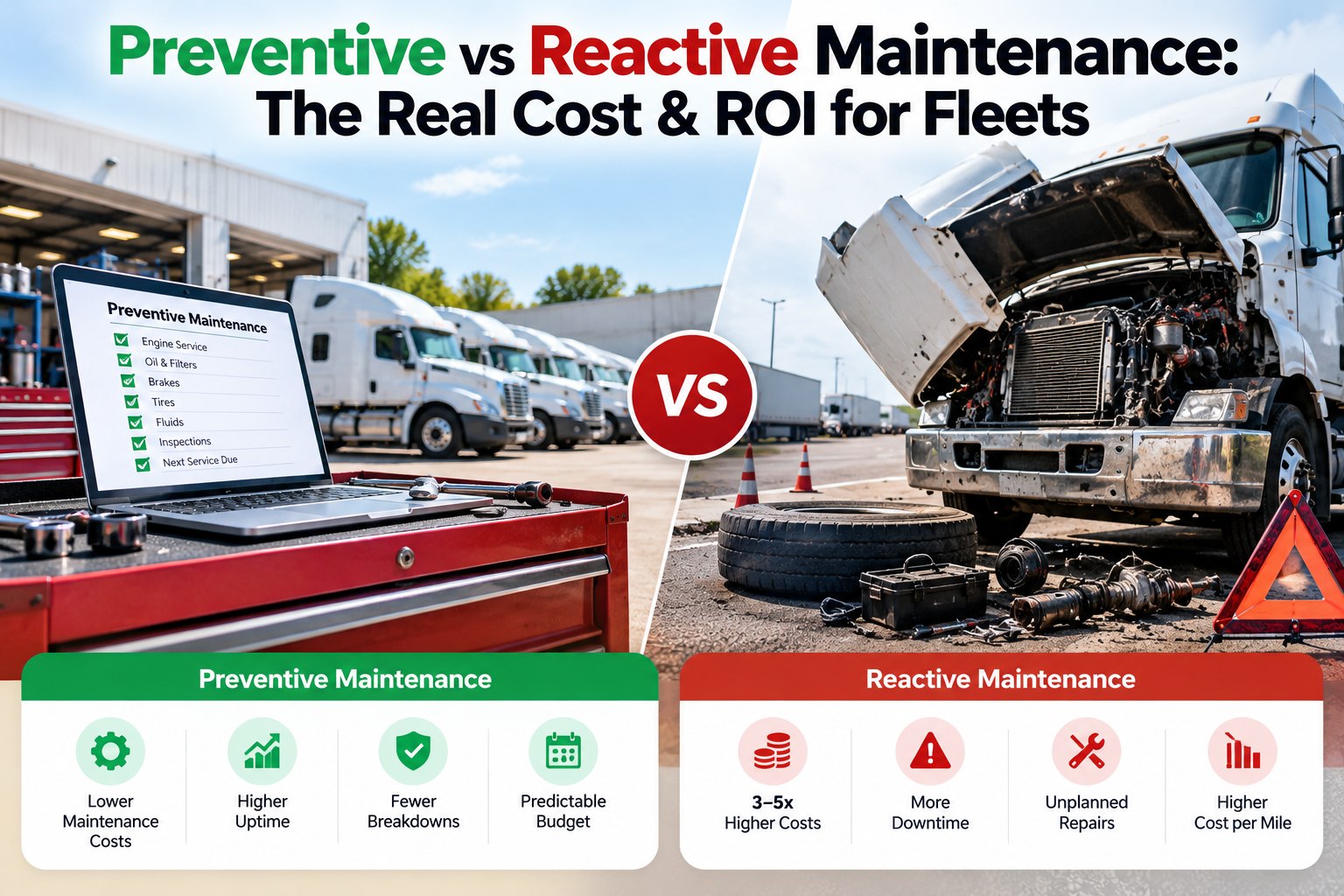
AI predictive maintenance uses machine learning models to continuously analyze vehicle sensor data, telematics, engine diagnostics, and historical repair records—calculating the probability that a specific component will fail within a defined timeframe. Unlike preventive maintenance (which services vehicles on fixed intervals) or reactive maintenance (which fixes what breaks), AI vehicle health monitoring acts on real vehicle condition data.
Data Collection
Telematics streams engine temps, fuel pressure, vibration patterns, and 200+ data points per vehicle
AI Analysis
Machine learning detects anomaly patterns and correlates cross-system deviations from baseline
Early Alert
System flags failure risk 2-4 weeks before breakdown—before any dashboard warning activates
Auto Work Order
System generates repair order, schedules technician, and orders parts automatically
Why 2026 Is the Tipping Point
The technology finally works at scale. Machine learning models now achieve 85-95% accuracy predicting major component failures, surfacing risk 20-45 days before traditional diagnostics raise alarms. The critical shift: you don't need expensive hardware. Most fleets can start generating predictions with telematics they already have. Schedule a demo to see how your existing data can power predictive insights.
Maintenance Strategy Comparison
What AI Monitors in Your Trucks
AI predictive maintenance isn't a single sensor reading. It's a pattern recognition engine correlating hundreds of data points across multiple vehicle systems simultaneously—catching early failure signatures 4-8 weeks before any fault code activates. Here's what modern truck failure prediction systems monitor across Class 3-8 vehicles.
Engine Systems
Oil pressure, coolant temp, fuel rail pressure, misfire patterns, EGR valve performance
Brake Systems
Pressure response curves, pad wear modeling, rotor temperature, air system health
Drivetrain
Transmission vibration, bearing patterns, differential stress, driveline torque analysis
Electrical
Battery degradation curves, alternator output, starter current draw, charging patterns
Want to see how AI predicts failures for your specific vehicles? Get a personalized walkthrough of FleetRabbit's predictive maintenance platform.
Real ROI: What Fleets Are Actually Achieving
These aren't projections—they're documented results from fleets that made the switch to data-driven fleet maintenance strategies. McKinsey research confirms leading organizations achieve 10:1 to 30:1 ROI ratios within 12-18 months. Most fleets see positive ROI within the first quarter.
Annual Savings by Fleet Size
Based on documented fleet predictive analytics implementations
Implementation: 4 Weeks to Predictions
The biggest misconception about AI predictive maintenance is that it requires massive infrastructure investment. Most fleets can start generating predictions with hardware they already have. FleetRabbit integrates with major telematics providers—Geotab, Samsara, Verizon Connect—pulling diagnostic data streams that already exist. Start your free trial to see how quickly predictions begin for your fleet.
Connect & Baseline
Integrate existing telematics and digitize maintenance records. AI begins building vehicle-specific baselines within 24 hours.
First Predictions
Machine learning generates first actionable failure predictions within 72 hours. Initial accuracy 75-80% using fleet-wide pattern data.
Workflow Integration
Connect alerts to work order management. Auto-generate repair orders, schedule technicians, and order parts automatically.
Measurable Results
Most customers report measurable reductions in unplanned breakdown frequency. First prevented failure often covers entire platform cost.
FleetRabbit: AI Predictions in 72 Hours
FleetRabbit's smart fleet maintenance platform is built for fleet managers who need practical AI—not a data science project. The platform supports all commercial vehicle types across Class 3-8: semi-trucks, straight trucks, refrigerated units, buses, and mixed fleets.
Predictions Begin in 72 Hours
No months-long implementation. Connect your telematics and start receiving AI-powered failure alerts within 3 days.
Start Free. Scale When Ready.
First 3 vehicles free forever. Paid plans start at $3/vehicle/month with no contracts. One prevented breakdown pays for an entire year of software.
Frequently Asked Questions
How quickly does AI predictive maintenance generate predictions?
FleetRabbit's machine learning models begin building vehicle baselines within 24 hours of connection and typically generate first actionable failure predictions within 72 hours. The models improve continuously as they accumulate more data from your specific fleet. Most customers see measurable reductions in unplanned breakdown frequency within the first 30 days.
Do I need to install new hardware on my trucks?
Most fleets can start generating predictions with hardware they already have. FleetRabbit integrates with major telematics providers—Geotab, Samsara, Verizon Connect, and others. For fleets without telematics, affordable OBD-II devices ($50-150 each) provide the necessary data connectivity.
What accuracy can I expect from AI failure predictions?
Modern ensemble machine learning models achieve 85-95% precision in predicting major component failures like bearing, pump, motor, and alternator issues. False positive rates have been reduced to 5-15% through advanced algorithms. Accuracy improves over time as the AI learns your fleet-specific patterns.
What's the ROI timeline for predictive maintenance?
Most fleets identify measurable savings within 30-90 days through reduced emergency repairs, lower towing costs, and fewer rental replacements. Documented implementations deliver 2-4x ROI within 12-24 months, with many fleets achieving full payback within the first quarter.
Can I run predictive and preventive maintenance together?
Yes—this is the recommended approach for 2026. 66% of leading fleets use a hybrid strategy: preventive maintenance for routine items and non-critical assets, predictive AI for high-value and failure-critical equipment. FleetRabbit supports both strategies in a single platform.
Stop Waiting for Breakdowns to Happen
73% of fleets still run reactive maintenance. The 27% using AI predictive maintenance are cutting downtime by 45% and achieving ROI within months. FleetRabbit predictions begin within 72 hours of connection.