Manual fleet inspections are broken,and everyone knows it. Drivers rush through checklists to meet departure times. Technicians miss subtle damage hidden by dirt or poor lighting. Paper forms get lost, damaged, or filled out days after the actual inspection. By the time a defect makes it into the system, it's already become an expensive repair, a roadside breakdown, or worse—a DOT violation that tanks your safety rating.
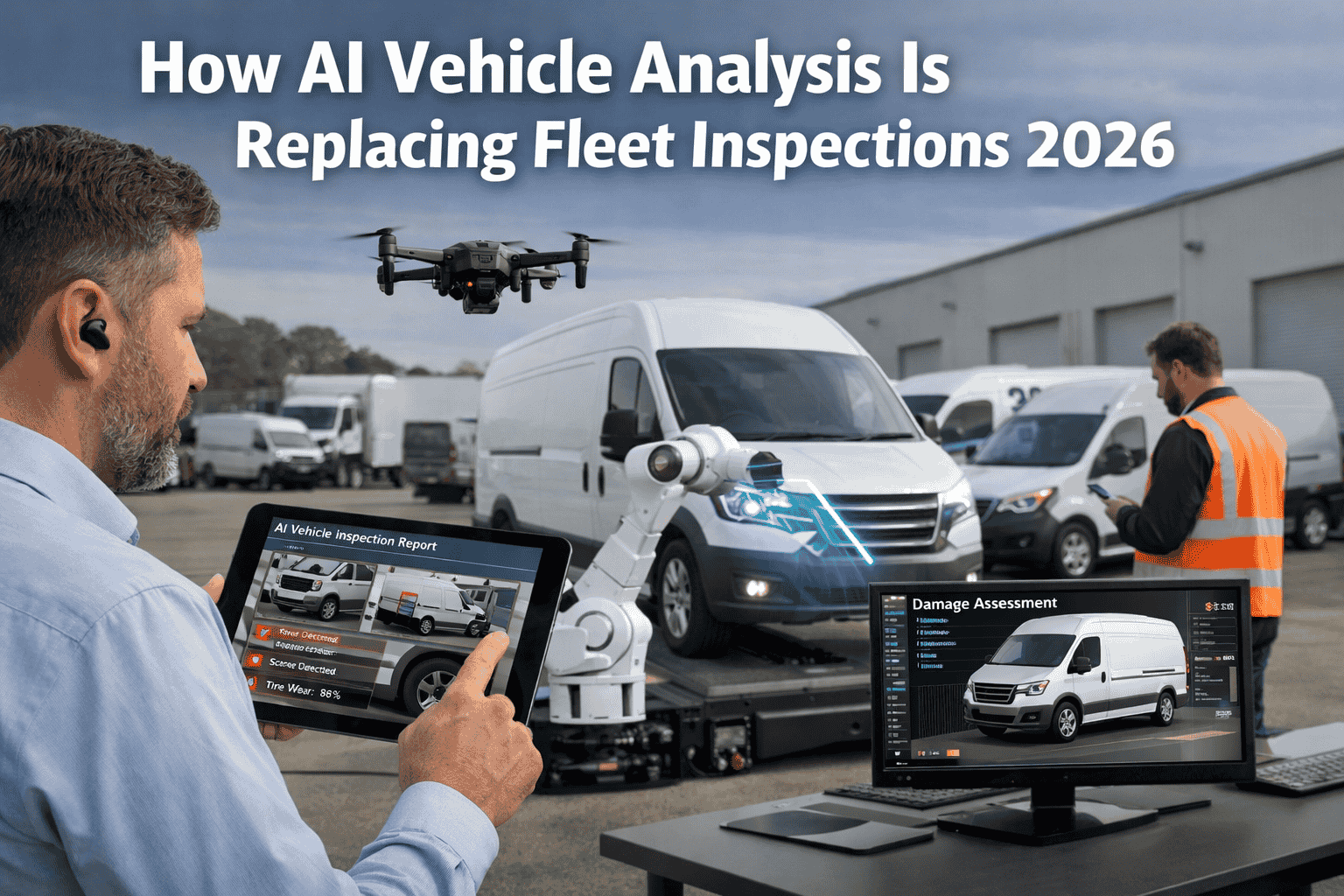
In 2026, AI vehicle analysis is doing what clipboard inspections never could: catching 95-99% of defects in minutes using nothing but photos from a smartphone. No special equipment. No expensive installation. Just computer vision trained on 30+ million real-world vehicle images, analyzing every photo your drivers take and flagging issues that human eyes consistently miss.
The End of Manual Inspections
Upload a photo. Get instant analysis. AI identifies damage, wear patterns, and maintenance needs that human inspectors miss 20-30% of the time—with 95-99% accuracy, in under 60 seconds.
The $6.9 Billion Shift: Why Fleets Are Abandoning Manual Inspections
The AI vehicle inspection market is projected to reach $6.9 billion by 2033, growing at 15.8% annually. This isn't hype—it's fleets recognizing that manual inspections have a fundamental limitation that no amount of training can fix: human inconsistency.
When UVeye compared their AI inspection systems against trained human inspectors, the results were stark: 96% defect detection accuracy for AI versus just 24% for manual inspections. That's not a marginal improvement—it's a 4x difference that translates directly into prevented breakdowns, avoided violations, and vehicles that stay on the road generating revenue instead of sitting in repair bays.
Market Reality Check
The AI vehicle inspection market grew from $1.5 billion in 2025 to a projected $5.2 billion by 2035—a 13.4% annual growth rate. Computer vision technology alone is expected to grow from $500 million in 2024 to $1.8 billion by 2035. Fleets that adopt now gain competitive advantage; those that wait will struggle to catch up.
The fleets leading this transformation aren't just saving time—they're documenting 35% lower repair costs, 40% faster inspection completion, and 89% fewer preventable breakdowns. Learn more about how AI is transforming truck inspections across the industry.
Why Manual Inspections Fail: The Human Consistency Problem
The problem isn't lazy drivers or untrained technicians. It's the fundamental limitation of human attention. Manual inspections miss defects that AI catches every single time—and those missed defects become breakdowns, violations, and accidents that cost fleets thousands.
Inspector Fatigue & Time Pressure
By the 20th inspection of the day, accuracy drops significantly. Drivers facing departure deadlines rush through checklists. The result? "Pencil whipping"—checking boxes without actually looking at the component.
Invisible Damage & Micro-Defects
Micro-cracks in brake components. Early-stage corrosion hidden under dirt. Subtle tire wear patterns indicating alignment issues. These defects are invisible to the naked eye—but not to AI trained on 30+ million vehicle images.
Inconsistent Standards & Subjectivity
What one inspector calls "acceptable wear" another flags as critical. What passes inspection in the morning fails in the afternoon. No two inspections are the same, even on the same vehicle by the same inspector.
Lost Documentation & Audit Failures
Paper gets lost. Handwriting is illegible. Records can't be found when auditors arrive. Digital records stored in the cloud are retrievable in seconds; paper files take hours—if they can be found at all.
The Real Cost of Manual Inspection Failures
How AI Vehicle Analysis Actually Works
No special hardware. No expensive installation. No IT department required. AI vehicle analysis works with the smartphones your drivers already carry, turning every inspection into a comprehensive condition assessment that catches what human eyes miss.
Understanding the technology helps fleet managers evaluate solutions and set realistic expectations. Here's exactly how photo-based AI analysis transforms your inspection workflow:
Photo Capture
Driver opens the mobile app and follows guided prompts showing exactly what to photograph and from which angles. The app prevents submission without required photos, eliminating skipped steps.
AI Analysis
Deep learning algorithms trained on 30+ million real-world vehicle images analyze each photo in real-time. The system detects 21+ damage types across 163+ vehicle components—including micro-damages invisible to the naked eye.
Instant Report
Comprehensive condition report generated automatically with annotated images, severity ratings, repair recommendations, GPS location, and timestamp. Ready for DOT audits instantly.
Automatic Action
Detected defects auto-generate work orders with all details. Maintenance gets notified instantly. Parts inventory is checked. Repairs are scheduled. Driver sees confirmation when complete.
The Technology Behind the Accuracy
Convolutional Neural Networks
AI vision systems use CNNs trained on thousands of annotated images of vehicle defects. These models learn to recognize patterns associated with tire wear, paint damage, rust formation, weld fatigue, fluid leaks, and component misalignment.
Continuous Learning
Every inspection becomes a data point that improves the model. The more vehicles you scan, the smarter the system gets about your specific fleet—adapting to your vehicle types, operating conditions, and common wear patterns.
Fraud Detection
AI identifies digitally altered images, duplicate photos, poor quality submissions, and attempts to conceal prior damage. Systems detect "photo of a photo" fraud attempts and flag suspicious patterns instantly.
What AI Detects That Human Inspectors Consistently Miss
AI doesn't get tired. It doesn't rush to meet departure times. It doesn't have a bad day. It applies the same rigorous standards to every image, every time, every vehicle. Here's what computer vision catches that clipboard inspections miss. Explore our full computer vision capabilities.
Tire Condition Analysis
- Tread depth measurement to 0.1mm accuracy
- Uneven wear patterns indicating alignment issues
- Sidewall damage, bulges, and cuts
- Mismatched tire sets across axles
- Age-related cracking and dry rot
Body & Frame Damage
- Dents as small as 5mm diameter
- Scratches, scrapes, and paint damage
- Early-stage corrosion and rust spots
- Frame misalignment indicators
- Structural integrity concerns
Safety-Critical Components
- Brake pad and rotor wear levels
- Light functionality and lens damage
- Windshield cracks, chips, and visibility issues
- Mirror condition and adjustment
- Wiper blade deterioration
Fluid Leaks & Underbody
- Oil stains and active drips
- Coolant leaks and residue
- Brake fluid spots
- Transmission and differential leaks
- Exhaust system damage
Detection Accuracy: AI vs Human Inspectors
The 20-25% accuracy gap means AI catches 1 in 4 defects that manual inspections miss—defects that become breakdowns, violations, and safety incidents.
See AI Detection in Action
Upload a photo and watch AI identify every issue in seconds. Start your free trial with up to 3 vehicles—no credit card required.
Manual vs AI: The Complete Comparison
The numbers speak for themselves. AI doesn't replace human judgment—it eliminates human inconsistency. Here's how the two approaches compare across every metric that matters for fleet operations:
The ROI of AI Vehicle Analysis: Real Numbers from Real Fleets
AI-powered inspections pay for themselves within 60 days. The first prevented breakdown often covers the entire system investment. Here's what fleets are actually saving:
Through early defect detection, prevented breakdowns, and reduced emergency repair costs
Saving $3,650 per driver annually in labor time that can be redirected to revenue-generating activities
Fleets using integrated AI inspection and predictive maintenance report near-elimination of surprise failures
From improved CSA scores, documented safety programs, and reduced claims history
Quick ROI Estimate for Your Fleet
Most fleets see complete ROI within 60 days. The first prevented roadside breakdown typically pays for the entire system investment.
See how AI works with predictive maintenance to maximize these savings even further.
Compliance & Documentation: Audit-Ready from Day One
Regulatory expectations are intensifying in 2026. FMCSA's shift to continuous, data-driven safety ratings means your inspection data feeds your compliance profile every month—not just during periodic audits. AI inspection systems automatically generate DOT-compliant documentation that protects your fleet.
Automatic DVIR Generation
Every inspection creates a complete Driver Vehicle Inspection Report with all FMCSA-required elements: timestamped photographs, GPS-verified locations, digital signatures, and complete component checklists.
Cloud Storage & Instant Retrieval
Records stored securely in the cloud and retrievable in seconds during audits. No more scrambling through filing cabinets. DOT regulations require carriers to produce records quickly—digital systems deliver.
Complete Audit Trail
Every defect tracked from detection through repair completion with photos, timestamps, and digital signatures. When auditors ask for proof of inspection and repair, you produce it instantly.
CSA Score Protection
Consistent, documented inspections improve your safety rating. Fleets with strong inspection programs save 10-15% on insurance renewals; those without face 20-40% premium increases.
February 2026 Update: FMCSA published final rule FMCSA-2025-0115 explicitly authorizing electronic DVIRs under 49 CFR 396.11 and 396.13. Digital signatures now fully replace wet ink requirements. Paper DVIRs remain legal but are increasingly disadvantaged during audits.
Getting Started with FleetRabbit AI Vehicle Analysis
No hardware to install. No complex IT integration. No weeks of training. AI vehicle analysis works with your existing smartphones and integrates with your current workflow in minutes, not months. Explore all our AI-powered features in the latest release.
Sign Up Free
Create your FleetRabbit account in 2 minutes. No credit card required. Free tier includes up to 3 vehicles with full AI analysis capabilities.
Add Your Fleet
Enter vehicles manually or import from your existing system. Configure inspection templates for your specific vehicle types—trucks, vans, trailers, equipment.
Train Your Team
Drivers download the mobile app and complete a 25-30 minute training. Guided workflows make the process simpler than paper forms. Most drivers prefer it immediately.
Start Scanning
Drivers follow app prompts to capture required photos. AI analyzes images instantly and flags issues automatically. Work orders generate without manual entry.
What Fleets Report After Adoption
Drivers prefer digital inspections because they're faster and eliminate paperwork hassles
Training takes only 25-30 minutes—most teams are fully operational within one day
ROI visible within 60 days; first prevented breakdown often pays for entire system
The longer you use the system, the smarter it gets about your specific fleet patterns
Frequently Asked Questions
Most fleets report the opposite—drivers actually prefer digital inspections because they're faster and eliminate paperwork. Training takes only 25-30 minutes, and guided workflows make the process simpler than paper forms. Drivers get immediate feedback on issues detected and confirmation when repairs are complete, which builds trust in the system.
Yes. As of February 2026, FMCSA explicitly authorizes electronic DVIRs under 49 CFR 396.11 and 396.13. FleetRabbit generates fully compliant inspection reports with all required elements: timestamped photographs, GPS-verified locations, digital signatures, and complete component checklists. Records are instantly retrievable during audits.
Most fleets see ROI within 60 days. The first prevented breakdown often pays for the entire system investment. Fleets report $8,500 per truck in annual repair savings through early defect detection, 40% reduction in inspection time (saving $3,650/driver annually), 15% insurance premium reductions from improved CSA scores, and near-elimination of DOT violation fines.
No. AI vehicle analysis works with any modern smartphone camera. The mobile app guides drivers through exactly what to photograph and from which angles. No special hardware, no installation, no IT integration required. If your drivers have smartphones, you're ready to start.
AI achieves 95-99% defect detection accuracy compared to 70-80% for trained human inspectors. The improvement comes from consistency—AI applies the same rigorous standards to every image, every time. It doesn't get fatigued, rushed, or distracted. Systems trained on 30+ million images detect micro-damages and subtle wear patterns that humans consistently miss.
Stop Missing Defects. Start Using AI.
FleetRabbit's AI vehicle analysis catches what human inspectors miss—95-99% accuracy, 5-minute inspections, instant audit-ready reports. Free for up to 3 vehicles. Just $3/vehicle/month to scale your entire fleet.