annual-dot-inspection-checklist

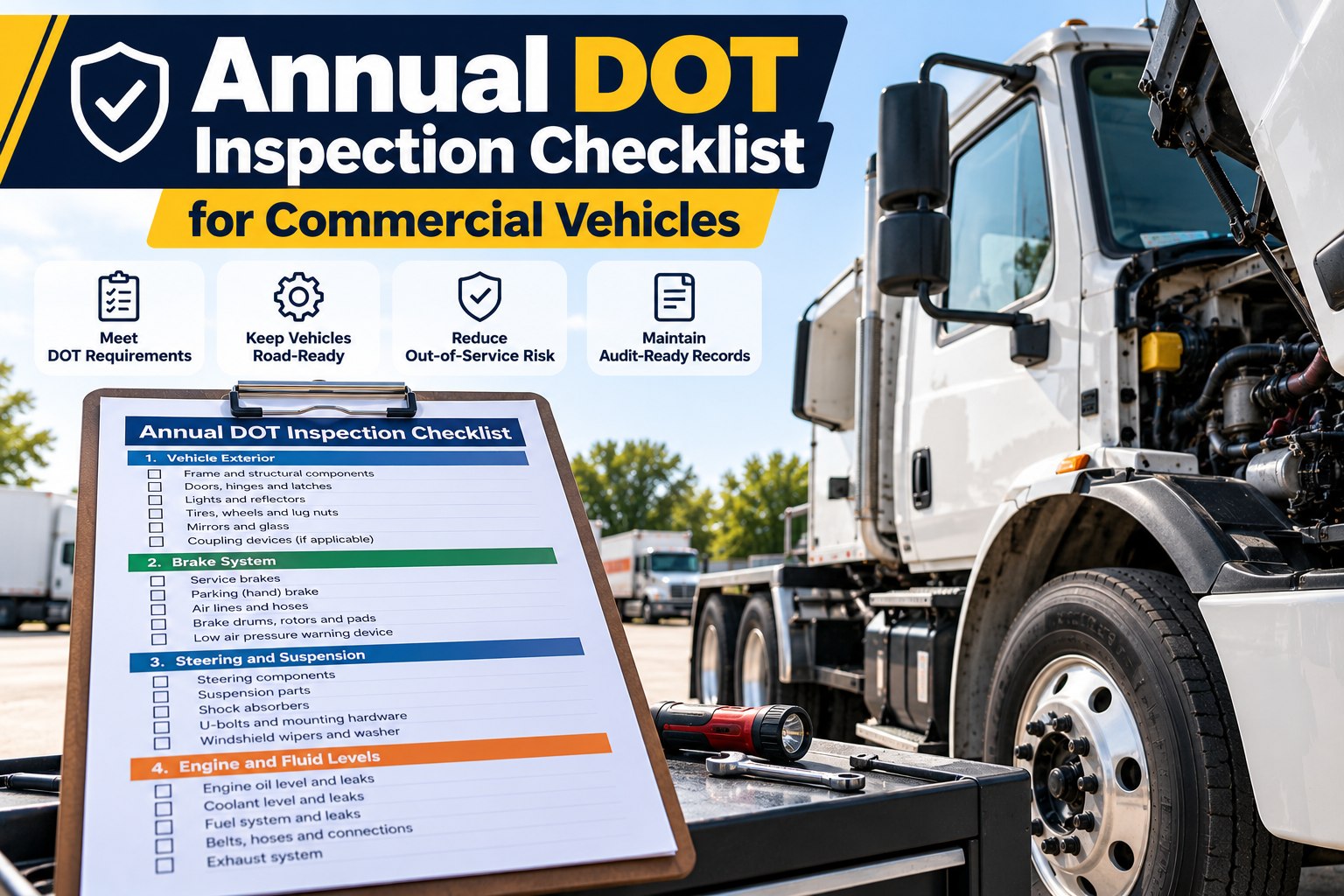
Annual DOT Inspection Checklist for Commercial Vehicles

By Sam Parker on October 9, 2026

The annual DOT inspection is a full inspection of every commercial motor vehicle, done at least once every 12 months by a qualified inspector against the standards in Appendix A to 49 CFR Part 396. It is separate from the driver's daily pre-trip, and it is the inspection that produces the report auditors ask for. This checklist covers the twelve sections of the standard with the numbers that decide pass or fail, the inspector qualifications, and the report fields to keep for 14 months. Schedule a call to put your annual inspection dates and reports in one place, or compare it with the daily pre-trip checklist.

ANNUAL DOT INSPECTIONS · SAFETY MANAGERS, SHOPS AND OWNER-OPERATORS
Twelve Months, One Report, Every Unit
An annual inspection only counts if it passed, was done by someone qualified, and can be shown on request. Here is the standard, the paperwork and the dates to track.
THE RULE AT A GLANCE
12
months between inspections, at most
1
inspection per unit, so a tractor and trailer need two
14
months to keep the report

When the Clock Runs Out

The 12 months run from the last day of the month the inspection was done, so a vehicle inspected on March 10, 2026 is covered through March 31, 2027. Use the month, not the day, when you set reminders. The example below is only an illustration.

Mar
2026
Inspected
Apr
2026

May
2026

Jun
2026

Jul
2026

Aug
2026

Sep
2026

Oct
2026

Nov
2026

Dec
2026

Jan
2027

Feb
2027

Mar
2027
Last day valid

Three Ways to Get It Done

IN-HOUSE
Your own qualified inspector
Allowed for most vehicles, if the person meets the inspector qualifications and you keep proof.
THIRD PARTY
A garage or fleet service
A commercial garage, leasing company or truck stop can act as your agent if it has the facilities and qualified inspectors.
STATE PROGRAM
A state periodic inspection
A passing state or equivalent program inspection counts, if it meets the federal minimums.

The Inspection Standard in Twelve Sections

These are the sections of Appendix A, each with the conditions that fail a vehicle. Tick a box only when the vehicle has been checked against it, and write down the measurement for any item near the limit.

1Brake system
FAILS IF
  • No braking action on a required axle
  • Stroke beyond the readjustment limit, such as 2 in. on a Type 30 clamp chamber
  • Air drum lining under 1/4 in. on non-steering axles
2Coupling devices
FAILS IF
  • Fifth wheel halves move more than 1/2 in.
  • Any crack in the assembly
  • Pintle hook horn worn down by more than 20%
3Exhaust system
FAILS IF
  • Leak forward of or directly below the driver or sleeper compartment
4Fuel system
FAILS IF
  • Any visible fuel leak
  • Missing fuel tank filler cap
5Lighting devices
FAILS IF
  • Any required lamp or reflector not working
6Safe loading
FAILS IF
  • Spare tire, load or dunnage that could fall onto the road
  • Cracked, loose or missing container securement devices
7Steering mechanism
FAILS IF
  • Free play over 2 in. (manual) or 4-1/2 in. (power) on a 16 in. wheel
  • Ball joint movement over 1/4 in.
  • Crack in the front axle beam
8Suspension
FAILS IF
  • Broken main spring leaf or deflated air suspension
  • Broken or missing U-bolt or spring hanger that shifts an axle
9Frame
FAILS IF
  • Cracked, broken, loose or sagging member
  • Loose or missing fasteners on engine, steering gear, suspension or fifth wheel
10Tires
FAILS IF
  • Steering tire under 4/32 in. of tread
  • Any other tire under 2/32 in.
  • A flat or noticeably leaking tire
11Wheels and rims
FAILS IF
  • Cracked or broken wheel
  • Elongated bolt holes
  • Loose, missing or stripped fasteners
12Windshield and wipers
FAILS IF
  • Crack wider than 1/4 in., or crossed by another crack
  • Inoperative wiper or a damaged power unit
Want the twelve sections built into your inspection form?
Tell us your fleet size and who inspects, and we will load the form with each section and a sign-off field.

Who Is Allowed to Sign

A pass is only valid if the inspector is qualified under 49 CFR 396.19. Check these four before the inspection, not after. Read the qualification rule.

  • Understands the Part 393 and Appendix A inspection criteria and can spot defective parts
  • Knows the methods, tools and equipment used in the inspection
  • Has a state or federal training certificate, or at least one year of combined training and experience
  • Qualification proof is on file for as long as they inspect for you, plus one year

What the Report Must Contain

The report under 49 CFR 396.21 is what you hand to an auditor. Keep the original or a copy for 14 months where the vehicle is housed or maintained. Read the report rule.

  • Name of the inspector
  • Name of the motor carrier
  • Inspection date
  • Vehicle identification
  • Components inspected and the result for each
  • Any component below the Appendix A standard
  • Inspector certification that the report is accurate and complete
  • Original or copy kept 14 months where the vehicle is housed

Annual, Pre-Trip and Roadside: Do Not Mix Them Up

Swipe the table horizontally on mobile.

← Swipe to see all columns →
InspectionDone byHow oftenRecord kept
Pre-trip and DVIRThe driverEach trip or dayDefect report, kept for 3 months
Annual inspectionA qualified inspectorAt least every 12 monthsInspection report, kept for 14 months
Roadside inspectionA state or federal officerRandom or targetedOfficer's report, sent to the carrier
Never Lose an Annual Report Between Inspections
FleetRabbit keeps each vehicle's inspection history, due dates and signed reports in one place, with reminders ahead of the month a unit expires. Daily DVIRs and annual reports sit side by side, so an auditor sees the whole file. Read the annual inspection rule.
Due-date reminders
Signed reports stored
One record per unit
DVIRs and annuals together

Frequently Asked Questions

What is an annual DOT inspection?
A full inspection of a commercial motor vehicle, done at least once in the preceding 12 months, against the minimum standards in Appendix A to 49 CFR Part 396. Read 49 CFR 396.17.
Does every vehicle need its own inspection?
Yes. Each unit in a combination counts separately, so a tractor and a semitrailer need one inspection each, and a full trailer needs a third.
What proof must be on the vehicle?
Either the inspection report or a sticker or decal showing the inspection date, who keeps the report, vehicle identification and a certification that the vehicle passed.
Can the carrier do its own inspections?
Yes, if the inspector meets the qualifications in 396.19. A carrier may also use a garage or fleet service as its agent, or rely on a passing state periodic inspection that meets the federal minimums.
How long are annual inspection records kept?
The report is kept for 14 months, at the place the vehicle is housed or maintained. Inspector qualification records are kept for as long as the person inspects for you, plus one year.
Is an annual inspection PDF enough?
A PDF works as a report template, but it does not remind you of due dates or keep reports with the vehicle. A digital record does both. Schedule a call to see how it works. For more detail, read our annual inspection fleet guide.
What does FleetRabbit cost?
FleetRabbit is free for up to three vehicles and $5 per vehicle per month after that. Start tracking your inspection records free.
Pass It Once, Prove It for 14 Months
The inspection takes a day. The record has to last more than a year. Keep both in one place, with the due date set before the month runs out.
Free tier for up to 3 vehicles · No credit card required · Reports stored with due dates

October 9, 2026By Sam Parker
All Blogs

Share This Story, Choose Your Platform!

From our blog

Get Fleet Rabbit App
#1 Truck Fleet Management Software

Download Our App
Scroll