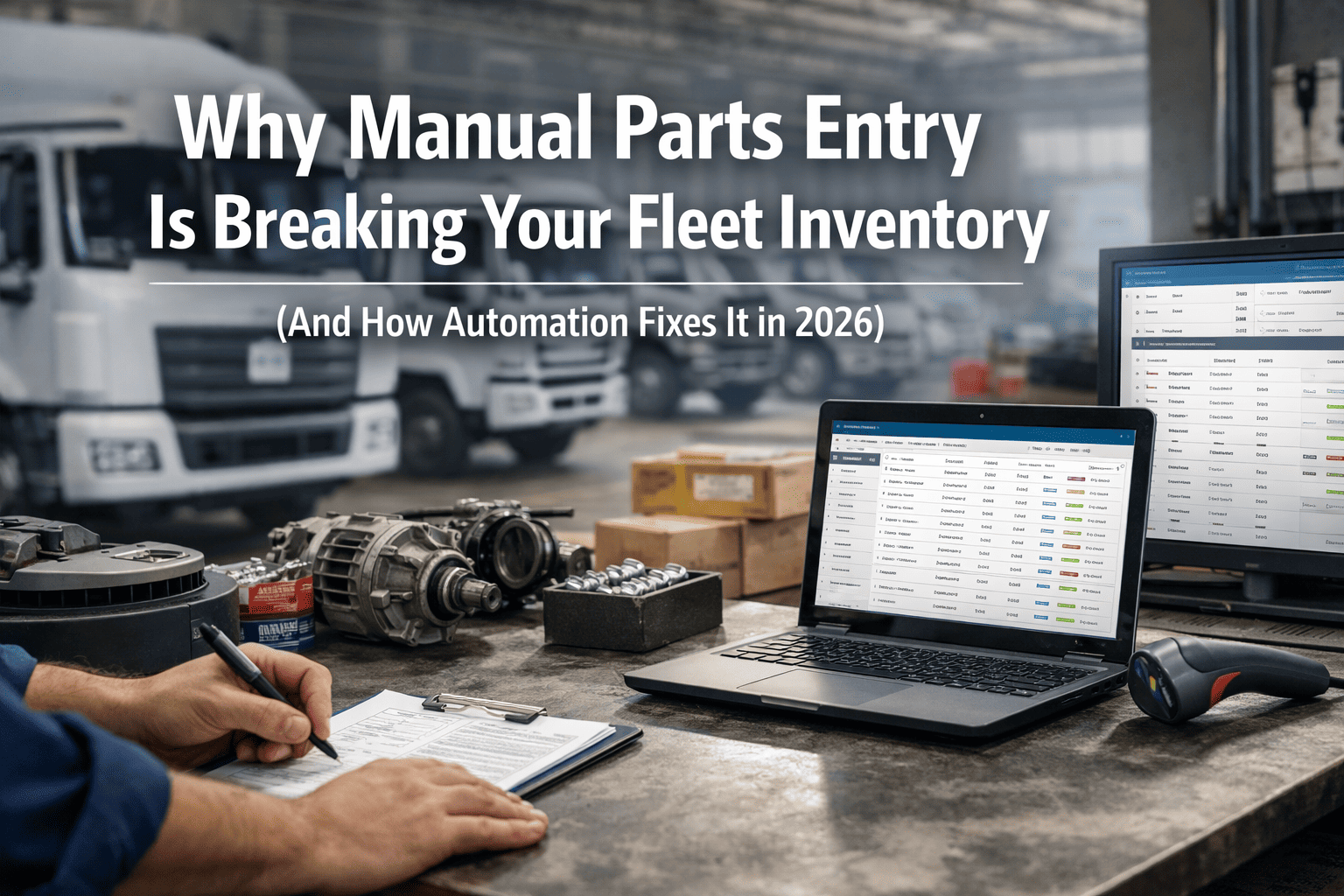
Every time a technician forgets to log a part—or logs it wrong,your fleet inventory management system drifts further from reality. Within weeks, your records show 8 brake pads while your shelf holds 2. This inventory mismatch is one of the biggest causes of fleet downtime and emergency orders, costing $448–$760 per day. Start automatic parts tracking free and see real-time inventory accuracy in action.
How Much Are Inventory Errors Costing YOUR Fleet?
What is Automatic Parts Deduction?
Automatic parts deduction instantly updates your fleet inventory the moment a technician adds parts to a work order. No manual entry, no delays, no human error. This is a core feature of modern fleet parts management software used to reduce downtime and improve inventory accuracy.
- Real-time sync between work orders and inventory
- Low-stock alerts triggered automatically
- Complete audit trail of every transaction
- Vehicle-level cost tracking built in
How One Forgotten Entry Cost Mike's Fleet $2,300 in a Single Week
This exact scenario plays out in fleets every week. With automatic parts deduction, the inventory would have updated instantly and triggered a reorder before the stockout.
The Error Cascade: How Manual Entry Destroys Accuracy
Most fleets rely on spreadsheets or disconnected systems that cannot track real-time parts usage across work orders and locations. Here's the chain reaction that happens with every manual,entry mistake. Learn more about fleet parts inventory automation.
Technician Uses Part
Brake pad installed on Vehicle #247
Entry Delayed
"I'll log it after lunch"
Another Tech Checks Stock
System shows 4 brake pads (wrong)
No Reorder Triggered
Threshold not met based on false count
Stockout Discovered
Vehicle #312 needs brake pads—shelf empty
Emergency Order + Downtime
Rush shipping + vehicle sidelined = $760 loss
Why Manual Parts Tracking Always Fails (It's Not Your Team's Fault)
This isn't about lazy technicians or bad processes. Human memory and manual data entry have fundamental limitations that no amount of training can fix. See how integrated work order management solves this at the system level.
Average delay between using a part and logging it: 4.2 hours. During that window, other decisions are made on wrong data.
Humans make 1-4 errors per 100 entries. At 500 parts transactions/month, that's 5-20 inventory ghosts created monthly.
"I'll log it later" has a 23% failure rate. Under time pressure, parts usage simply vanishes from the record.
When logging takes 3+ steps, compliance drops. Techs focused on repairs skip "administrative" tasks.
What Are You Using Now? (Honest Comparison)
The difference between manual tracking and automated fleet parts management systems is not just operational—it directly affects cost, uptime, and efficiency.
Excel / Google Sheets
- No real-time sync with work orders
- Manual entry required for every transaction
- No automatic reorder alerts
- Version conflicts between users
- No audit trail of changes
Paper / Clipboard
- Data lost, damaged, illegible
- Zero visibility until manual transfer
- No alerts possible
- Cannot search or analyze
- Compliance nightmare
Generic Inventory Software
- Not built for fleet operations
- No work order integration
- No vehicle-level tracking
- Requires manual workarounds
- Separate system to manage
FleetRabbit Auto-Deduction
- Instant sync when parts added to work orders
- Zero manual inventory entry needed
- Smart reorder alerts before stockouts
- Vehicle-level cost tracking built in
- Complete audit trail
How Automatic Parts Deduction Works
Automatic parts deduction works as part of a fleet parts management system that connects work orders, inventory, and procurement in real time. This integrates seamlessly with AI-powered predictive maintenance.
Work Order Created
PM schedule, DVIR, or breakdown triggers new work order
Parts Selected
Tech picks required parts from digital catalog
Instant Deduction
Stock counts update automatically—no manual step
Smart Alerts
Low-stock notifications fire before you run out
Results You Can Expect (Within 30 Days)
These results are based on fleets using automated inventory management systems across small to mid-sized operations. Most fleets see measurable improvement within the first week.
Fewer Stockouts
Near-elimination of emergency parts orders
Less Admin Time
From hours to minutes on inventory tasks
Saved Per Vehicle/Year
Downtime, emergency orders & admin costs eliminated
Inventory Accuracy
What your system shows matches your shelves
"We went from discovering stockouts the hard way to never being surprised. Last month we had zero emergency orders for the first time in 3 years. The ROI was obvious within the first two weeks."
Why FleetRabbit for Automatic Parts Deduction?
Not all inventory systems are built for fleet operations. Generic warehouse tools often fail to handle vehicle-specific parts tracking and maintenance workflows. FleetRabbit's inventory system was built specifically for fleet operations—parts deduction integrates directly with work orders, preventive maintenance schedules, and vehicle cost tracking.
No contracts. No setup fees. First 3 vehicles free forever. Cancel anytime.
Real-Time Sync
Parts deducted instantly—not batch processed overnight
Vehicle Cost Tracking
See exactly which trucks consume which parts
Results in 7 Days
See measurable improvement within your first week
Common Questions About Fleet Parts Automation
Automatic parts deduction improves fleet inventory accuracy by updating stock counts the moment parts are added to work orders—no delays, no manual steps. If you had 12 oil filters and added 2 to a work order, inventory now shows 10 instantly. This real-time sync eliminates the gap between actual usage and recorded inventory, achieving 99.96%+ accuracy compared to 96-99% with manual entry.
The system automatically restores the inventory count. If a tech removes 2 brake pads from a work order, those 2 pads are instantly credited back to inventory. The system maintains a complete audit trail of all changes—who changed what, when, the original value, and the new value—giving you full visibility into every transaction.
Yes. FleetRabbit tracks inventory across all locations with location-specific stock levels, reorder points, and alerts. When a technician at Location A uses parts, only Location A's inventory updates. You can view consolidated inventory across all sites or drill down to individual locations for precise stock management.
Most fleets see measurable improvement within 7 days and full ROI within 14-30 days. At $3/vehicle/month, you only need to prevent one $50 emergency shipping fee per vehicle per year to break even—and most fleets eliminate multiple emergency orders in their first month alone. The average fleet saves $3,400 per vehicle annually.
Every Week You Wait Costs Money
A 25-vehicle fleet loses approximately $1,635 per week to inventory errors, emergency orders, and downtime. That's $6,500+ per month—more than 50x the cost of solving the problem.
Fleet inventory accuracy is not just about tracking parts—it's about preventing downtime before it happens.
Stop Losing Money to Inventory Errors
Manual parts entry costs fleets $3,400+ per vehicle annually. See how automation eliminates these costs in a 15-minute demo—and get your personalized savings analysis.