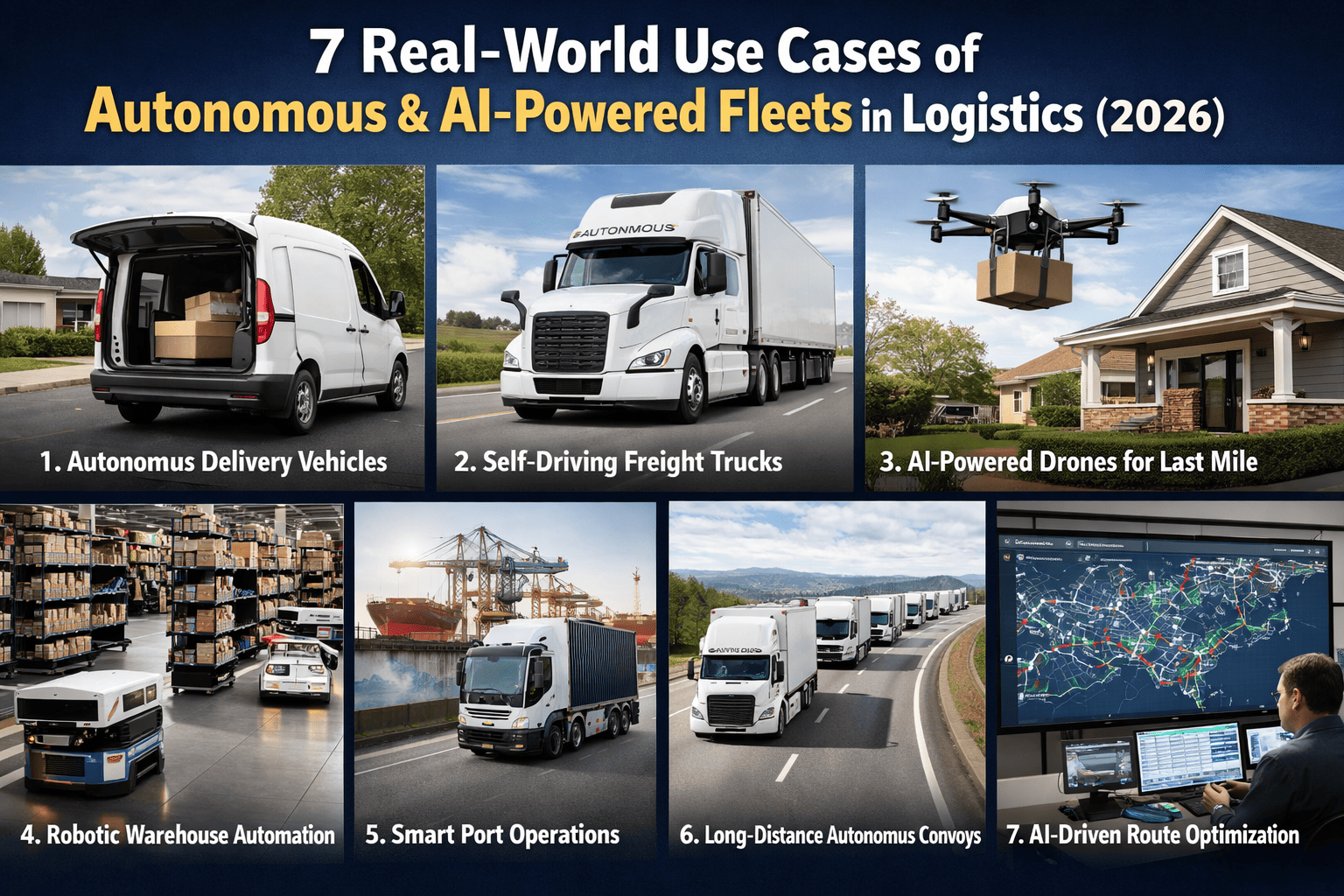
Autonomous and AI-powered fleets are no longer future concepts - they are operating today, delivering real results across logistics, retail, and healthcare. In 2026, Aurora's driverless trucks have logged 250,000+ miles with zero collisions. Zipline's drones completed 2 million autonomous deliveries. Walmart's AI-powered warehouses cut shipping costs by 30%. This guide showcases 7 proven use cases transforming fleet operations right now - with real companies, real numbers, and real ROI. Book a demo to see how AI can transform your fleet.
From driverless delivery vans to AI route optimization that cuts fuel by 15% - these are not pilots or demos. They are production systems running millions of miles across global supply chains.
The 7 Use Cases Transforming Fleet Operations
These are not experimental projects - they are commercially deployed systems with documented results. Each use case represents a different approach to autonomous fleet optimization, from fully driverless delivery vans to AI-powered route planning. For a deeper dive into AI capabilities, see our complete AI fleet management use cases guide.
Autonomous Delivery Vehicles
Driverless vans and box trucks handling middle-mile deliveries between distribution centers and retail stores on fixed, repeatable routes - 24/7 without driver fatigue.
Self-Driving Freight Trucks
Fully autonomous Class 8 semi-trucks operating on long-haul highway corridors, eliminating Hours of Service constraints and doubling asset utilization.
AI-Powered Drones for Last Mile
Autonomous drones delivering food, retail, and medical supplies within 10-mile radius in under 30 minutes - bypassing traffic and road infrastructure entirely.
Robotic Warehouse Automation
Autonomous forklifts, picking robots, and mobile robots transforming fulfillment centers with 24/7 operations, faster picking, and reduced labor dependency.
Smart Port Operations
AI-powered container terminals with autonomous straddle carriers, automated guided vehicles (AGVs), and intelligent crane systems orchestrating cargo movement.
Long-Distance Autonomous Convoys
Truck platooning technology where a lead human driver guides multiple follower trucks that drive autonomously, reducing fuel consumption and extending driver capacity.
AI-Driven Route Optimization
Machine learning algorithms that continuously optimize delivery routes based on real-time traffic, weather, delivery windows, and vehicle capacity - adapting faster than any human dispatcher.
Which Use Case Fits Your Fleet?
You do not need autonomous trucks to benefit from AI today. FleetRabbit delivers AI route optimization, predictive maintenance, and fuel intelligence starting at $3/vehicle/month - the capabilities every fleet can implement now. Free for up to 3 vehicles.
The ROI Reality: What AI Fleet Management Actually Delivers
Autonomous and AI-powered fleet systems are not just technically impressive - they deliver documented financial returns. Here is what the data shows across different implementation types. For more on calculating your potential savings, explore our fleet ROI calculator guide.
Plus 15-20% more stops per day with AI-powered routing.
Within 12-18 months. Most fleets see payback in 44 days.
24/7 operation without HOS limits, rest breaks, or fatigue.
Shipping costs down 30% with automated fulfillment systems.
How to Start: The Practical AI Adoption Path
Most fleets do not jump straight to autonomous trucks. They follow a proven adoption path that builds data infrastructure while delivering immediate ROI. Learn more about implementation in our predictive maintenance guide.
- AI-driven route optimization (10-15% fuel savings)
- Predictive maintenance (89% accuracy)
- Digital DVIR and compliance automation
- Driver safety coaching
- Automated dispatch decisions
- Demand forecasting
- Warehouse automation integration
- GenAI fleet assistants
- Autonomous delivery vehicles
- Self-driving freight trucks
- Truck convoy platooning
- End-to-end supply chain AI
Why 2026 Is the Right Time to Start
Three forces are converging to make AI fleet adoption both urgent and accessible. For a comprehensive look at autonomous integration, see our autonomous truck fleet guide.
The US faces an 80,000+ truck driver shortage with average driver age of 46-47. AI extends existing workforce capacity through efficiency gains and convoy platooning.
70% of new fleet software is cloud-based. AI capabilities like route optimization that required enterprise budgets are now accessible to any fleet size.
FleetRabbit delivers AI route optimization, predictive maintenance, and analytics starting at $3/vehicle. No contracts. No hardware required.
Frequently Asked Questions
AI-driven route optimization (Use Case 7) delivers the fastest ROI for most fleets - typically 44 days average payback. Unlike autonomous vehicles requiring regulatory approval and infrastructure, route optimization works with your existing fleet and delivers 10-15% fuel savings immediately. Predictive maintenance is the second-fastest, preventing breakdowns that cost $760+ in direct repairs.
No. Use Cases 4 and 7 (warehouse robotics and AI route optimization) require zero autonomous vehicles. You can implement AI route optimization, predictive maintenance, and driver safety coaching today with your existing fleet. 89% of enterprise fleets using AI focus on these foundational capabilities, not autonomous vehicles.
Fleets of any size benefit from AI route optimization and predictive maintenance. Small fleets under 25 vehicles often see higher percentage ROI because one prevented failure has immediate impact on tight margins. FleetRabbit is free for up to 3 vehicles, making AI accessible to owner-operators without enterprise budgets.
Self-driving freight trucks (Use Case 2) are live now on specific Sun Belt corridors. Aurora targets 200+ trucks by end of 2026. Autonomous convoys (Use Case 6) are closer to mainstream adoption since they still use a human lead driver. For most fleets, the key is building AI data infrastructure now to be ready when autonomous capacity reaches your routes.
Start Your AI Fleet Journey Today
65% of fleet managers plan to implement AI by 2027, but only 27% currently use it. Early adopters are capturing competitive advantages that compound over time. FleetRabbit gives you AI route optimization, predictive maintenance, and smart analytics - capabilities you can implement today while autonomous technology matures.