The most expensive mistake on a diesel EGR fault is fitting a new valve to an engine whose passages are still packed with carbon. It happens constantly, because a scan tool reports an EGR flow problem and the valve is the obvious part to blame — but a new valve does not help if the passages, cooler and intake are clogged, and the code returns within weeks. Cleaning is reported to resolve roughly half of EGR faults outright, since on a soot-loaded diesel the valve is frequently mechanically sound underneath the deposits. The decision worth getting right is not which brand of valve to buy. It is whether this valve needs cleaning, replacing, or nothing at all because the actual fault is somewhere else in the system. Start free with three vehicles and record which it turned out to be.
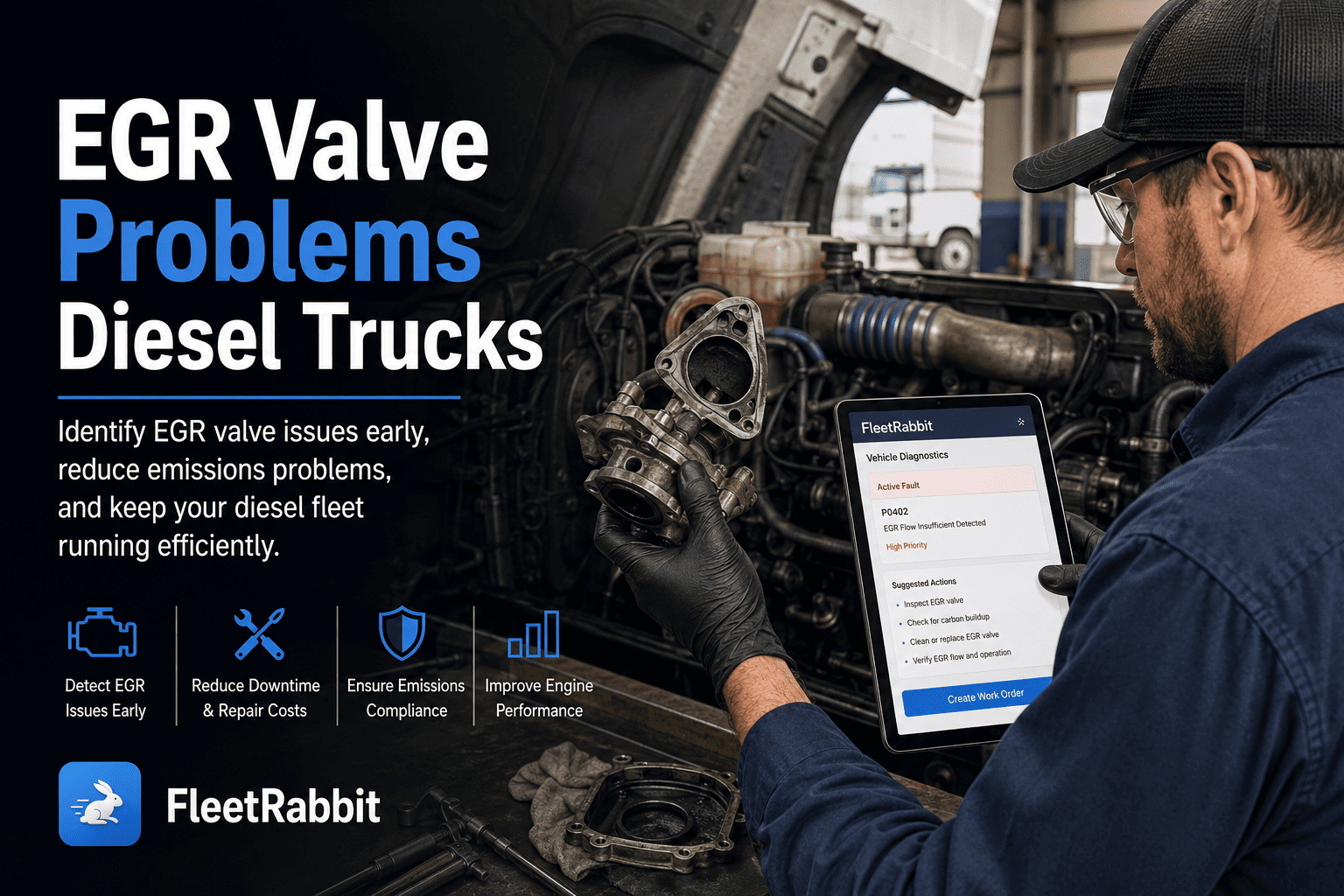
EGR Valve Problems in Diesel Trucks
The symptoms that point at the valve, the test that decides between cleaning and replacing, why a new valve so often fails to clear the code, and the parts of the job most shops leave out.
Which Side of the Fork Are You On?
The distinction is mechanical, not diagnostic. A dirty valve and a failed valve produce similar codes and very different bills.
| Finding | What it means | Action |
|---|---|---|
| Heavy carbon, flap moves freely once cleared | The valve is restricted rather than failed — soot has simply narrowed the flow path | Clean the valve, passages, cooler and manifold |
| Commanded position matches actual position | The valve is doing what it is told, so the fault is elsewhere in the system | Stop. Investigate cooler, wiring, intake and boost before touching the valve |
| Failed motor, sensor or electrical fault | Cleaning cannot repair any of these, however thorough | Replace |
| Cracked housing, worn seat, seized or wobbly flap | Mechanical damage beyond deposit buildup | Replace |
| Unexplained coolant loss alongside the code | Points at the cooler rather than the valve entirely | Pressure-test the cooling system before ordering any EGR part |
The Valve Is Only Half the Job
The single most common reason a repaired EGR fault comes back within weeks.
Why It Clogs, and What You Control
Five drivers of soot accumulation. Four of them are duty-cycle decisions rather than mechanical faults, which makes them a fleet problem rather than a workshop one.
Short-trip duty, extended idle and interrupted regenerations all show up in fleet data long before a code does. Fleet Rabbit brings telematics fault codes into the same queue as inspection defects and repair history, so a unit producing its second EGR fault in a year is visible as a pattern with the first repair's findings attached — rather than as a fresh diagnosis starting from nothing.
What It Costs
Published 2026 ranges. Diesel sits at the top of every band, and the cooler is the line that moves the total most.
| Item | Reported range | What drives it |
|---|---|---|
| Cleaning, done in-house | Materials in single figures, plus labour to remove and refit | Solvent and a brass brush. Reported to resolve around half of EGR faults outright |
| Cleaning, professionally | Broadly the equivalent of $90–$230 | Remove, decarbonise and refit — still well below replacement on most platforms |
| Valve, aftermarket | Roughly $60–$150 | Cheap aftermarket valves are specifically reported as failing early — a false economy on an awkward-access part |
| Valve, original equipment | Roughly $150–$500 | Electronic valves cost more than older vacuum-controlled designs |
| Labour | Roughly $100–$400 | Four bolts and a connector on an accessible valve; one to two hours where it sits under the intake |
| EGR cooler | Roughly $300–$800 on top | Often fails alongside the valve on diesels, and integrated cooler-valve units push the total higher again |
| Diesel truck, all in | Commonly $200–$700, exceeding $1,000 where a cooler or heavy carbon cleaning is involved | Access, soot load, and whether the cooler and intake need service at the same time |
The Coolant Tell
One symptom changes the diagnosis entirely, and it is easy to miss because it does not present as an EGR problem.
On Deleting It
Worth stating clearly, because the suggestion comes up in every workshop conversation about repeat EGR faults.
Preventive Handling
Four measures. There is no universal cleaning interval, so the trigger has to be condition and duty cycle rather than a fixed number.
Frequently Asked Questions
Rough idle, hesitation, reduced power, poor fuel economy, excessive smoke and a check engine light, along with failed emissions testing. Which symptoms appear depends on the failure direction — stuck closed raises combustion temperatures and NOx, while stuck open floods the intake, kills throttle response and contaminates the oil. Carbon accumulates in only one direction, which is why restricted flow is by far the more common fault.
Clean when the valve is dirty but mechanically sound — restricted by soot and oily deposits rather than broken. Replace when the motor, sensor or internal mechanism has failed, or where the housing is cracked, the seat worn, or the flap seized. Cleaning cannot repair a failed motor, damaged sensor or electrical fault however thorough it is. Cleaning is reported to resolve around half of EGR faults, so on a soot-loaded diesel it is the sensible first move.
Most often because the passages, cooler or intake manifold were still clogged — a new valve does not help if the flow path around it is restricted. Guidance is consistent that the valve is only half the job and the pipe, cooler and manifold need cleaning at the same time. The other possibility is that the valve was never the fault: if commanded position matched actual position, the problem was elsewhere in the system all along.
Published 2026 ranges put valve replacement broadly at $200 to $700, with diesel trucks and engines carrying EGR coolers exceeding $1,000. Aftermarket valves run roughly $60 to $150 and original equipment $150 to $500, with labour between $100 and $400 depending on access. An EGR cooler adds roughly $300 to $800 on top. Cleaning costs a fraction of any of that. Ask for the diagnostic charge, part, labour, gaskets and coolant itemised separately.
Stop replacing valves and pressure-test the cooling system. Unexplained coolant loss alongside EGR faults points at the cooler, and published guidance is direct that a cooler leak needs its own diagnosis rather than another valve. This matters beyond the repair cost — cooler clogging has been linked to elevated combustion temperatures and higher head gasket failure risk, so a deferred emissions repair can become an engine repair.
There is no universal interval. Inspect when symptoms, flow codes or the manufacturer's service information indicate deposits. Some soot-heavy diesel operations pull the valve and cooler for cleaning somewhere in the 60,000 to 100,000 mile range, but duty cycle matters more than mileage — short trips, extended idling, interrupted regenerations, oil vapour and poor fuel all accelerate buildup, while highway running slows it without eliminating the risk of actuator or sensor failure.
Not on a road vehicle. Blocking or removing the system defeats an emissions control and violates federal law, with equivalent prohibitions elsewhere. It also triggers fault codes and is obvious the moment the truck is emissions tested. And it costs you the check engine light as a warning system for everything else on the engine. For a specific code walkthrough, see our P0401 and P0402 diagnostic guide.