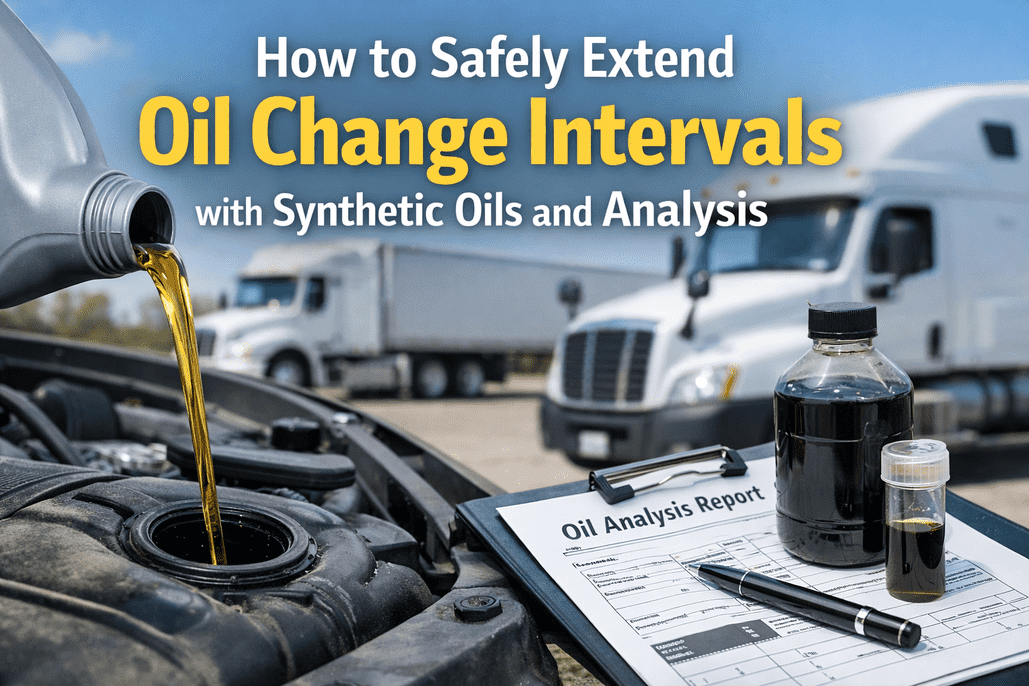
The idea that every truck in your fleet needs an oil change at exactly 25,000 or 35,000 miles is costing you money on both ends. Trucks running efficient long-haul routes with low idle time and consistent loads are getting pulled into the shop with oil that still has 30-40% of its useful life remaining. Meanwhile, vocational trucks idling 40-50% of the time are running degraded oil that is damaging bearings and cylinder liners 5,000 miles before their scheduled service. Synthetic oils combined with oil analysis programs give fleet managers the data to safely extend intervals on trucks where the oil supports it - and shorten intervals on trucks where it does not. The result is fewer unnecessary oil changes, longer engine life, lower total cost per mile, and zero guesswork. Cummins is now targeting 100,000-mile oil drain intervals on the 2027 X15 engine using data-driven oil life monitoring. Volvo offers 60,000-mile intervals on D11 and D13 engines with approved synthetic oils. The technology exists - the question is how to implement it safely in your fleet without risking engine damage or voiding warranties. Track oil analysis results and optimize intervals with FleetRabbit.
Why Synthetic Oils Enable Longer Intervals
Not all engine oils degrade at the same rate. Conventional mineral-based oils begin breaking down under heat and oxidation faster than synthetic oils because their molecular structure is irregular and less thermally stable. Synthetic oils are engineered with uniform molecular chains (Group IV polyalphaolefins or Group V esters) that resist thermal breakdown, maintain viscosity under stress, and hold their additive packages longer. This fundamental chemistry difference is what makes extended oil drain intervals possible - but only when combined with verification through oil analysis.
OEM Extended Drain Programs
Engine manufacturers have invested heavily in data collection and testing to support longer oil drain intervals for modern engines. These are not theoretical numbers - they are OEM-backed, warranty-covered intervals that have been validated through millions of miles of real-world fleet testing. However, each program has specific requirements for oil specification, oil analysis participation, and duty cycle qualification that must be met.
Track Every OEM Interval Across Your Entire Fleet
FleetRabbit stores OEM-specific extended drain requirements, tracks oil analysis results, and automatically adjusts service schedules based on each truck's qualified interval - even in mixed fleets with multiple engine platforms.
Oil Analysis: The Safety Net for Extended Drains
No fleet should extend oil drain intervals without oil analysis. Period. Oil analysis is the only way to verify that the oil in a specific engine, operating under that truck's specific duty cycle, is actually safe to run beyond the standard interval. It costs $15-$40 per sample and provides data worth thousands in prevented failures and validated savings. Here is what a comprehensive oil analysis report tells you and how to interpret the results for interval decisions.
The Graduated Extension Method
The safest way to extend oil drain intervals is to do it gradually, in controlled increments, with oil analysis verification at every step. Never jump from 25,000 miles to 60,000 miles in one move. Instead, use the graduated extension method that OEMs and oil analysis labs recommend for fleet implementation.
Sample oil at your current scheduled change interval for 2-3 consecutive services on each truck. This establishes a baseline for wear metals, TBN, soot, viscosity, and contamination levels. If oil analysis at your current interval shows the oil still has significant remaining life (TBN above 5.0, viscosity within 10% of baseline, soot below 2%), the data supports extending.
Add 5,000-10,000 miles to your interval and sample at the new change point. Compare results to your baseline. If wear metals have not increased proportionally beyond what the extra mileage would predict, TBN remains above 4.0, and no contamination is present, the extension is validated. If any parameter is trending toward the condemning limit, hold at this interval.
If the first extension results are clean, add another 5,000 miles. Continue sampling at every change. At this point, consider adding a mid-interval sample (halfway through the drain) to catch any rapid degradation events between changes. The mid-interval sample is especially important for trucks that may experience duty cycle changes.
After 3-4 cycles of graduated extension with consistently clean analysis results, you have established the optimal safe interval for that duty cycle group. Document the validated interval, continue sampling at every oil change for ongoing verification, and reduce to every-other-change sampling only after 6+ consecutive clean results. FleetRabbit automates this graduated extension tracking with built-in analysis result monitoring.
Cost Savings Model: 50-Truck Fleet
Here is what happens financially when a 50-truck linehaul fleet extends its oil change interval from 35,000 miles to 50,000 miles using synthetic oil and oil analysis verification. These numbers use conservative assumptions based on Class 8 diesel trucks running 120,000 miles per year.
See Your Real Savings Before You Commit
FleetRabbit tracks per-service and per-mile oil costs across your fleet so you can model extended drain savings with your actual numbers - not hypothetical calculations. Start your free trial.
Safety Guardrails: When Not to Extend
Extended drain intervals are not appropriate for every truck or every duty cycle. Some operating conditions degrade oil so rapidly that even premium synthetic oils cannot safely reach extended intervals. Here are the non-negotiable guardrails that should override any cost-saving ambition.
Idle Time Exceeds 30%
High-idle trucks burn fuel that dilutes oil and generate soot without proportional mileage accumulation. A dump truck idling 45% of the time at 25,000 miles has engine wear equivalent to a highway truck at 40,000+ miles. Use engine hours as the primary interval trigger, not mileage, for high-idle applications.
Oil Analysis Shows Contamination
Any trace of sodium or potassium (coolant contamination), fuel dilution above 2-3%, or water content above 0.1% means the oil must be changed immediately regardless of mileage. These contaminants cause exponential damage the longer they circulate. Do not wait for the next scheduled change.
Wear Metal Trends Are Rising
Individual wear metal readings mean less than the trend across consecutive samples. If iron is climbing from 45 to 55 to 70 ppm over three samples, the engine is telling you something is wearing abnormally - even if no single reading exceeds the alarm limit. Do not extend intervals on a truck with rising wear trends until the source is diagnosed.
Severe Dust or Construction Environments
Trucks operating in dusty conditions (quarries, construction sites, unpaved roads) experience elevated silicon contamination from abrasive particles that bypass air filtration. This dirt accelerates cylinder liner, ring, and bearing wear. Shorten intervals rather than extend them for dust-exposed trucks, and inspect air filters at every PM.
Engine is Past 500,000 Miles Without Overhaul
High-mileage engines have increased blow-by, wider bearing clearances, and greater oil consumption. While synthetic oil benefits these engines, the increased contamination rate from worn components often prevents safe interval extension. Keep standard or slightly shortened intervals on pre-overhaul engines and use oil analysis primarily for engine health monitoring rather than interval extension.
Go / No-Go Decision Matrix
Use this decision matrix at every oil analysis result to determine whether to maintain, extend, or shorten the drain interval for each truck.
Frequently Asked Questions
Not if you follow the engine manufacturer's extended drain program requirements. Cummins OilGuard, Detroit Connect Analytics, Volvo Premium Oil Program, and Navistar's extended drain programs all allow intervals well beyond the standard 25,000-35,000 miles with full warranty coverage maintained. The key requirements are using OEM-approved synthetic oil, participating in an oil analysis program with samples submitted at prescribed intervals, and meeting the duty cycle qualifications for the extended interval. What voids the warranty is extending intervals arbitrarily without OEM approval or oil analysis verification.
Oil analysis programs have very low startup costs. Most labs including Blackstone Laboratories and POLARIS Laboratories provide free sample kits with prepaid shipping. Analysis costs run $15-$40 per sample depending on the lab and test package. For a 50-truck fleet sampling at every oil change (120-170 services per year), the total annual analysis cost is $1,800-$6,800. This investment pays for itself many times over through extended intervals, prevented failures, and validated warranty compliance. FleetRabbit integrates with lab results for automated interval tracking.
Synthetic or synthetic-blend oil is strongly recommended for intervals above 35,000 miles. Conventional Group I/II oils degrade through oxidation and shear more rapidly than synthetic Group III+ or Group IV oils, limiting their safe service life. Most OEM extended drain programs either require or recommend synthetic formulations. Cummins CES 20092 (their premium extended drain spec) effectively requires synthetic-quality base stocks. Detroit's preference for FA-4 10W-30 is inherently a synthetic product. While conventional CK-4 15W-40 is technically approved for standard intervals, synthetic oils are what make intervals of 50,000-80,000+ miles possible.
During the initial extension phase, sample at every oil change. For OEM programs like Cummins OilGuard at 80,000-mile targets, Cummins requires samples every 10,000 miles throughout the drain. For graduated self-directed extensions, sample at the current change point and add a mid-interval sample when extending beyond 40,000 miles. Once you have established a validated interval through 4-6 consecutive clean results, you can reduce to sampling at every oil change (which is already less frequent due to the extended interval). Never stop sampling entirely - the ongoing verification is what protects your engines and warranties.
Yes. FleetRabbit supports condition-based oil change scheduling by integrating telematics data (mileage, engine hours, idle percentage), oil analysis lab results, and OEM-specific interval requirements. The platform stores each truck's qualified interval, triggers service alerts based on the correct parameter (miles, hours, or analysis result), tracks the graduated extension process, and maintains complete documentation for warranty and audit purposes. For mixed fleets with different engine platforms and different qualified intervals, FleetRabbit manages each truck's schedule individually while providing fleet-wide compliance visibility. Start your free trial to see how it works.
Extend Intervals Safely. Save Confidently.
FleetRabbit gives you the data infrastructure to extend oil drain intervals with full confidence - tracking analysis results, validating extensions, and protecting your engines and warranties across every truck in your fleet.