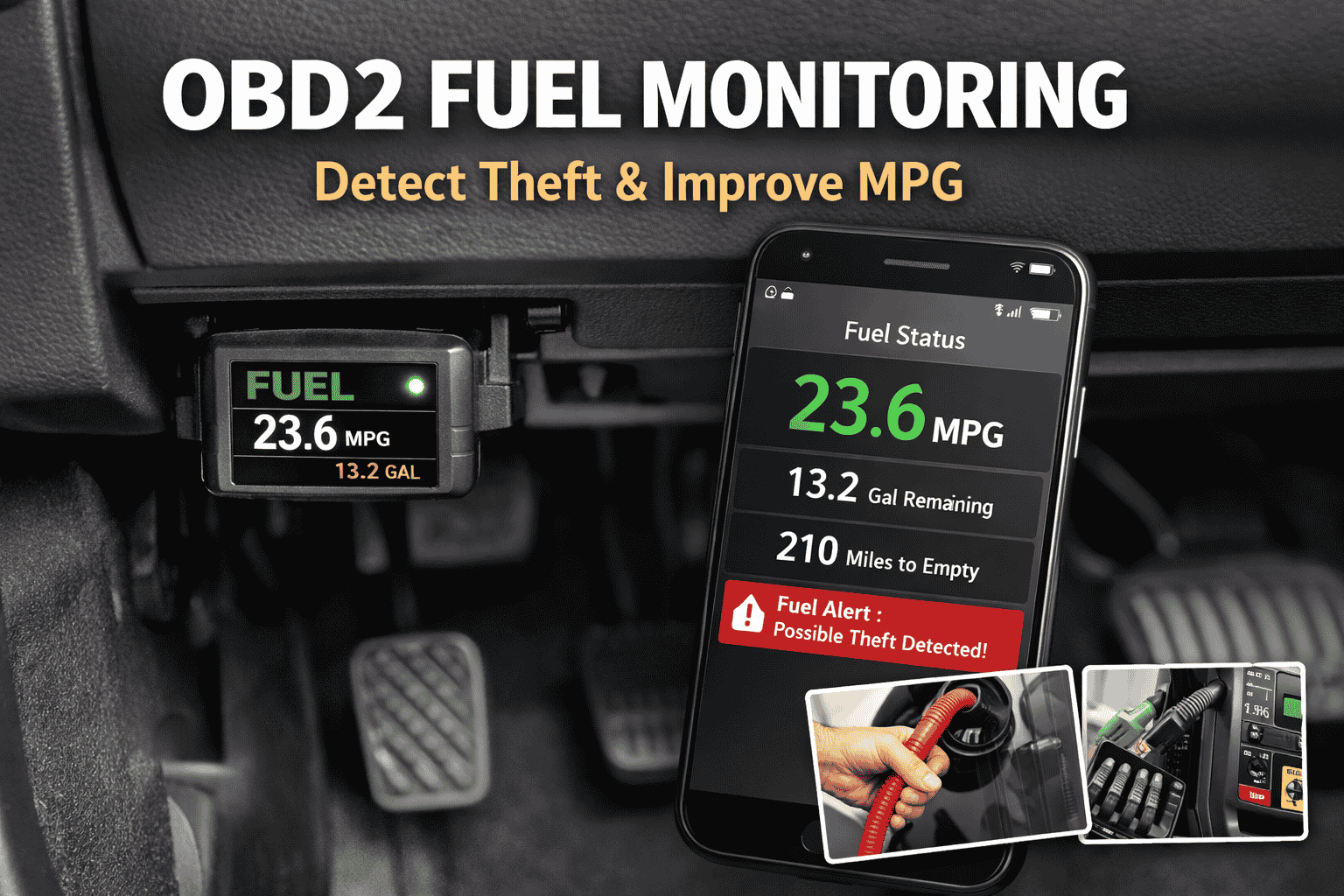
Your OBD2 port transmits over 300 real-time parameters every second including the exact fuel consumption data that reveals where your money is going. Fleets using OBD2 fuel monitoring save 10-25% on fuel costs by catching theft, eliminating waste, and optimizing every mile. The difference between losing 6-15% of your fuel budget to invisible theft and achieving 95% theft detection? A $15-50 plug-and-play device that pays for itself in 30 days.
See Every Drop. Stop Every Loss.
Traditional fuel monitoring relies on receipts, dipsticks, and monthly reconciliation — discovering theft weeks after it happened. OBD2 fuel monitoring captures real-time consumption data directly from your engine's computer, detecting anomalies within seconds and providing evidence packages with GPS coordinates, timestamps, and driver identification.
Start tracking fuel consumption free with FleetRabbit's plug-and-play OBD2 solution.
How OBD2 Fuel Monitoring Works
Every vehicle manufactured after 1996 contains a diagnostic port that communicates directly with the Engine Control Unit (ECU). This 16-pin connector — located under your dashboard — provides access to real-time engine data that reveals exactly how fuel is being consumed, wasted, or stolen.
OBD2 Device
Plug-and-play device connects to your diagnostic port in 30 seconds
ECU Data Stream
Captures RPM, fuel flow, engine load, throttle position in real-time
AI Analysis
Machine learning calculates consumption, detects anomalies, scores efficiency
Instant Alerts
Real-time notifications for theft, unusual consumption, or fuel events
The 6 OBD2 Parameters That Reveal Fuel Truth
Not all OBD2 data matters for fuel monitoring. These six parameters — learn to read them in our complete guide — provide everything needed to calculate consumption, detect waste, and catch theft:
Engine RPM
Revolutions per minute indicate engine speed and load conditions. High idle RPM (above 1,000) wastes fuel. Erratic readings suggest fuel delivery problems.
MAF Sensor (Mass Air Flow)
Measures air entering the engine — the primary input for calculating instantaneous fuel consumption. Directly correlates to fuel being burned.
Engine Load
Percentage of maximum engine capacity being used. High sustained load indicates heavy cargo, aggressive driving, or mechanical problems increasing consumption.
Throttle Position
Percentage of throttle opening. Aggressive acceleration (rapid throttle changes) wastes 15-25% more fuel than smooth driving.
Fuel Trim (Short and Long)
Shows how ECU adjusts fuel delivery. Values beyond 15% indicate vacuum leaks, failing sensors, or injector problems that hurt economy.
Fuel Level
Real-time tank percentage from vehicle sensor. Comparing fill-ups against consumption calculations reveals theft, leaks, or card fraud.
Start Reading Your Fleet's Fuel Data Today
FleetRabbit's OBD2 integration captures all 6 critical parameters automatically, with AI analysis that turns raw data into actionable fuel insights.
Fuel Theft Detection: From Weeks to Seconds
Fuel theft costs commercial fleets 6-15% of their total fuel budget annually. Traditional methods discover theft during monthly reconciliation — weeks after the fuel and money are gone. OBD2 monitoring catches theft the moment it happens. Here's how different theft methods are detected:
Siphoning
35% of theftPhysical extraction during overnight parking or remote stops. Modern pumps extract 50+ gallons in minutes.
Card Fraud
40% of theftUnauthorized purchases, buddy fueling, or filling personal vehicles and containers on company cards.
Buddy Fueling
15% of theftDriver fills company vehicle then uses same transaction to fill personal vehicle or friend's tank.
Internal Abuse
10% of theftPersonal use of company vehicles, unauthorized trips, or excessive idling that consumes fuel without productive work.
Your Fuel Savings Breakdown
OBD2 fuel monitoring delivers ROI through multiple channels. For a 25-vehicle fleet spending $500,000 annually on fuel, here's the typical savings breakdown — calculate your specific numbers:
What Per-Vehicle Analytics Reveals
OBD2 data transforms into actionable vehicle-by-vehicle fuel intelligence. Instead of fleet-wide averages that hide problems, you get individual MPG tracking for every truck, consumption trends over time, and efficiency scoring that reveals exactly which vehicles and drivers need attention.
Individual MPG Tracking
See exact fuel efficiency for each vehicle, not just fleet averages. Identify your best and worst performers instantly.
Efficiency Scoring
Automatic A-D grades for each driver based on fuel consumption, idling, and driving behavior patterns.
Trend Analysis
Track MPG changes over weeks and months. Spot gradual efficiency drops that indicate maintenance needs.
Coaching Alerts
Automatic flags when a vehicle falls 15%+ below fleet average, with specific behavior recommendations.
Fleet-Wide vs Per-Vehicle Monitoring
Get Your Fleet's Real MPG Numbers
FleetRabbit shows per-vehicle fuel efficiency in real-time, automatically flagging underperformers and identifying coaching opportunities that save thousands annually.
5-Minute Installation Guide
OBD2 fuel monitoring requires zero technical expertise. The diagnostic port is standardized across all vehicles manufactured after 1996 (gasoline) and 2008 (diesel). Here's the complete setup process:
Locate the OBD2 Port
Under the dashboard, typically near the steering column within 2 feet of the driver. Some vehicles have it behind a small cover panel. Check your owner's manual for exact location.
Plug In the Device
Insert the OBD2 tracker firmly into the port until it clicks. The device powers on automatically — no batteries or wiring required. LED indicators confirm connection.
Connect to Platform
Device automatically transmits data via cellular network to your FleetRabbit dashboard. Vehicle appears in your fleet within 60 seconds of installation.
Start Monitoring
Real-time fuel consumption, MPG calculations, and anomaly detection begin immediately. Historical data builds over first 7 days to establish baseline patterns.
Vehicle Compatibility
Frequently Asked Questions
Modern OBD2 fuel monitoring achieves 90-95% accuracy using machine learning algorithms that analyze MAF sensor data, RPM, engine load, and throttle position together. Research shows Random Forest and neural network models outperform traditional ECU calculations, with MAPE (Mean Absolute Percentage Error) below 10% for fuel consumption rate. The system calibrates to each vehicle over the first week, improving accuracy as it learns the specific engine characteristics.
No. OBD2 tracking devices only read data from the vehicle's computer — they don't write commands or modify any settings. The device operates identically to a mechanic's diagnostic scanner. No OEM has voided a warranty for OBD2 tracker use, and the devices draw minimal power (typically under 0.5 watts) that doesn't affect battery life or vehicle performance.
Quality OBD2 trackers include tamper detection. When power is disconnected, the system immediately sends an alert via SMS and email with last known GPS location. Many devices include a backup battery that continues tracking for several hours after disconnection, allowing you to locate and recover the vehicle. Unauthorized removal attempts create an audit trail with timestamps.
Yes. Diesel vehicles from 2008+ use the same standardized OBD2 port. For heavy-duty commercial trucks, devices supporting SAE J1939 protocol access even more detailed fuel data including fuel rate, engine hours, and PTO status. For older equipment without OBD2, separate fuel level sensors can be installed that integrate with the same monitoring platform.
Fuel card monitoring tracks transactions but cannot verify fuel actually entered your fleet vehicle. Buddy fueling appears as legitimate purchases. OBD2 monitoring measures actual fuel level changes and consumption, then cross-references with card transactions to catch discrepancies instantly. Combined, they achieve 95%+ fraud detection versus 30-40% with cards alone.
Join fleets saving $1,200+ per vehicle annually with OBD2 fuel monitoring. Plug-and-play setup in 30 seconds, real-time theft detection, and per-vehicle analytics that pay for themselves in 30 days.