At the end of every shift, your drivers have 5 minutes to catch defects before they become breakdowns, violations, or accidents. FMCSA estimates proper DVIRs prevent 14,000 accidents annually yet only 7% of carriers pass compliance reviews without a DVIR violation. The gap between safe fleets and vulnerable ones? A systematic post-trip inspection process that actually works.
End-of-Day Inspections That Actually Catch Problems
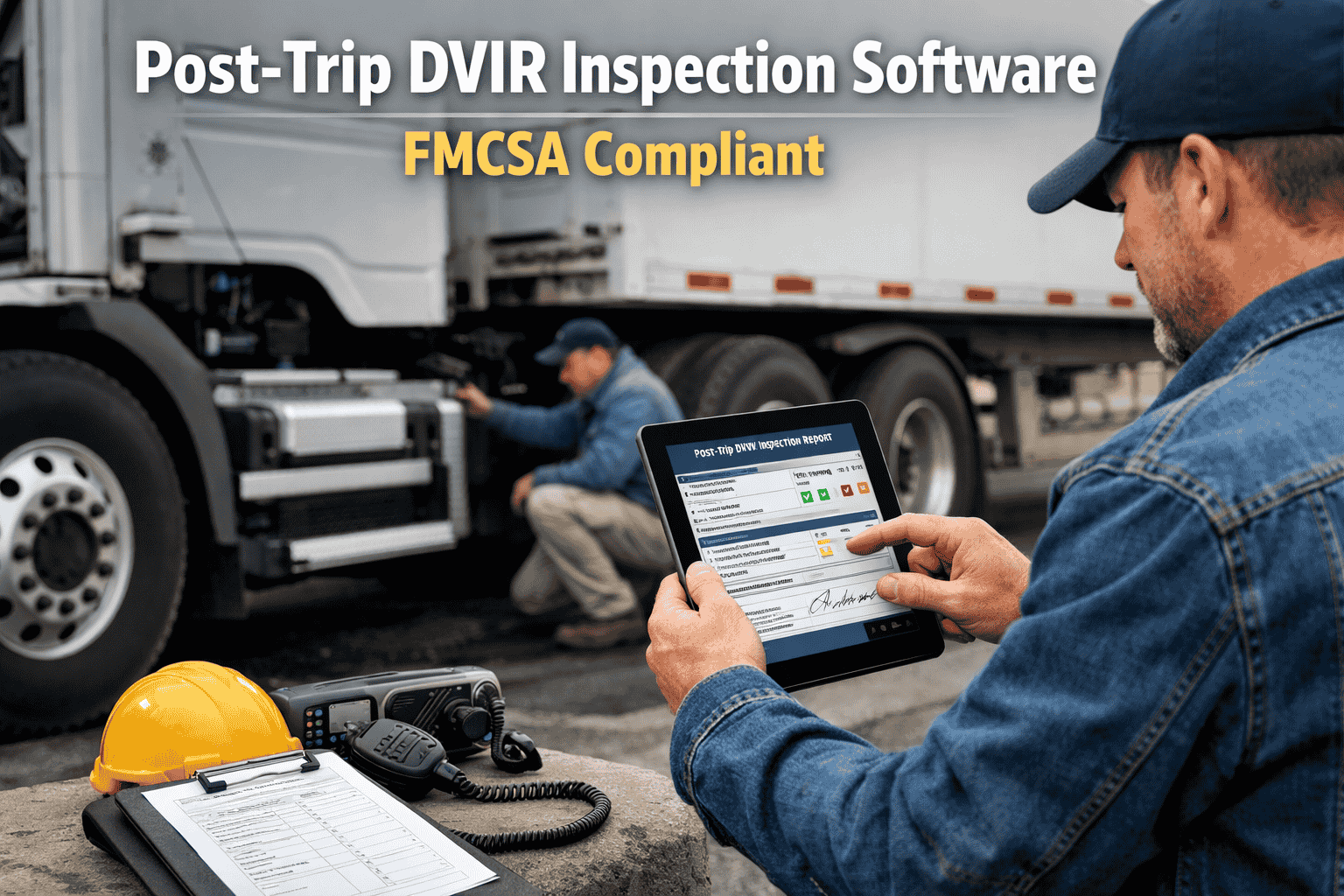
Post-trip DVIR software replaces paper checklists with guided digital inspections, photo-verified defects, and automatic work orders. Drivers complete inspections in under 3 minutes. Defects route to maintenance instantly. No more lost paperwork or missed handoffs.
What is a Post-Trip DVIR?
A Driver Vehicle Inspection Report (DVIR) is the federally mandated document drivers complete at the end of each shift documenting any defects found during operation. It creates a legally binding chain of accountability: the driver who finds a defect, the carrier who repairs it, and the next driver who confirms the repair before operating the vehicle. Break any link in that chain and the violation follows.
When is DVIR Required?
Who Must Sign?
How Long to Keep?
The 11 FMCSA-Required Inspection Components
Under 49 CFR 396.11, every post-trip DVIR must cover these 11 component categories. Any defect "affecting safe operation or likely to cause breakdown" must be documented. These same items are harmonized with pre-trip requirements under 392.7. Learn more about complete DVIR requirements.
Service Brakes
Including trailer brake connections, air lines, adjustment
Parking Brake
Holding capacity, proper engagement
Steering Mechanism
Free play, power steering, linkage
Tires
Tread depth, pressure, sidewall damage
Coupling Devices
Fifth wheel, safety chains, kingpin
Wheels & Rims
Cracks, loose lugs, proper seating
Lighting & Reflectors
Headlights, taillights, turn signals, clearance
Horn
Audible signal device, proper operation
Windshield Wipers
Blade condition, washer fluid
Rear Vision Mirrors
Both sides, proper adjustment
Emergency Equipment
Fire extinguisher, triangles, fuses
Why Post-Trip Matters More Than Pre-Trip
Pre-trip gets the training attention, but experienced fleet managers know post-trip creates the real value. Here's the key difference that transforms your maintenance operations:
Defect Found at Pre-Trip (5 AM)
Defect Found at Post-Trip (6 PM)
Complete Audit Trail
Every post-trip defect starts the 3-signature chain that FMCSA auditors examine in 89% of compliance reviews. Digital DVIRs create tamper-proof records with GPS timestamps that paper can never match.
Predictive Maintenance Data
Post-trip reports over time reveal defect patterns by vehicle, route, and driver. This data enables predictive maintenance—fixing components before they fail on the road where costs multiply 5-10x.
Nuclear Verdict Defense
Average truck accident jury verdicts continue climbing, with several exceeding $100 million in 2024-2025. Plaintiff attorneys specifically target inspection records. Digital DVIRs with photos prove safety diligence.
Driver Accountability
Systematic end-of-day checks build inspection habits. Under the 2026 CSA overhaul, "Driver Observed" violations are now a separate scoring category—the quality of your post-trip directly impacts your safety rating.
See How Post-Trip DVIRs Prevent Morning Delays
Watch drivers complete compliant inspections in under 3 minutes with photo evidence and instant defect routing to maintenance.
Paper DVIRs vs Digital DVIRs: The Real Difference
FMCSA's final rule (effective March 23, 2026) explicitly authorizes electronic DVIRs. But the regulatory change is just the start—here's what each system actually produces when an auditor, attorney, or insurance adjuster asks for your documentation:
FMCSA eDVIR Final Rule Now in Effect
FMCSA published final rule (Docket FMCSA-2025-0115) on February 19, 2026 explicitly authorizing electronic DVIRs under 49 CFR 396.11 and 396.13. Electronic DVIRs were already permitted since 2018 under 390.32, but this removes all ambiguity. All three signatures can now be captured electronically with timestamps. FMCSA actively encourages the transition to electronic methods. Learn more about eDVIR compliance.
How FleetRabbit Post-Trip Process Works
Our 5-step workflow ensures every defect gets documented, routed, repaired, and certified before dispatch. No phone calls, no missed handoffs, no broken chains. The entire process integrates with preventive maintenance scheduling for complete fleet management.
Driver Opens App at End of Shift
Guided checklist appears covering all 11 FMCSA items plus custom items you've added. GPS automatically captures location. Vehicle auto-selected based on driver assignment.
Tap-Based Walk-Around Inspection
Driver taps through each component: OK, Defect, or N/A. No writing required. Smart defaults speed up "no defect" inspections while ensuring nothing gets skipped. System won't submit until all items addressed.
Photo-Documented Defects
When defect marked, camera opens automatically. Driver captures photo, adds description, selects severity (minor/major/safety-critical). Photo evidence eliminates "he said/she said" disputes with maintenance.
Automatic Work Order Creation
The moment driver submits DVIR, defect reports route to maintenance team. Mechanic receives push notification with all details and photos. No phone calls, no missed handoffs. Work orders queue by priority.
Mechanic Repairs & Certifies Digitally
Technician completes repair and signs certification digitally. System updates original DVIR with repair timestamp, mechanic signature, and optional repair photos. Vehicle status changes to "ready" in system.
Next Morning: 3-Signature Chain Complete
Before pre-trip, system presents prior DVIR with defects and repair status. Next driver must review and sign acknowledgment before operating. Cannot skip this step. The complete chain (Driver → Mechanic → Next Driver) is documented with timestamps. Learn more about pre-trip inspection requirements.
Common DVIR Violations & Fines
FMCSA audits DVIR records in 89% of compliance reviews, and only 7% of motor carriers pass without a single violation. Understanding these violations helps you prevent them:
Failure to Prepare DVIR
Driver doesn't file DVIR when defects are found. Each day without proper documentation is a separate violation. A fleet of 50 trucks with systematic failures could face $63,500+ from a single audit.
Falsification of DVIR
Driver or carrier knowingly submits false information. Includes backdating, fabricating inspections, or altering defect records. One of the most serious violations with potential criminal liability.
Dispatching with Unrepaired Defects
Carrier dispatches vehicle with known safety defects not repaired and certified. Per-vehicle, per-instance fine. Can result in immediate out-of-service order.
Missing Repair Certification
Defect documented but no mechanic certification on record. Breaks the 3-signature chain auditors check. Common when using paper forms and repairs happen overnight.
Missing Driver Acknowledgment
Next driver operates vehicle without reviewing and signing prior DVIR. The third signature in the chain is often missed because paper forms get lost overnight.
Failure to Retain Records
DVIRs, repair certifications, and acknowledgments must be retained minimum 90 days. Paper forms get lost, damaged, or misfiled. Auditors request specific dates.
Stop Risking DVIR Violations
FleetRabbit's automated workflow ensures every defect gets documented, repaired, and certified before dispatch. Join fleets that pass audits with zero violations.
Post-Trip Inspection Best Practices
Beyond regulatory compliance, these best practices maximize the safety and efficiency value of your post-trip program:
Require Daily DVIRs Even When Not Legally Mandatory
For property-carrying CMVs, no-defect DVIRs aren't legally required. But filing them daily creates a positive compliance pattern that proves inspections were actually conducted. Invaluable during audits and litigation. FleetRabbit makes daily DVIRs take under 2 minutes.
Always Require Photo Evidence for Defects
Written descriptions cause disputes between drivers and mechanics. "Brake issue" could mean anything. A photo shows exactly what's wrong—and proves the defect existed before repair. Photo evidence speeds diagnosis and protects against "pencil whipping" claims.
Classify Defect Severity Consistently
Not all defects are equal. A burned-out clearance light is different from a brake issue. Severity classification (minor/major/safety-critical) helps maintenance prioritize the overnight repair queue and ensures safety-critical items get immediate attention.
Track Recurring Defects by Vehicle
When the same defect appears repeatedly on the same vehicle, something is systematically wrong. Digital DVIRs make patterns visible. A truck that reports brake issues monthly needs deeper investigation, not just repeated repairs.
Retain Records Beyond 90 Days
FMCSA requires 90 days, but lawsuits run years. A 2024 accident might not go to trial until 2027. If you can't produce the DVIR from the week of the accident, plaintiff attorneys will argue you didn't conduct inspections. Digital storage is essentially free—keep everything.
Include Pre-Trip and Post-Trip in One System
The same 11 FMCSA components apply to both inspections. Using separate systems creates confusion and gaps. FleetRabbit handles both in one app—post-trip flows naturally into the next day's pre-trip with DVIR acknowledgment built in.
Frequently Asked Questions
It depends on your vehicle type. For property-carrying CMVs, DVIR is only required when defects are found (since the 2014 rulemaking). For passenger-carrying CMVs, a DVIR is required every day regardless of whether defects are found.
However, most compliance experts strongly recommend filing a "no defect" DVIR daily for all vehicles as company policy. This creates a positive compliance record and proves inspections were actually conducted—invaluable during audits and litigation.
Yes, absolutely. Electronic DVIRs have been permitted since 2018 under 49 CFR 390.32. FMCSA's final rule (Docket FMCSA-2025-0115, effective March 23, 2026) adds explicit eDVIR authorization to 396.11 and 396.13, removing all remaining ambiguity.
Digital signatures, cloud storage, and mobile submission are fully compliant. FMCSA actively encourages the transition to electronic methods—the American Trucking Associations, OOIDA, and NTTC all supported the rulemaking.
FMCSA requires a minimum of 90 days (3 months) retention for DVIRs, repair certifications, and driver acknowledgments. This includes the original DVIR, the repair certification signed by the mechanic, and the acknowledgment signed by the next driver.
Best practice is 12-24 months minimum, since lawsuits can run years after an incident. Digital storage is essentially free—FleetRabbit stores records indefinitely so you're never caught without documentation.
Pre-trip (49 CFR 392.7) verifies the vehicle is safe to operate before departure. The driver must be "satisfied that the motor vehicle is in safe operating condition."
Post-trip (49 CFR 396.11) documents defects found during the day's operation at end of shift. Both cover the same 11 component categories, harmonized by FMCSA in the 2014 rulemaking.
The key difference: post-trip creates the repair window (overnight), while pre-trip confirms repairs are complete and the vehicle is safe for the new day.
When defects are found, the DVIR requires three signatures to complete the compliance chain:
1. Driver who finds the defect signs the original DVIR
2. Mechanic or carrier official who certifies the repair (or that repair was deemed unnecessary)
3. Next driver who acknowledges they reviewed the DVIR and repair status before operating
FleetRabbit captures all three signatures electronically with timestamps, ensuring the chain never breaks.
The vehicle cannot legally be dispatched until defects affecting safe operation are repaired and certified on the original DVIR. Dispatching a vehicle with known unrepaired safety defects is a serious violation with fines up to $15,420 per instance.
FleetRabbit prevents this by locking vehicle status until repair certification is complete. Drivers cannot be assigned to vehicles with open safety-critical defects.
Yes. FleetRabbit's mobile app works offline. Drivers can complete the full post-trip inspection including photos and defect documentation even without cell signal. The DVIR syncs automatically when connection is restored, with the original completion timestamp preserved.
This is essential for drivers who end their shifts at remote locations, customer sites, or areas with poor coverage.
Make Every Post-Trip Count
Stop losing defects to illegible paper and missed handoffs. Digital DVIRs catch problems, route repairs instantly, and keep you audit-ready. Free for up to 3 vehicles—no credit card required.