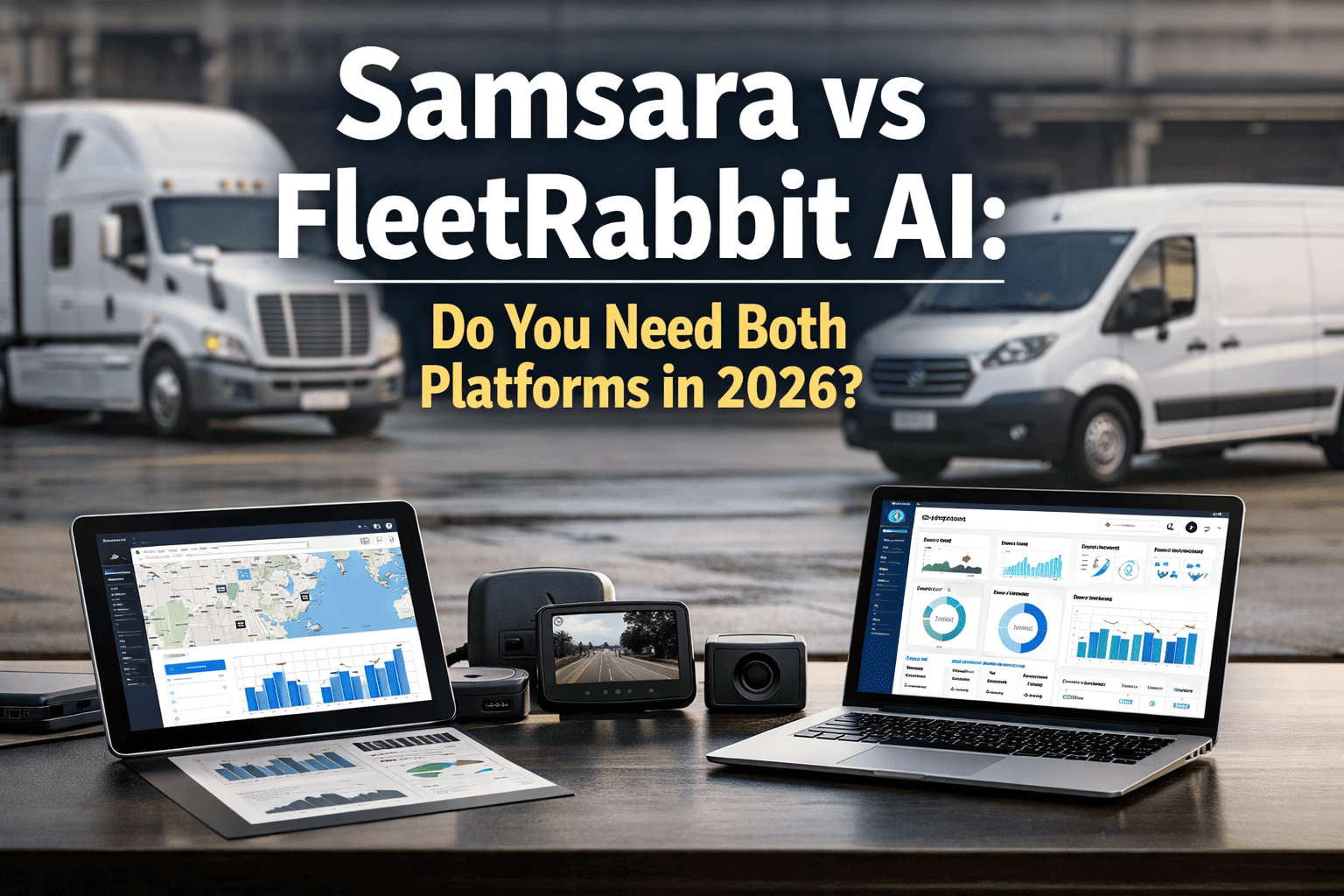
Fleet managers in 2026 face a confusing software landscape: Samsara dominates GPS tracking and telematics, while maintenance-first platforms like FleetRabbit AI focus on work orders, inspections, and predictive repairs. The question isn't which platform is betterit's whether you need one, the other, or both. Samsara excels at showing where your vehicles are and how drivers behave. FleetRabbit AI excels at keeping those vehicles running and compliant. For most fleets, the answer is integration: let Samsara track, let FleetRabbit maintain, and connect them so fault codes become work orders automatically. This guide breaks down exactly what each platform does, where they overlap, and how to build a tech stack that actually serves your operation. Book a demo to see how the platforms work together.
Samsara vs FleetRabbit AI: The Real Comparison
One tracks vehicles. One maintains them. Here's how to decide—or why you might need both.
Samsara
Telematics-FirstFleetRabbit AI
Maintenance-FirstThe Core Difference: Tracking vs. Maintaining
Before comparing features, understand the fundamental architectural difference. Samsara was built as a telematics platform—GPS tracking, driver behavior, and ELD compliance are its core strengths. FleetRabbit AI was built as a fleet CMMS—preventive maintenance, work orders, and AI inspections are its foundation. One shows you where vehicles are. The other keeps them running.
This architectural difference matters because maintenance bolted onto a tracking platform is never as deep as maintenance built from the ground up. Conversely, GPS tracking added to a CMMS via API provides location data but not native dashcams or ELD hardware. The smartest fleets use both: Samsara for tracking and safety, FleetRabbit for maintenance and compliance.
Feature-by-Feature: What Each Platform Does Best
Instead of a generic checkbox matrix, here's an honest breakdown of where each platform excels—and where it falls short:
Real-Time GPS Tracking
Live-to-the-second tracking with traffic overlays, geofences, and route replay. FleetRabbit shows location via telematics API but doesn't provide native GPS hardware.
AI Dash Cameras
AI-powered dashcams detect distracted driving, harsh events, and collisions. Automatic cloud upload for incident review. FleetRabbit doesn't offer camera hardware.
ELD Compliance
FMCSA-certified electronic logging with HOS tracking, automatic duty status, and IFTA reporting. FleetRabbit integrates with ELD data but isn't an ELD provider.
Work Order Management
Full work order lifecycle from creation to completion. Parts allocation, labor tracking, vendor management, and cost analysis. Samsara offers basic service records.
Preventive Maintenance
PM scheduling by mileage, engine hours, or time—with automated reminders and proactive alerts. Samsara provides basic maintenance reminders but lacks deep PM configuration.
AI-Powered Inspections
AI reads inspection photos to auto-detect defects, categorize issues, and create work orders automatically. Samsara offers digital DVIRs but without AI defect detection.
See FleetRabbit AI in Action
Watch how AI inspections auto-detect defects, create work orders, and integrate with your existing Samsara telematics—all in one demo.
The Integration Answer: Why Most Fleets Need Both
Here's the reality: Samsara and FleetRabbit aren't competitors—they're complements. Samsara collects vehicle data from the field. FleetRabbit turns that data into maintenance action. The magic happens when they connect:
Fault code P0171 triggered
Data flows every 15 min
Work order created automatically
Without this integration, fault codes sit in Samsara until someone manually creates a work order in your maintenance system. With integration, the entire chain—detection to assignment to repair—happens automatically. Learn more about unified telematics platforms and how they eliminate data silos.
When to Choose One Over the Other
While integration is ideal, some fleets genuinely need one platform more than the other. Here's how to decide:
Choose Samsara If...
- Your primary challenge is driver safety and behavior
- You need ELD compliance and HOS tracking
- Real-time location visibility is critical for dispatch
- You want AI dashcams for incident documentation
- Your maintenance is handled externally (outsourced shops)
Choose FleetRabbit If...
- Your primary challenge is unplanned breakdowns
- You need deep PM scheduling and work order tracking
- AI-powered inspections would reduce manual defect logging
- Parts inventory and cost tracking are priorities
- You already have GPS/telematics and need maintenance depth
Pricing Reality Check
Neither platform publishes transparent pricing, but here's what the market data shows for 2026:
- Hardware: $99-148 per vehicle (one-time)
- Contracts: 36-month minimum typical
- Free trial: 30 days
- Best for: GPS, cameras, ELD
- Hardware: None required (software-only)
- Contracts: Month-to-month available
- Free tier: 3 vehicles forever
- Best for: Maintenance, inspections, work orders
The cost difference is dramatic because the platforms serve different purposes. Samsara's price includes GPS hardware, cellular connectivity, and camera infrastructure. FleetRabbit is software-only—it connects to your existing telematics rather than requiring proprietary hardware. For most fleets, running both is still more cost-effective than unplanned breakdowns.
Start With 3 Vehicles Free
Test FleetRabbit AI alongside your existing Samsara setup. Connect your telematics, run AI inspections, and see how maintenance automation works—no credit card required.
Frequently Asked Questions
No—and it's not designed to. FleetRabbit is a maintenance platform, not a telematics provider. It doesn't offer GPS hardware, dashcams, or ELD devices. If you need real-time vehicle tracking and driver safety tools, you'll still need Samsara (or similar). FleetRabbit excels at what Samsara doesn't: deep PM scheduling, AI inspections, work orders, and parts inventory.
Yes, but they're basic. Samsara offers maintenance reminders, service records, and fault code alerts. However, it lacks deep PM configuration, parts inventory, labor tracking, vendor management, and AI-powered defect detection. For fleets with in-house shops or complex maintenance needs, Samsara's maintenance is insufficient as a standalone solution.
FleetRabbit connects to your Samsara account via API. Every 15 minutes, it syncs GPS location, odometer readings, engine hours, and fault codes. When Samsara detects a fault code or DVIR defect, FleetRabbit can automatically create a work order and assign it to a technician. No manual data entry required.
Absolutely. FleetRabbit works as a standalone CMMS even without telematics integration. You can manually enter odometer readings, schedule PMs by calendar date, and use AI inspections via the mobile app. However, connecting telematics (Samsara, Geotab, Motive, or others) automates data flow and unlocks fault-to-work-order automation.
If you have no fleet software: start with whichever problem is costing you more. Frequent accidents and no visibility? Samsara first. Frequent breakdowns and missed maintenance? FleetRabbit first. If you already have Samsara but struggle with maintenance, add FleetRabbit to turn that telematics data into proactive repair action.
The Best Fleet Tech Stack Uses Both
Samsara tracks. FleetRabbit maintains. Together, they create a closed loop where vehicle data automatically drives maintenance action. See the integration in action—book a demo or start with 3 vehicles free today.