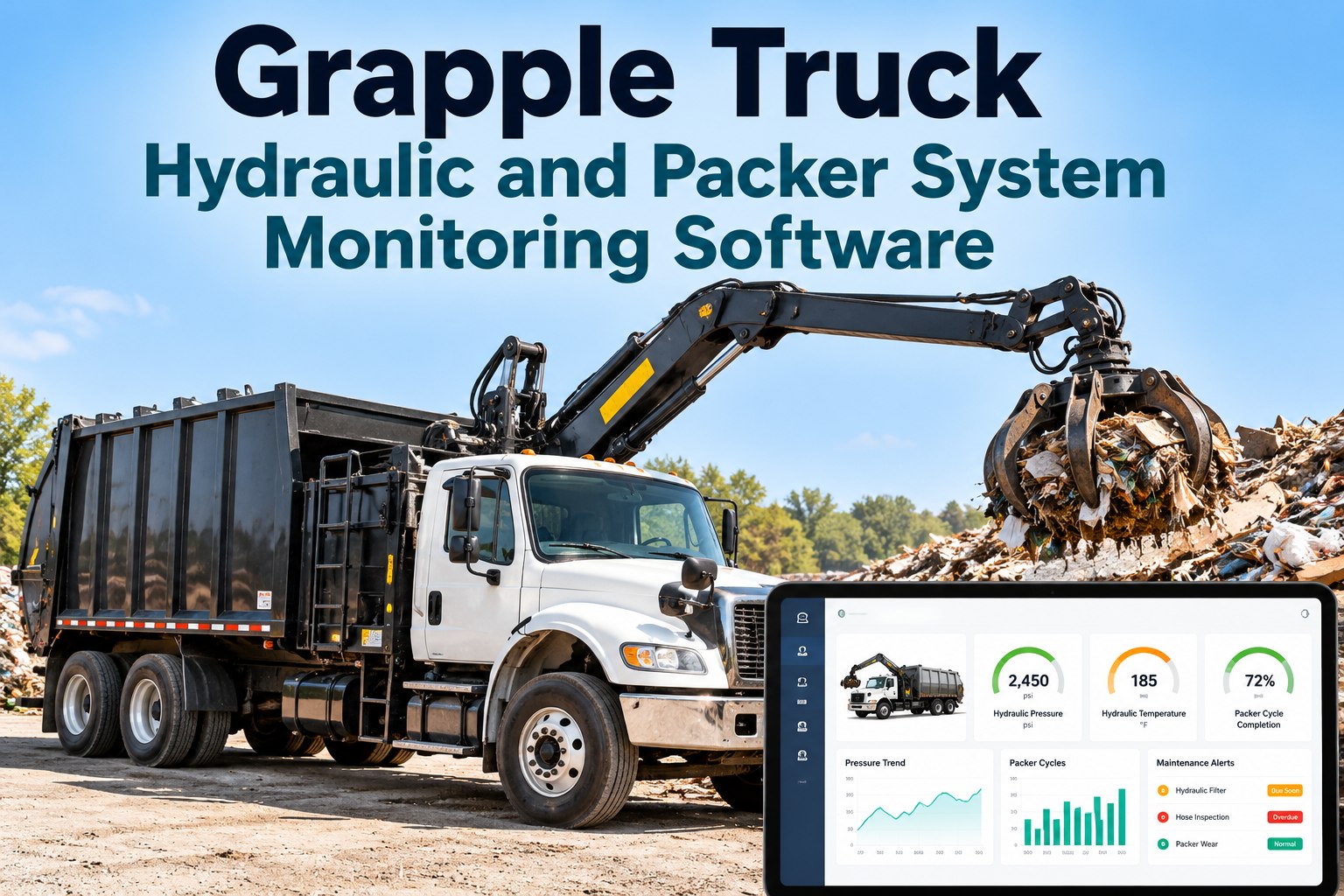
Grapple truck hydraulic monitoring software is only as good as the signals it catches, and grapple hydraulics give plenty: a weeping fitting, a boom that sinks while parked, oil that runs hot by noon, a hose cover worn down to the wire. This guide shows how to read those four signals on a loader-hour schedule and turn each one into a work order — and you can see that workflow on your own grapple trucks in a 20-minute demo.
Waste & recycling · Knuckleboom grapple trucks
Grapple hydraulics rarely fail without warning. They weep, sink, run hot and slow down first.
For bulky-waste supervisors and shop leads: what to check on the loader, how often to check it, and when a finding should pull the truck off the route.
Fluid
Dirty, wet or foamy oil
Heat
Oil running past 180°F
Hold
Boom or outrigger sinks
Hose
Cover worn to the wire
Most Grapple Trucks Have No Packer — Their Hydraulics Feed a Boom, a Grapple and a Dump Body
The "packer system" line in most refuse specs assumes a compactor, and a grapple truck usually has none. Waste Advantage Magazine describes the type as a hydraulic knuckleboom tipped with a clamshell bucket, usually paired with a dump body or trailer. A typical loader such as the Petersen TL-3 reaches 20 feet with a 4-foot telescoping extension and lifts 3,200 lb at full reach, according to a dealer spec sheet.
Bulky-waste programs run grapples in six layouts — loader and body on one chassis, rear steer, roll-off, rear-mounted loader with a haul truck or a trailer, and transfer systems — so the circuits you monitor depend on the one you own. Only transfer setups that load into a compactor body add a true packer cycle to the list. You can map your own grapple layout as assets on a free account before deciding what to inspect.
Power
PTO + hydraulic pump
→
Control
Valve bank + holding valves
→
Main boom & knuckle
Lift, outer boom and telescope cylinders
Rotator & grapple
Continuous-rotation motor, jaw cylinder
Slew drive
Ring bearing, slew gear oil
Outriggers
Stabilizer cylinders, pilot check valves
Body hoist & tailgate
Dump body raise, lower and latch
Packer body
Transfer setups only: pack and eject cycle
One pump and one reservoir serve every consumer, so dirt or heat that starts in one circuit reaches all of them.
Four Signals That Show Grapple Hydraulics Are Failing Before a Hose Bursts at the Curb
A burst line looks sudden, but the system has usually been talking for weeks. Each of the four signals below has a safe way to check it and a foreseeable cost if it is ignored, which is what makes it monitorable rather than a matter of luck.
Fluid
Contaminated oil wears every component it touches
You see
Milky, dark or foamy oil in the sight glass, or a filter bypass indicator showing.
Check
Level with the oil cooled, top up only through a filtered fill, and sample for particle count, water and wear metals.
Becomes
Scored cylinder rods, sticking valves and a pump that wears out early.
Heat
Hot oil quietly shortens seal, hose and fluid life
You see
Burnt-smelling oil, sluggish controls by mid-route, hoses that feel stiff.
Check
Note reservoir temperature after a heavy shift and clean the cooler fins on every wash.
Becomes
Hardened seals and short hose life — Gates puts it at half the expected life for every 18°F (10°C) above a hose's rating.
Hold
A boom that sinks is leaking internally
You see
Boom or grapple settling while parked, outriggers creeping, the truck starting to lean.
Check
Hold a fixed position with the PTO off, mark the rod, and measure again after three minutes.
Becomes
A load that won't stay put over a sidewalk, and stabilizers that stop stabilizing.
Hose
Covers wear through where the boom bends
You see
Wet fittings, abrasion at the knuckle and rotator, cracked or blistered cover.
Check
Look, don't touch: shut down, relieve pressure, and pass cardboard over a suspected pinhole.
Becomes
A burst line on a residential street and an injection-injury risk to anyone nearby.
Where hydraulic failures start
Contaminated fluid, 70–80%
Filtration maker HYDAC attributes 70–80% of hydraulic system failures to contaminated fluid.
Hydraulic oil temperature zones
100–140°F
140–180°F
180°F+
Machinery Lubrication notes that oil above 180°F (82°C) damages most seal compounds and speeds oil breakdown.
The two numbers point the same way: most of what kills a grapple circuit is visible in the oil long before it shows on the curb. If you want each of these checks built into your operators' pre-trip, a short demo shows how.
A Grapple Hydraulic Monitoring Cadence Set by Loader Hours, Not Chassis Miles
Palfinger's Epsilon refuse-loader service manager, Jason Bernstein, recommends cleaning, a full visual check and lubrication of every moving joint every 50 operating hours or once a month, and greasing the slewing ring's ball track every 500 hours and at least once a year. The cadence below builds daily operator checks and lab sampling around that core. Your loader manual sets the final intervals; treat these as the frame you fill in.
Swipe sideways to see every column
Two rules keep the cadence honest. Only filtered oil of the original viscosity goes in, because the wrong fluid causes jerky crane movement, and every sample result gets filed against the loader it came from. You can set up these intervals on a free account in an afternoon.
Loader-hour PM
Put the cadence above on a schedule that counts hours, not miles
Set the loader up as its own asset, load the eight checks, and let due dates follow the hour meter while the chassis keeps its own mileage schedule.
Two Clocks on One Truck: Why the Odometer Can't Schedule Grapple Hydraulics
A grapple truck works its hydraulics while it is parked. Every pile on a bulky-waste route is a stop with the PTO engaged, so the loader can log a full day of wear while the odometer barely moves. Scheduling hydraulic service on miles therefore lands it late on the hardest-working trucks and early on the quiet ones.
Chassis clock · miles and calendar
Brakes and brake adjustment
Tires, steering and suspension
Engine oil and driveline service
Annual inspection under 49 CFR 396.17
Same truck, separate due dates
Loader clock · hour meter
Hydraulic oil, filters and samples
Boom pins, bushings and grease points
Slewing ring, slew gear and rotator
Cylinder seals, hoses and holding valves
Run both clocks side by side in your preventive maintenance schedule and neither one has to guess for the other. If the hours already live in your telematics, a walkthrough shows how they reach the PM schedule without retyping.
When a Grapple Hydraulic Finding Pulls the Truck Off the Route — and When It Can Wait for Tonight
Operators need a decision rule they can apply at the curb, not a judgment call made under schedule pressure. Three tiers cover almost every hydraulic finding on a grapple truck.
Stop now
Lower the boom, PTO off, relieve pressure, photograph and tag out
Spraying or pinhole leak · hose cover worn through to the reinforcement · boom, grapple or outrigger that will not hold · burst, crushed or kinked line
Shop tonight
Finish the route with care, book the bay before the truck returns
Weeping fitting · oil running hotter than its usual end-of-shift reading · cycles noticeably slower · jerky grapple rotation
Log and trend
Record it with a photo and watch it at the next check
Light cover scuffing with no wire showing · seepage film that has not grown since the last check · oil sample due within the week
Safety
Never run a hand along a pressurized line. Britannia P&I notes that fluid at pressures as low as about 100 psi can puncture skin, and an injection injury needs immediate medical care even when it looks like a small sting.
Written down this way, the rule protects the operator who stops a truck as much as the truck itself. Give operators the same three tiers inside a free photo-verified pre-trip checklist and the call no longer depends on who is driving.
Which Standard Governs Your Grapple Inspection Record: ANSI Z245.1, ASME B30.22 or Part 396
Many maintenance pages file grapple loaders under the articulating crane standard without checking its exemptions. The loader, the waste body and the chassis can each fall under a different document, and the record should show which one you followed.
ANSI Z245.1
The waste-equipment standard
The 2017 revision names grapple vehicles alongside rear, front and side loaders and roll-off equipment, and covers their care, maintenance and operation.
ASME B30.22
Articulating boom cranes — with exemptions
It exempts machines fitted with non-lifting attachments and scrap and material handlers covered by B30.25. Ask your loader OEM which volume their loader is built to.
49 CFR Part 396
The chassis underneath
Driver vehicle inspection reports, repair certification and the annual inspection apply to the truck the loader sits on.
The stakes are real: refuse and recyclable material collectors had the fifth-highest fatality rate of any civilian occupation in 2024, at 37.4 per 100,000 full-time workers, according to SWANA's summary of Bureau of Labor Statistics data. If you want an outside check of how your records map to each document, bring a recent grapple inspection to a demo.
How FleetRabbit Turns Grapple Hydraulic Signals Into Closed Work Orders
FleetRabbit sits between the operator's walkaround and the shop's repair bay. Each signal above becomes a checklist item, each failed item becomes a work order, and the loader keeps its own hour-based schedule next to the chassis.
Inspect
Grapple checklists that work offline
Oil level, hose and hold-check items with required photos in
digital inspections, completed without signal and synced later.
Repair
Photo-verified defects open work orders
A failed hose or hold check opens a work order with the photo, unit and operator attached.
Schedule
Hour-based PM beside mileage PM
Hydraulic service runs on engine or loader hours while brakes and tires stay on miles.
Stock
Hoses, filters and seals ready
Parts tied to the job through
parts and inventory, so the hose is on the shelf before the truck backs in.
Record
Oil analysis on the asset history
Lab reports attached to the loader, so a rising particle count sits next to the repairs it predicted.
What the 20-minute demo covers
1
Your grapple layout set up as truck and loader assets
2
A pre-trip with hold checks and photo rules
3
A worn hose turning into a work order
4
Loader-hour PM running beside chassis miles
5
Parts staged against the open job
Grapple Truck Hydraulic Monitoring: Questions Shop Leads Ask Most
Do grapple trucks have a packer system?
Most do not. A grapple truck usually loads into an open dump body or a trailer, so its hydraulics drive the boom, rotator, grapple, outriggers and body hoist. Only transfer setups that load into a compactor body add a packer cycle to monitor.
How often should grapple hydraulic oil be sampled?
Follow your loader manual first. One OEM knuckleboom loader guide lists a hydraulic oil sample at 500 hours, and fleets running dusty bulky-waste routes often sample sooner, then adjust once they see how fast their particle counts climb.
How much boom drift is too much?
Your loader OEM sets the limit. As a field reference, Caterpillar trainers treat more than half an inch of movement in three minutes, with the engine off and the cylinder held in position, as a sign of leakage across the piston seals.
What hydraulic oil temperature is too hot?
Above 180°F (82°C) most seal compounds start to degrade and the oil breaks down faster. Many fleets aim to keep oil roughly between 100°F and 140°F and treat a reading that climbs shift after shift as a cooler or contamination problem.
Is a grapple loader covered by ASME B30.22?
Not automatically. B30.22 exempts machines fitted with non-lifting attachments and scrap and material handlers covered by B30.25, while ANSI Z245.1 names grapple vehicles directly. Confirm with your loader OEM which standard it is built and certified to.
Can operators complete hydraulic checks with no cell signal?
Yes. FleetRabbit's mobile inspections work offline and sync when the device reconnects, which matters at landfills and storm-debris sites. You can
try it free on up to three trucks.
Catch the Weep Before It Becomes a Burst Hose on the Curb
Put fluid, heat, hold and hose checks into every pre-trip, run loader service on hours, and let every finding become a work order with a photo attached.
Free for up to 3 trucks · No credit card required
October 22, 2026
By Derek Goes
All Posts