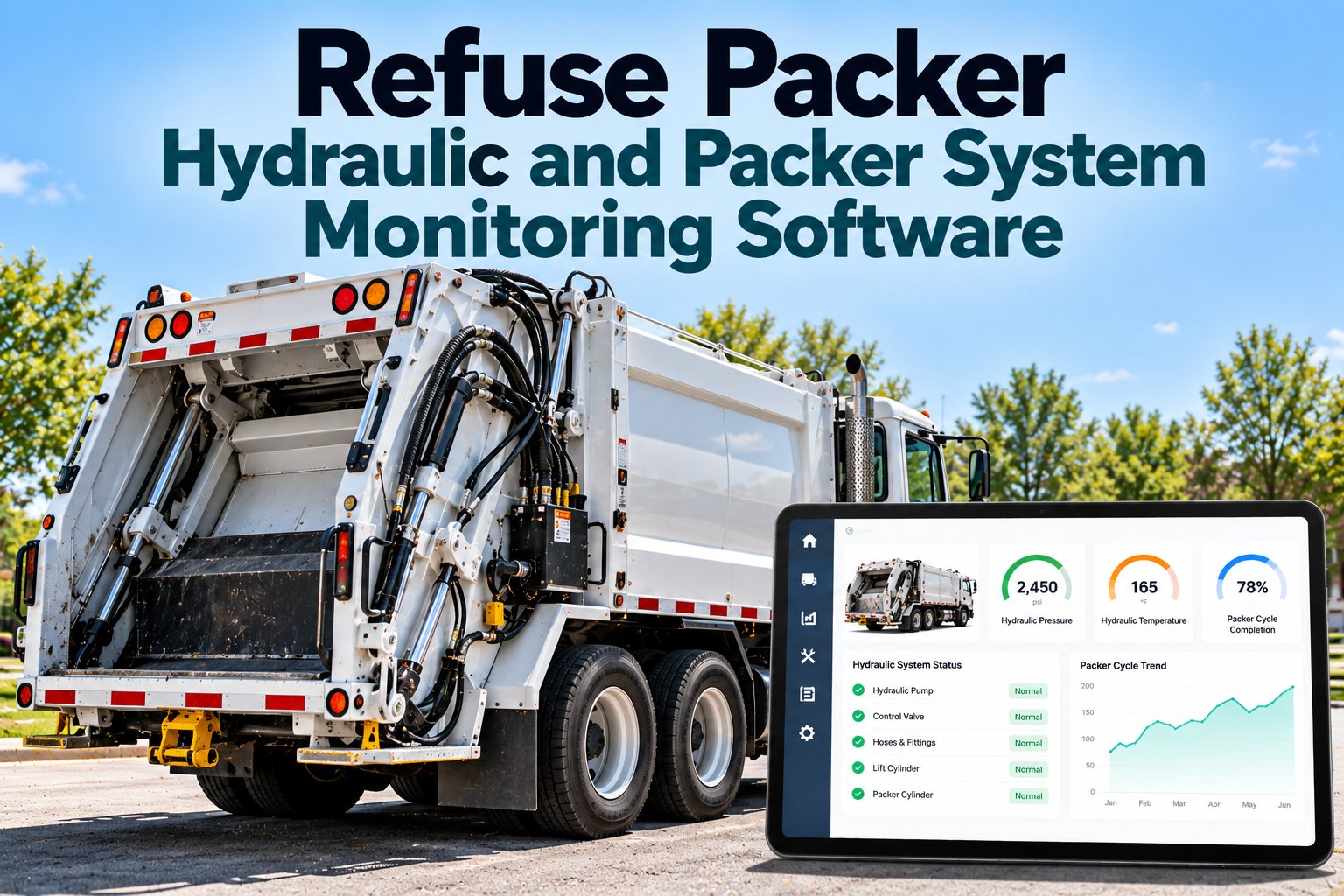
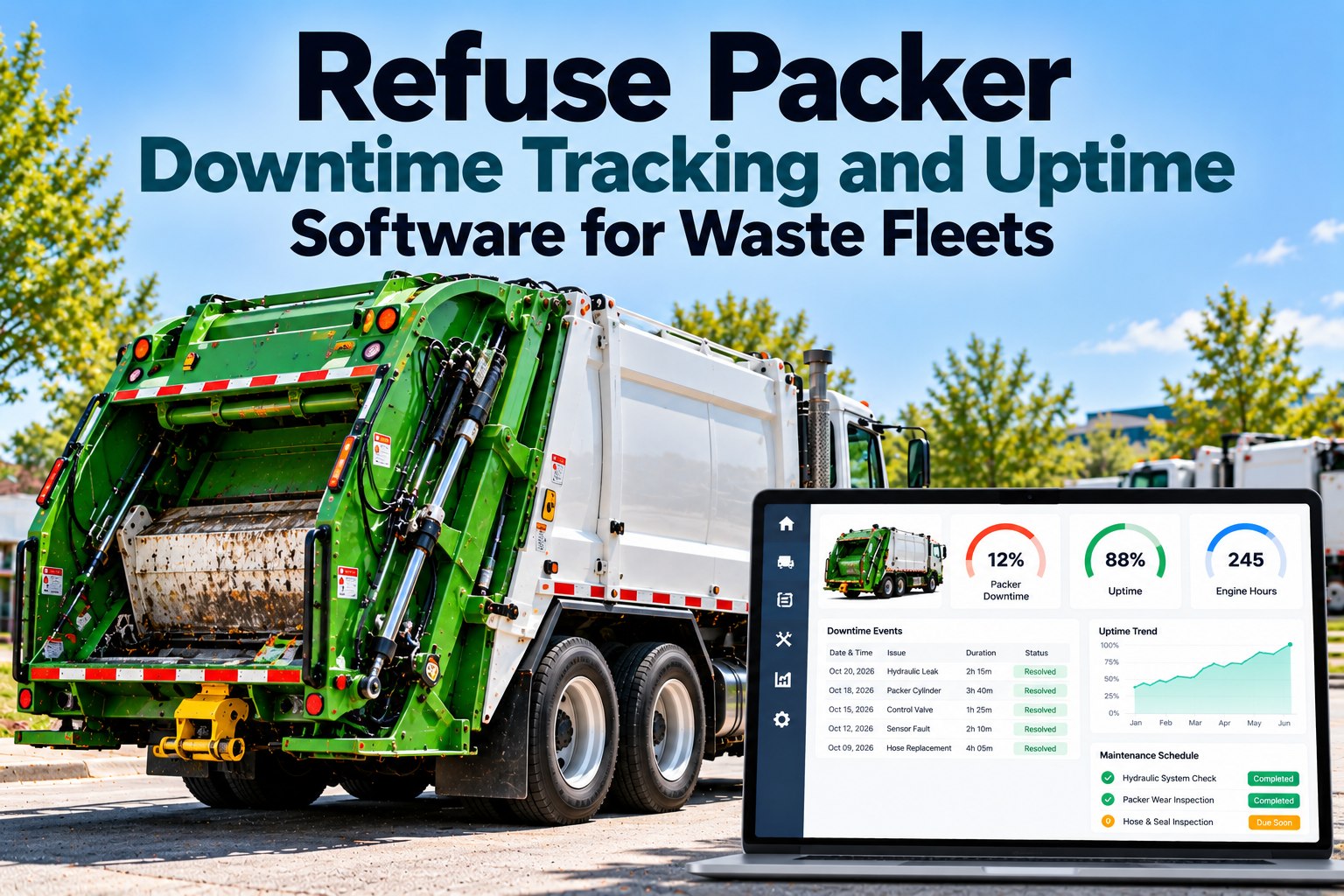
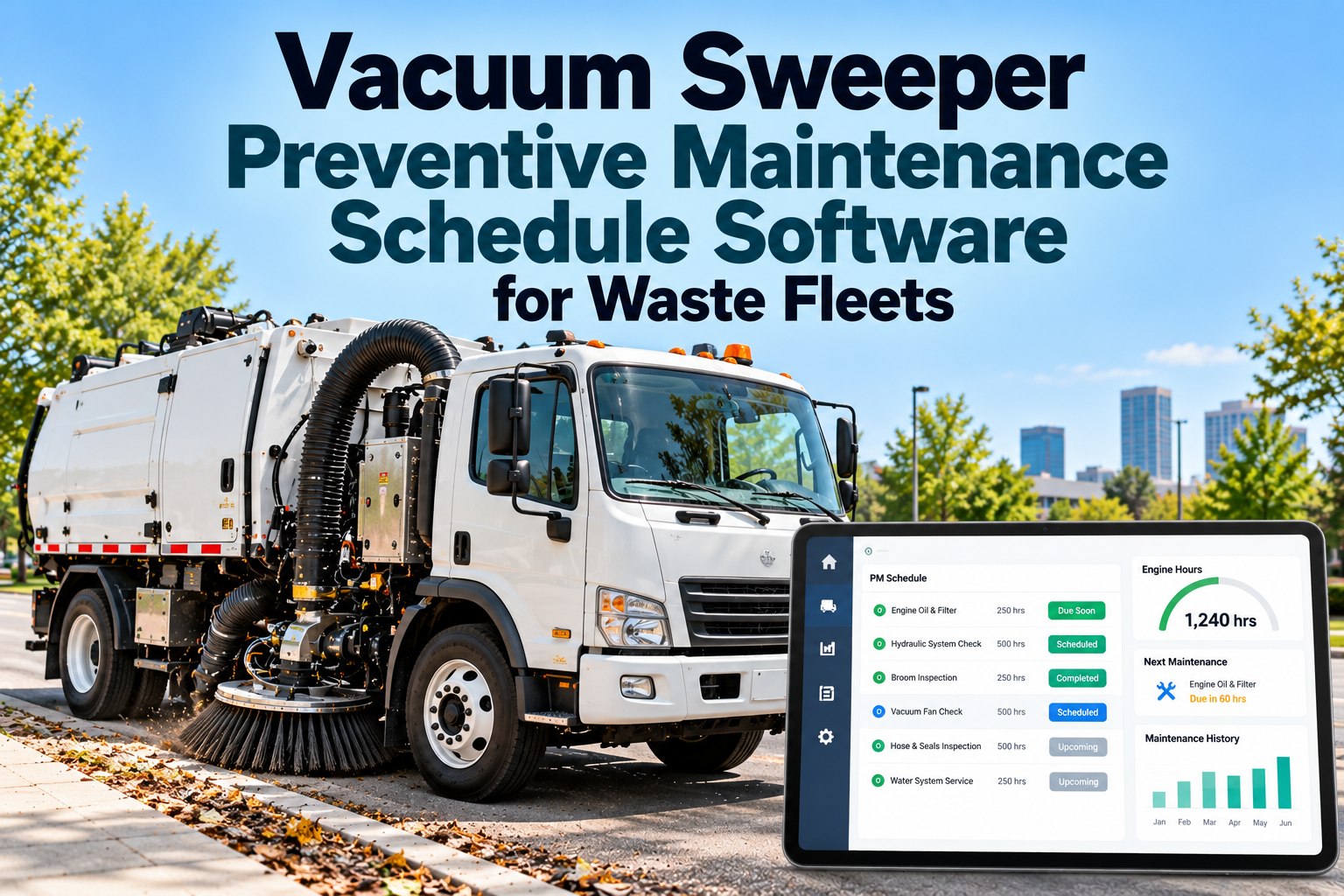
Refuse packer hydraulic monitoring software starts with gauges your trucks already carry. Most packer bodies come with a system pressure gauge, a tank temperature gauge, a sight gauge and a return-filter indicator. Read all four every shift, write the numbers down and compare them with last week, and you will spot most hydraulic failures before they leave oil on a residential street. This guide covers what each gauge tells you, how to check hoses safely, and what drivers should do when a line fails mid-route. You can also see the full workflow in a 20-minute demo.
Waste & recycling fleets · Packer hydraulics
Your packer already has four hydraulic gauges. Monitoring only starts when someone reads them every shift and logs what they say.
For shop leads, safety managers and route supervisors running rear, front and side loaders on residential and commercial routes.
Pressure gauge
Is the system building force?
Temperature gauge
Is the oil running hot?
Sight gauge
Is oil leaving the tank?
Filter indicator
Is dirt getting past the filter?
On a Garbage Truck, a Hydraulic Failure Is Also a Spill on a Public Street
When a hose bursts on a bulldozer, the oil lands on a job site. When one bursts on a refuse truck, it lands on a residential street, in a gutter or a storm drain. In East Lansing, Michigan, the cost of one failed packer hose grew for weeks after the truck itself had been repaired.
New Year's Eve 2020
A hydraulic hose fails on a city sanitation truck. About 55 gallons of oil are released.
The days after
The oil reaches a private storm sewer and runs on into a retention pond.
About four weeks
The spill in the pond goes unnoticed before cleanup begins.
The bill
Two cleanup contracts, $10,568 and roughly $23,982 — more than $34,000 for one hose.
As reported by East Lansing Info in 2021, including its follow-up on the city's lessons learned.
The hose was a small part; the unrecorded spill was the costly part. No amount of route optimization in waste collection rescues a day when a truck is parked on a cul-de-sac surrounded by absorbent pads. The cheapest fix is the one where the leak shows up on a gauge or a walkaround first. If you want those readings in one place, start a free packer hydraulic log for up to three trucks.
The Four Gauges on a Refuse Packer Hydraulic System and What Each Reading Means
A 2022 municipal bid specification for a rear-loading body from the City of Charleston, West Virginia, shows what buyers expect a packer to come with. The spec calls for a relief valve and pressure gauge, normal maximum operating pressure of 2,000 psi or less, a tank of at least 40 gallons with sight and temperature gauges, and a 10-micron return filter with a bypass valve and a visual indicator. Those four instruments are your monitoring system.
Tells you
Whether the pump and relief valve are building packing force
Baseline
The body maker's rating — the Charleston spec caps normal operation at 2,000 psi
Act when
Pressure won't reach its usual peak, or packing slows at the same reading
Tells you
How hard the system is working and how well it sheds heat
Baseline
Your truck's normal reading on a typical route day
Act when
It climbs toward 180°F (82°C) — Machinery Lubrication notes seal damage above that point
Tells you
How much oil is in the tank with the body stowed
Baseline
Full mark, read at the same point in the shift each time
Act when
The level falls between checks — the oil went somewhere, possibly onto a street
10µ
Return-filter indicator
Tells you
Whether oil is passing through the filter or around it
Baseline
Indicator in the clean zone after a filter change
Act when
It reaches bypass — unfiltered oil is now circulating through pumps and valves
HYDAC attributes 70–80% of hydraulic system failures to contamination, which is why the filter indicator deserves the same attention as the pressure gauge.
Each reading means more when you compare it with the last one. A tank at 160°F tells you little; a tank that ran 145°F all month and 160°F today tells you something has changed. A quick walkthrough shows how readings trend per truck.
A Shift-by-Shift Packer Hydraulic Log That Catches Trouble Days Early
Here is what a week of readings from one rear loader might look like when the driver logs the four gauges at the end of each shift. On any single day the numbers look fine. Read across the week, they show a failure on its way.
Swipe sideways to see the full log
Shift
Peak pressure
Tank temp
Sight gauge
Filter
What it means
Mon
1,950 psi
146°F
Full
Clean
Baseline week
Tue
1,950 psi
148°F
Full
Clean
Normal
Wed
1,940 psi
151°F
¾
Clean
Oil leaving the system — walk the hoses
Thu
1,880 psi
168°F
¾
Rising
Running hotter, weaker — shop this week
Fri
1,790 psi
184°F
½
Bypass
Out of service before the next route
Illustrative readings. Your limits come from your body manufacturer and your own baseline.
Wednesday is the day to catch it: the oil level has fallen and nothing else has changed yet. That only works if the four readings sit on the same garbage truck DVIR the driver already completes, so a falling level reaches the shop the same afternoon. You can add gauge fields to your driver inspections free.
Four readings, one minute
Put pressure, temperature, level and filter on every packer inspection your drivers already complete
Refuse Packer Hydraulic Hose Checks: What to Condemn on Sight and What Never to Touch
Hoses on a packer body flex every cycle, rub against brackets and sit in road grime, heat and moisture. The Charleston spec asks for SAE-rated hoses installed without flat spots for that reason. A good hose check is visual, done with the PTO off and the body stowed or propped.
Condemn the hose if you see
Cover worn through to the wire or textile reinforcement
Blisters, soft spots or bulges under the cover
Kinks, flattened sections or a crushed bend
Cracked, hardened or heat-glazed cover
Wet oil at a crimp, or a fitting that has slipped
Rub marks where the hose meets a bracket or another line
Never, on any packer
Run a hand along a hose to find a pinhole leak — use a piece of cardboard
Tighten a leaking fitting while the system is under pressure
Work under a raised tailgate without the body prop in place
Return a truck to its route with a weeping hose "to finish the day"
Why hands are off
A pinhole stream can inject fluid through skin at pressures as low as about 100 psi, according to Britannia P&I safety guidance. Treat any injection as a surgical emergency, even if the wound looks small.
Heat ties the gauges to the hoses. Gates notes that hose life can be cut roughly in half for every 18°F a hose runs above its rated temperature, so a tank that has been running hot is a reason to inspect hoses sooner. Add hose condition to scheduled preventive maintenance, and see how a condemned hose becomes a work order.
When a Packer Hose Fails Mid-Route: A Spill Response Every Driver Can Follow
Even good monitoring won't prevent every failure. What happens in the next ten minutes decides whether you are dealing with a small mess or a storm sewer. Put these steps in the cab and in the driver's training record. Your state and city set their own spill reporting rules, so your supervisor's number goes on the card too.
Stop
Pull over safely, disengage the PTO, shut down the engine
Contain
Pads, absorbent or sand around the puddle; cover the nearest storm drain first
Report
Call the supervisor with location, gallons and whether oil reached a drain
Tag out
Mark the truck out of service; it doesn't pack again until repaired
Record
Photos, the failed part, cleanup used — attached to the truck's history
Some fleets also change the fluid. Lake Township, Ohio, has run its refuse trucks on a biodegradable hydraulic fluid for more than 15 years. When a main line released about 20 gallons, the crew contained it with sand and oil-dry, and no hazmat response was needed, according to a 2025 MWS article; the fluid's color also makes a spill easy to see. Recology's Mercer Island, Washington crew had a line failure in July 2021 with a plant-based biodegradable fluid, and cleanup was completed the same afternoon. Biodegradable fluid makes a spill easier to manage, but you still have to clean it up and report it.
Cab spill kit, packer trucks
Absorbent pads and socks
Storm drain cover
Bag of granular absorbent
Nitrile gloves and eye protection
Heavy-duty disposal bags
Supervisor and spill line numbers
How FleetRabbit Turns Refuse Packer Hydraulic Readings Into Scheduled Work
FleetRabbit doesn't bolt sensors onto your packer. It makes sure the gauges you already have get read, recorded and acted on, every shift, on every truck.
Driver logs
Four gauge readings and a hose walkaround on DOT-ready
mobile inspections, with photos, even offline
Out-of-range flags
A low level, hot tank or filter in bypass opens a work order instantly
Shop repairs
Hoses, filters and fluid tracked against the truck; spill photos attached
Engine-hour PM
Filter and fluid service come due on engine hours, not just miles
What the 20-minute demo covers
A packer inspection with gauge fields and a hose check
A falling sight-gauge reading turning into a work order
Filter and fluid PM set on engine hours
One truck's audit-ready history: readings, repairs and spills
Refuse Packer Hydraulic Monitoring: Questions From Waste Fleet Managers
Does hydraulic monitoring need sensors on the packer?
No. Most packer bodies already carry a pressure gauge, a tank temperature gauge, a sight gauge and a filter indicator. Monitoring means reading them on a schedule, recording the numbers and acting when they move. Sensors can add detail later.
How often should drivers read the hydraulic gauges?
Every shift, at the same point in the shift, so readings compare fairly. Level and filter are easiest to check at the end of the day with the body stowed.
What hydraulic oil temperature is too hot on a garbage truck?
Follow your body manufacturer's limit. As a general guide, sustained temperatures above about 180°F (82°C) start damaging seals and shorten hose life, so a rising trend is a reason to inspect.
Should waste fleets switch to biodegradable hydraulic fluid?
Many municipal fleets have, because spills on streets are easier to contain and clean. Check compatibility with your body maker first, and keep your spill response the same either way.
Can packer hydraulic checks go on the driver's DVIR?
Yes. The DVIR already covers the truck; adding gauge readings and a hose check keeps body and chassis defects in one report the shop sees the same day.
How quickly can we start logging readings?
Read · Record · Repair
Catch the Next Packer Hose Failure on a Gauge, Not on a Residential Street
Four readings every shift, hoses checked by eye, a spill plan in every cab, and one record that shows it all happened.
Free for up to 3 trucks · No credit card required
October 22, 2026
By Alex Rowan
All Posts