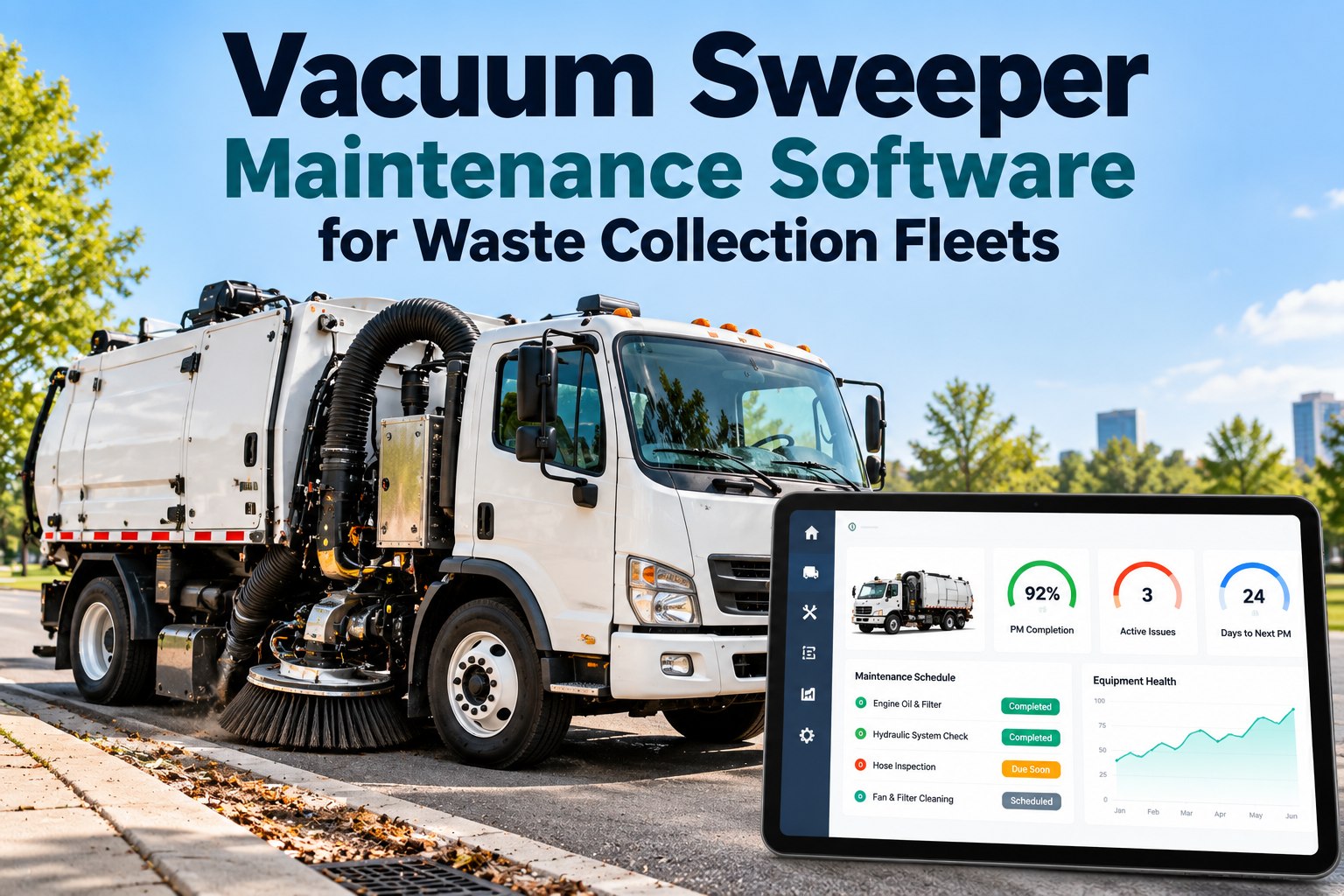
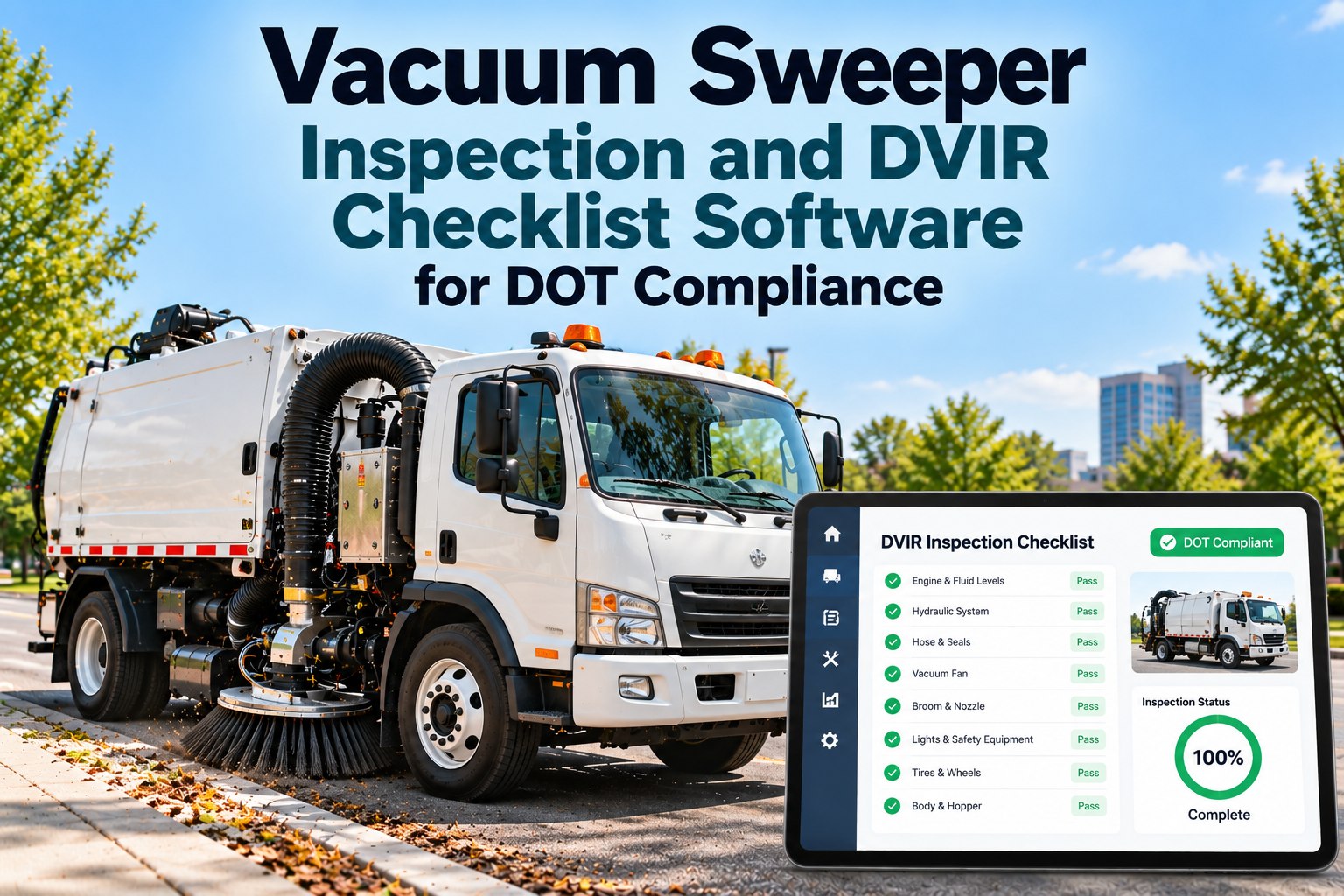
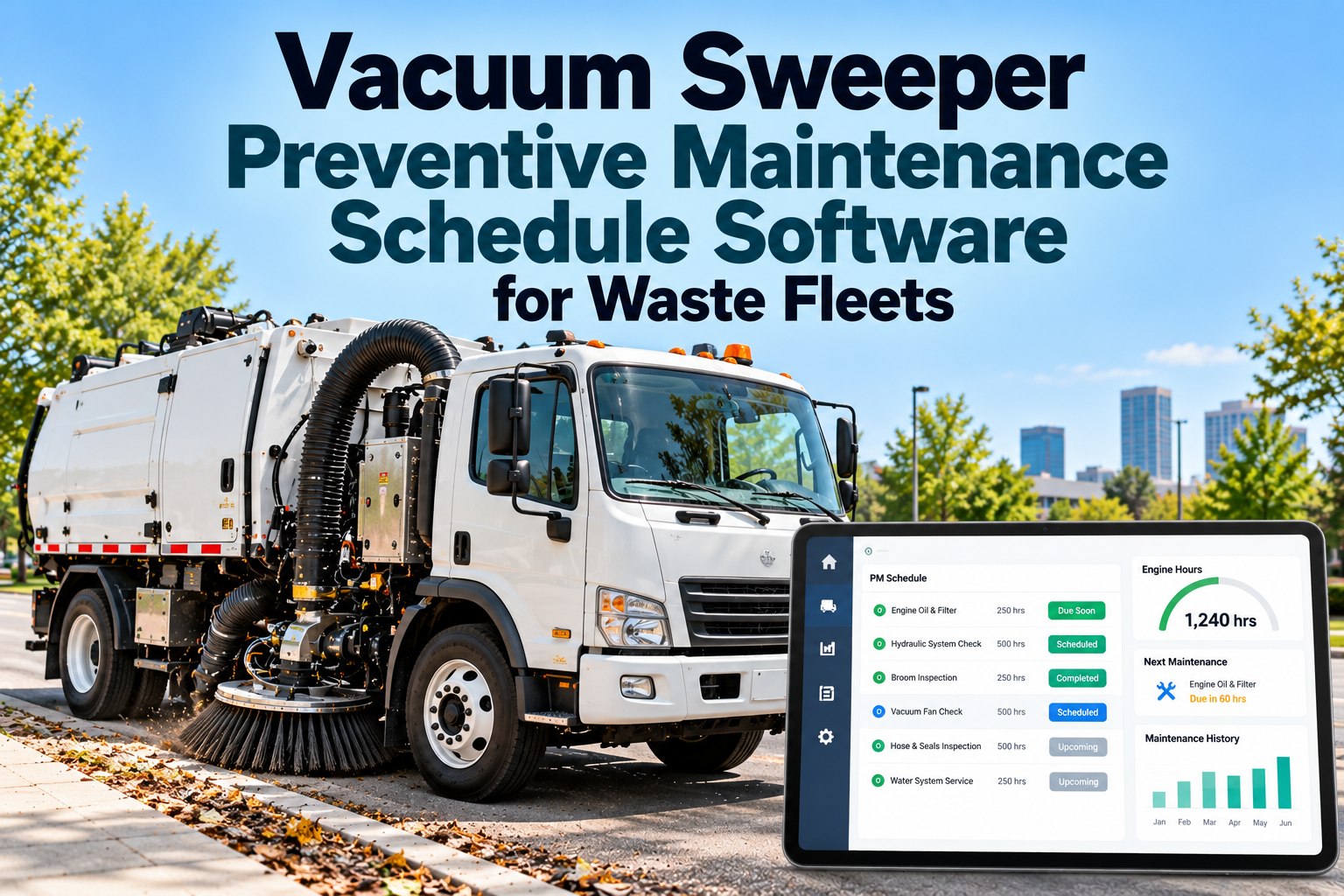
Vacuum sweeper maintenance software has one job that generic fleet tools miss: keeping the air path tight. A vacuum sweeper picks up only what its fan can pull through the nozzle, so a worn seal, a clogged screen or an eroded impeller vane costs pickup long before anything breaks. Here is what to check, how often, and how to run the whole routine from one schedule in a 20-minute demo.
Waste & municipal fleets · Vacuum street sweepers
When a vacuum sweeper stops picking up, the fan is usually fine. The air is leaking somewhere on the way to it.
For sweeper supervisors and shop leads who want suction problems caught at the dump site, not discovered as a street that still looks dirty.
Suction check at every dump
Rear-door seals wiped and mating faces clean
Transition bulb seal clean and seated
Screens washed, hopper corners scraped
Water tank full, every spray orifice firing
A Vacuum Sweeper Is an Airflow Machine — Every Leak Between Nozzle and Fan Costs Pickup
Steve Dunning, a technical training instructor at Elgin Sweeper, traces poor pickup on pure vacuum sweepers to the same short list again and again: worn seals, misadjusted nozzle gaps, holed hoses and impeller vanes eroded by grit. All of them sit on one path. Follow the air from the pavement to the exhaust and you have the inspection route.
Pickup head
Leaks when
Curtains ride too high or the deck height drifts out of spec
Curtains ¼ in off ground
→
Suction hose
Leaks when
Grit wears it from the inside until it holes through
Rotate every 150 hrs
→
Bulb seal
Leaks when
Debris sits on the nozzle-to-hopper seal after a dump
Clean at every dump
→
Hopper & doors
Leaks when
Rear-door seals are dirty or torn, or the access door isn't sealing
Wipe seals at every dump
→
Screens
Chokes when
Caked screens starve the fan and push grit through as carryover
Wash daily
→
Impeller
Weakens when
Vanes erode, holes form, buildup throws it out of balance
Inspect every 50 hrs
Intervals from Elgin's maintenance guidance for its Whirlwind pure vacuum sweeper. Use your own model's manual for the final numbers.
Read left to right, the path also tells an operator where to look first: the cheap, fast fixes are at the front, the expensive one is at the end. That ordering is easy to bake into a free photo-verified sweeper checklist so nobody skips straight to blaming the fan.
Pure Vacuum, Regenerative Air or Broom: Know Which Sweeper You Maintain Before You Build the Checklist
Fleets often run all three types and give them one shared checklist. That misses the point, because each design wears out in a different place and handles its air differently.
Swipe sideways to compare all three
Pickup methods and best uses follow sweeper dealer Haaker Equipment; air handling and wear points come from Elgin's training material. If your fleet mixes types, a demo shows how each model carries its own checklist.
Carryover Is the Number One Reason Vacuum Sweeper Impellers Wear Out Early
"Abrasion from carryover is the number one cause for impeller wear and failure," Dunning writes. Carryover is grit that gets past the hopper and screens into the fan, where it sandblasts the vanes at full speed. Three habits cause almost all of it, and each has a cheap fix.
Screens left caked
Fix: wash them daily in the down position, then wash the hopper.
Running with no water
Fix: refill before the tank runs dry and clear any spray orifice that isn't firing.
Fan faster than the job needs
Fix: run only the speed that lifts the debris; extra RPM adds carryover.
→
Result
Eroded vanes, lost suction, imbalance and vibration
Left alone, the vibration moves on to fan bearings and the driveline.
Stop rule
Treat vibration as a stop signal. Inspect the impeller right away; if the fan is replaced, a 2017 For Construction Pros sweeper maintenance guide advises replacing the driveline bearings with it.
Dunning also recommends spraying water into the impeller inlet above the screens, with the hopper down and the rear engine running, to wash carryover out during the daily cleanout. Capture that step and the screen wash as photo items, and you can see on a free account which units skip them.
Vacuum Sweeper PM on Sweeping Hours: From Every Dump to Every 150 Hours
The schedule below runs from the smallest interval to the largest. The every-dump and daily items belong to the operator; the hour-based items belong to the shop and should trigger from the meter, not from someone's memory.
Every dump
Clean rear-door seals and mating surfaces
Clean the transition bulb seals between nozzle and hopper
Daily
Wash screens, then the hopper, scraping corners behind the inlet chutes
Flush carryover from the impeller inlet
Water tank full, filter clean, every nozzle orifice firing
Curtains and skirts sealing to the ground; gutter broom strike pattern
50 hours
Lock out, rotate the impeller by hand a full turn and check vanes for holes
Grease impeller bearings, without over-greasing
Inspect the housing liner; sooner if water use has been inconsistent
150 hours
Rotate suction hoses so wear spreads around the inside wall
Per manual
Hydraulic oil of the right viscosity, filters and pressure settings
Engine services, belts and pulleys on the sweeping engine's hours
Winter
In service: non-toxic antifreeze in the water system
In storage: tanks, hoses and pumps fully emptied so ice can't form
Which meter drives the schedule?
Dual-engine sweepers
The auxiliary engine's hour meter drives fan, impeller and sweeping-engine service; the chassis odometer drives brakes and tires.
Single-engine sweepers
One engine does both jobs — Elgin's Whirlwind1 does away with belts and the fluid coupler — so log sweeping hours apart from road miles.
Intervals come from Elgin's Whirlwind guidance and the winterizing tips Elgin shared through World Sweeper. Put them on a preventive maintenance schedule that counts hours, and a walkthrough shows how the meter readings arrive.
Put the 50-hour impeller check on the meter, not on a whiteboard
Set each sweeper's sweeping engine up as its own meter and the inspection comes due on its own, with the lockout steps attached.
Which Vacuum Sweeper Records You Have to Produce Depends on Who Owns the Sweeper
A sweeper's paperwork is set less by the machine than by its owner and its location. The same model can carry very different record duties in a city yard, at a contractor and in a regulated air district.
City-run sweepers
Mostly exempt from FMCSA vehicle rules
FMCSA guidance exempts government employers and drivers from Parts 390–399, but CDL rules (Part 383) and drug and alcohol testing (Part 382) still apply.
Contract sweeping companies
No government exemption
A private contractor sweeping city streets doesn't inherit the city's exemption, so inspection and maintenance records follow Part 396 as your state applies it.
South Coast air district
Certified sweepers, two years of records
SCAQMD Rule 1186 requires certified PM10-efficient sweepers for routine public sweeping, maintenance to the manufacturer's specifications and two years of operating and maintenance records.
Rule 1186's maintenance clause is worth noticing: an air district can ask to see that you followed the maker's service specs, which is the same evidence a good compliance record keeps anyway. If you sweep in more than one jurisdiction, set up each unit's record trail on a free account.
How FleetRabbit Keeps the Air Path Tight Across Every Vacuum Sweeper You Run
FleetRabbit turns the airflow path into a routine: operators check it at the dump, failed items open work orders, and hour-based PM covers what the operator can't see.
Check
Operator inspects seals, screens and water at the dump, with photos
→
Repair
A failed item opens a work order for the shop
→
Prevent
Impeller, hose and engine service come due on hours
Sweeper checklists, offline
Every-dump and daily items in
digital inspections, with required photos, completed without signal and synced later.
Defects become work orders
A torn bulb seal or dead spray nozzle opens a work order with the photo and unit attached.
Hour-based PM
Impeller inspections and hose rotation run on engine hours while chassis service stays on miles.
Records that answer an audit
Inspections, repairs and services kept per unit, ready for a contract review or an air district request.
Repeat failures in view
The same unit eating impellers or hoses shows up in its history, pointing at carryover habits.
What the 20-minute demo covers
Your sweepers set up by type: pure vacuum, regenerative air or broom
An every-dump seal and screen check with photo rules
A dead spray nozzle turning into a work order
50-hour impeller and 150-hour hose PM on the meter
Wear parts staged against the open job
Vacuum Sweeper Maintenance Software: Questions Fleet Managers Ask
Why is my vacuum sweeper losing suction?
Usually an air leak or restriction, not a weak fan. Check the cheap points first: rear-door and bulb seals, screen condition, curtain height at the pickup head and holes in the suction hose. Only then inspect the impeller vanes for erosion.
How often should a vacuum sweeper impeller be inspected?
Elgin's training guidance for its Whirlwind sweeper says every 50 operating hours, sooner if water hasn't been used consistently, and immediately whenever vibration appears. Lock out the sweeper and rotate the impeller a full turn by hand.
How often should suction hoses be rotated?
Every 150 hours on the Whirlwind, according to Elgin. Debris wears the inside of the hose along one side, and rotating it spreads that wear so the hose lasts longer before it holes through.
How is regenerative air maintenance different from pure vacuum?
A regenerative air sweeper keeps its air in the system instead of venting it, so its checklist adds the pressure slot setting, curtains and the impeller drive belt. A pure vacuum sweeper puts more weight on suction hoses, seals and impeller vanes.
Do FMCSA rules apply to city-owned sweepers?
Mostly not. FMCSA guidance exempts government employers and drivers from Parts 390–399, though CDL and drug and alcohol testing rules still apply. Private contractors sweeping for a city don't share that exemption.
Can operators complete sweeper checks with no signal?
Yes. FleetRabbit's mobile inspections work offline and sync once the device reconnects, which helps at landfills and dump sites with poor coverage. You can
try it free on up to three sweepers.
Keep Every Vacuum Sweeper Pulling Full Suction, Route After Route
Check the air path at every dump, inspect impellers on the hour meter, and turn every torn seal or dead nozzle into a work order with a photo attached.
Free for up to 3 units · No credit card required
October 22, 2026
By Alex Rowan
All Posts