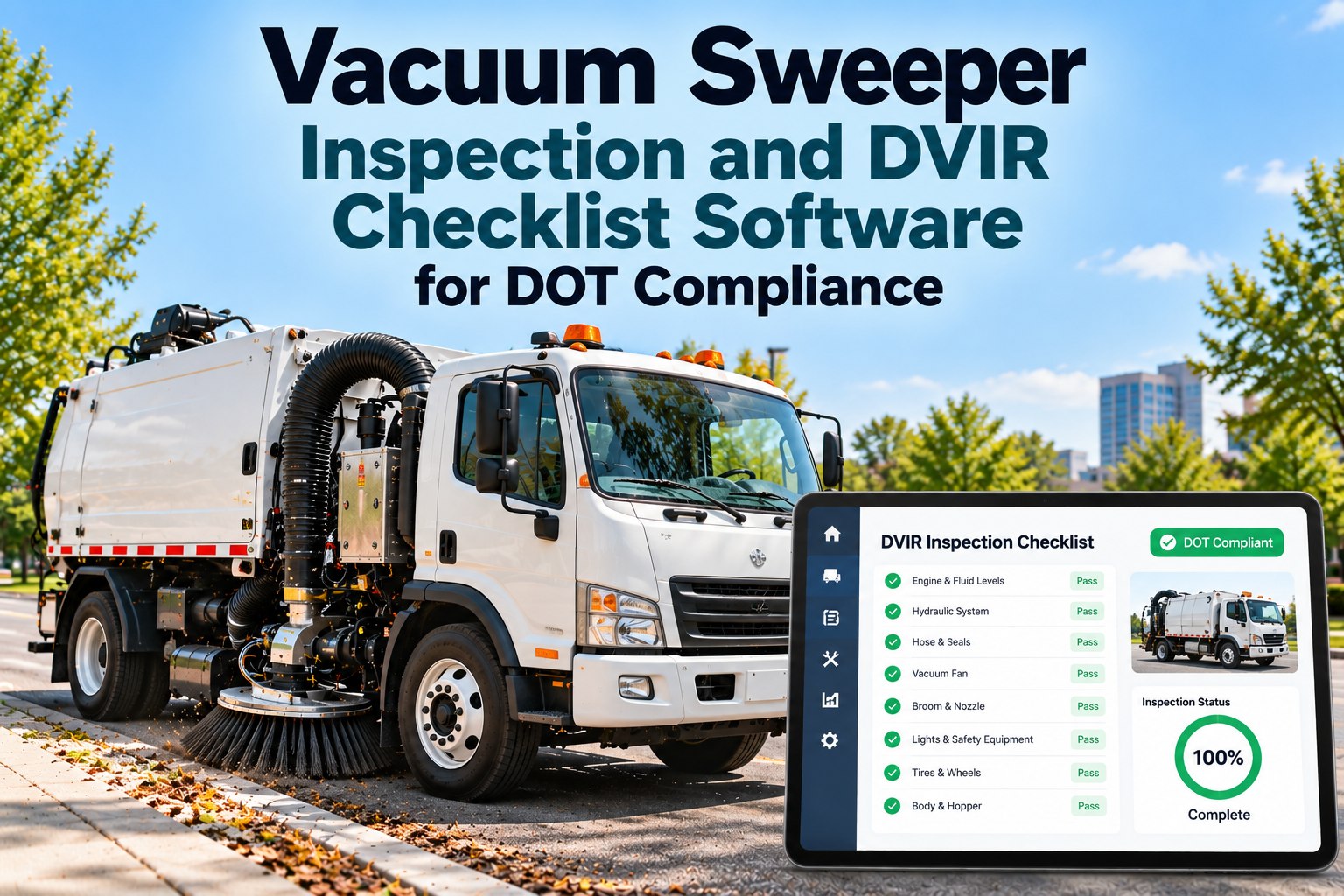
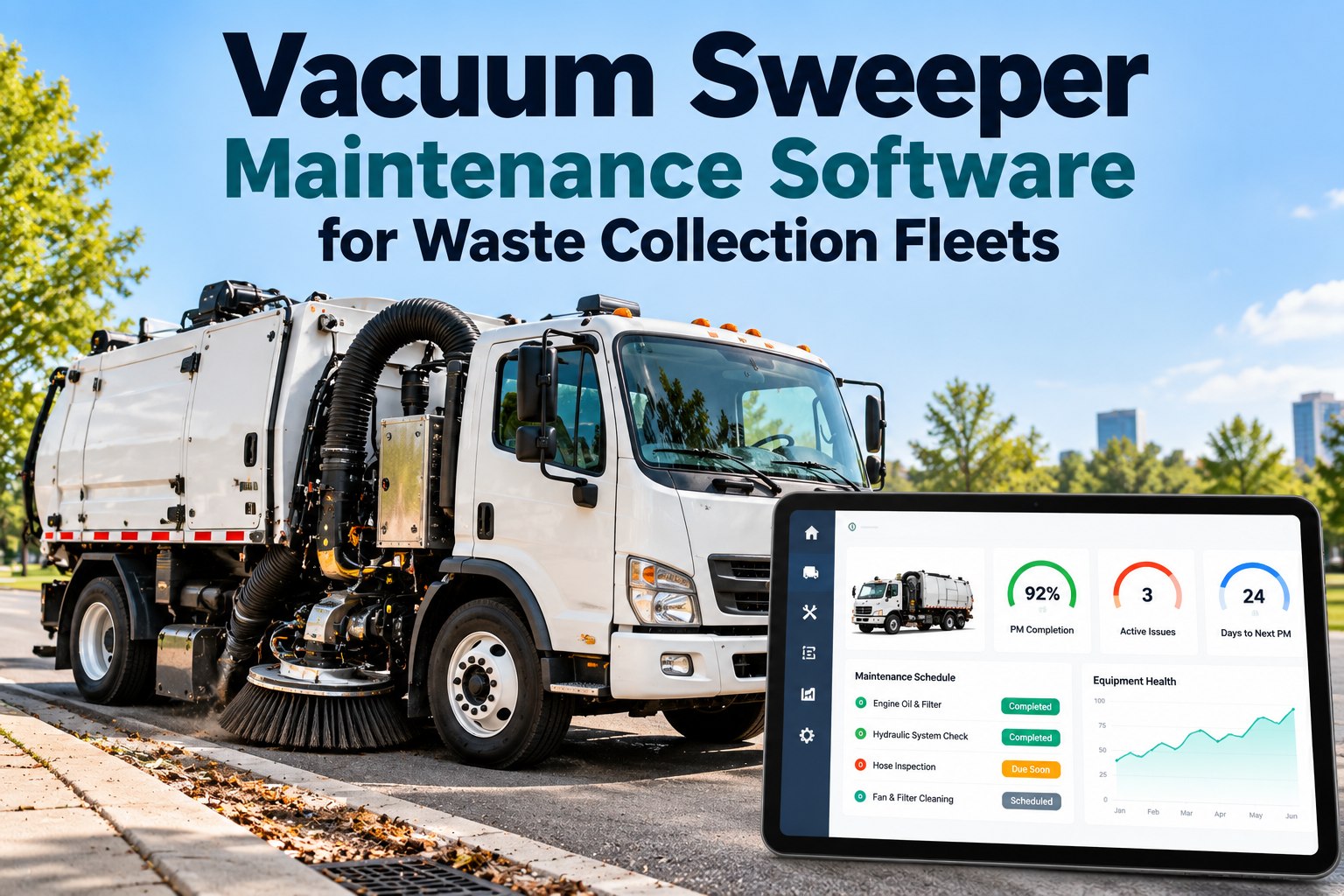
Vacuum sweeper inspection checklist software has to cover two inspections in one walkaround: the DOT items every commercial vehicle needs, and the sweeping system that decides whether the street actually gets clean. Below is a 40-point checklist you can tick through, grouped the way an operator walks the truck — and you can see it running as a digital DVIR in a 20-minute demo.
Waste & municipal fleets · Vacuum sweeper DVIR
A sweeper can pass its DOT walkaround and still leave the street dirty. Your checklist has to catch both.
The DOT half
Brakes, steering, lights, tires, wheels, horn, wipers, mirrors, emergency gear
Drives the DVIR and the repair sign-off
+
The sweeping half
Curtains, seals, hoses, screens, water spray, brooms, warning lights
Drives pickup, dust control and work orders
One Walkaround, Two Jobs: Why the DOT Items and the Sweeping Items Go Different Ways
Under 49 CFR 396.11, the driver's report has to cover at least eleven parts — service and parking brakes, steering, lighting and reflectors, tires, horn, wipers, mirrors, coupling devices, wheels and rims, and emergency equipment — and a report is only required when a defect is found. None of those items mention a pickup head, a hopper seal or a spray bar. The sweeping half still needs checking every shift; it just routes differently once something fails.
Affects safe operation
Listed on the DVIR and signed
Repaired before the next dispatch
Carrier certifies repair or that none was needed
Next driver reviews and signs
Affects sweeping only
Logged with a photo
Work order opened for the shop
Sweeper may keep working if safe
Fixed before it costs pickup or dust control
Keeping the two lanes apart stops a torn curtain from blocking a safe truck, and stops a soft brake from hiding inside a "sweeper issues" note. You can set up both lanes on a free account and let each finding route itself.
The Vacuum Sweeper Inspection Checklist: 40 Checks Grouped the Way You Walk the Truck
Tick through it in order: cab, chassis, warning equipment, then the sweeping system from the pickup head back to the hopper, finishing with the post-trip items after the last dump. DOT items carry their rule reference; sweeping items carry their source.
Sweeping-system checks follow Elgin Sweeper's Whirlwind training guidance and Haaker Equipment's 2026 sweeper PM schedule; broom strike pattern from broom makers quoted in For Construction Pros. Adapt each item to your model's manual.
The ticks above work for one walkaround. To keep them as a dated, signed record for every sweeper, every shift, a demo shows the same checklist in the app.
Put all 40 checks on every operator's phone, with photos where they matter
Works offline at the dump site and syncs when the signal returns.
Out of Service or Keep Sweeping? Sorting Vacuum Sweeper Findings Before the Shift Starts
Most findings sort themselves once the rule is written down. Anything that makes the truck unsafe to drive stops it; anything that only hurts pickup goes to the shop on a work order.
Do not dispatch
Brake, steering or tire defects
Lights or reflectors needed for road travel out
Hydraulic or fuel leak reaching the ground
Impeller vibration at start-up
Sweep, shop tonight
Single dead spray orifice
Small curtain tear that still seals
Broom near its wear limit
Seal that cleaned up but looks worn
Note and watch
Light hose scuffing, no wear-through
Minor screen staining after washing
Cosmetic body damage
Your own rule will move a few items between columns — a dust-control failure can be a hard stop in a regulated air district, for instance. Write it once and attach it to the checklist, and the free plan applies it to every unit.
What a Vacuum Sweeper DVIR Must Contain — and What the 2026 Electronic DVIR Rule Changed
The report itself is short. It identifies the vehicle, lists any defect that would affect safe operation or cause a breakdown, and carries the driver's signature. The chain that follows it is where fleets slip.
Driver
Lists defects at day's end and signs
→
Shop
Repairs safety defects before the next run
→
Carrier
Certifies repaired or not needed
→
Next driver
Reviews the report and signs
→
Records
Report and certifications kept 3 months
eDVIR rule
FMCSA's final rule, published February 19, 2026 and effective March 23, 2026, states plainly that DVIRs may be completed and kept electronically under 49 CFR 390.32. Paper reports remain allowed.
City sweepers
FMCSA guidance exempts government employers and drivers from Parts 390–399, so a city-run sweeper isn't bound by 396.11 — though many cities keep DVIRs anyway. Private sweeping contractors don't share the exemption.
Kept electronically, the whole chain sits on one record per sweeper in DVIR records, with the three-month retention handled for you. If a contract audit is coming up, bring a recent report to a walkthrough.
How FleetRabbit Turns the Sweeper Checklist Into Signed DVIRs and Work Orders
FleetRabbit runs this checklist on the operator's phone, routes every failed item down the right lane, and keeps the signed record.
Sweeper VS-07 · Pre-trip
Service brakes and air lines
Pass
Lighting and reflectors
Pass
Curtains intact
Fail · photo
Every spray orifice firing
Pass
Work order opened for curtain tear
Signed by operator · 05:48
Illustrative screen
Sweeper checklist, offline
Defects routed automatically
Safety defects go onto the DVIR; sweeping defects open a work order with the photo attached.
Signatures and certification
Driver signature, repair sign-off and next-driver review kept together on one report.
What the 20-minute demo covers
Your sweeper checklist set up from the 40 items above
A failed curtain becoming a work order
A brake defect blocking dispatch until it's certified
The signed DVIR chain on one record
Vacuum Sweeper Inspection Checklist Software: Questions Answered
What does a vacuum sweeper DVIR have to cover?
At minimum the eleven items in 49 CFR 396.11: service brakes, parking brake, steering, lighting and reflectors, tires, horn, wipers, mirrors, coupling devices, wheels and rims, and emergency equipment. Sweeping-system checks are good practice but sit outside the federal list.
Is a DVIR required if nothing is wrong?
Under 396.11, a driver only has to prepare a report when a defect is found or reported. Many fleets still record a clean inspection every shift so they can show the check happened.
Can sweeper DVIRs be completed on a phone?
Yes. FMCSA's final rule effective March 23, 2026 states that DVIRs may be completed and kept electronically under 49 CFR 390.32, and paper remains allowed too.
Do city-owned sweepers need DVIRs?
FMCSA guidance exempts government employers and drivers from Parts 390–399, which includes the DVIR rule. Many cities keep DVIRs as policy, and private contractors sweeping for a city are not exempt.
How long must sweeper DVIRs be kept?
Three months from the date the report was prepared, together with the repair certification and the next driver's review, under 396.11.
Can operators complete the checklist with no signal?
Make Every Sweeper Walkaround a Signed Record, Not a Ticked Sheet in the Cab
DOT items onto the DVIR, sweeping items onto work orders, and every signature in one place when an auditor or contract manager asks.
Free for up to 3 units · No credit card required
October 22, 2026
By Emily Parker
All Posts