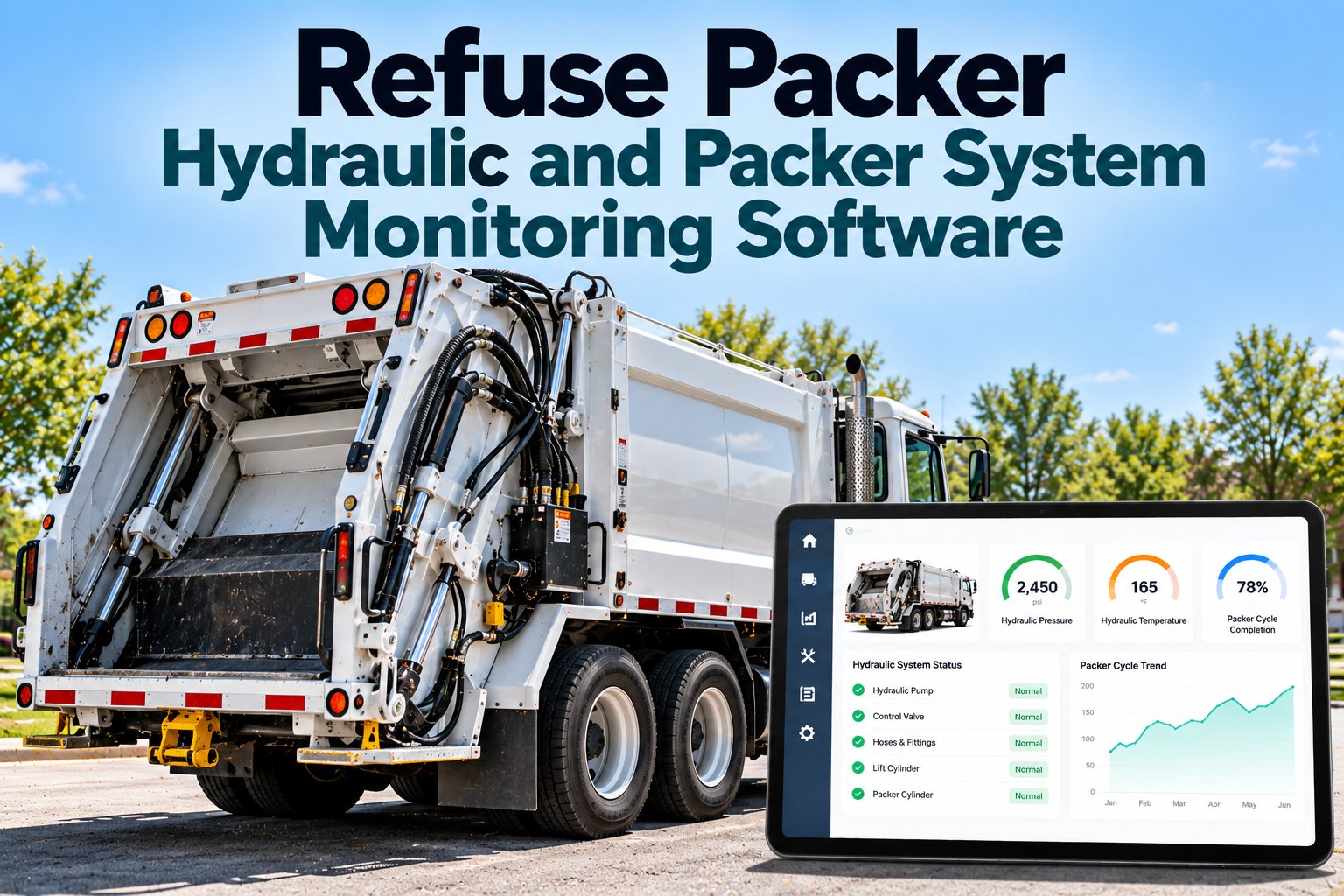
Refuse packer maintenance software earns its keep at the parts that slide and pivot. A packer body works by pushing heavy, wet, abrasive refuse thousands of times a week, and it wears out where steel rides on steel — wear shoes, guide tracks, bushings, seals and the hopper floor. This guide maps those wear points, sets a rhythm for checking them, and shows how to run that rhythm from one schedule in a 20-minute demo.
Waste & recycling fleets · Refuse packer bodies
The chassis gets you to the route. The packer does the work — and it wears out one contact surface at a time.
For shop leads and fleet managers keeping rear, front and side loaders packing at full force through every shift.
Load
Refuse into the hopper
→
Sweep
Blade swings through
→
Slide
Load pushed into body
→
Repeat
Every stop, every shift
Inside a Rear-Loader Packer Body: Where Each Part Is Built to Wear
A rear loader packs in a two-step cycle: a sweep blade swings down through the hopper, then a slide blade drags the load forward into the body, where an ejection panel holds it back. Front and side loaders use a packer panel instead, but the same rule holds: whatever moves against refuse or against a track is a wear part. A 2022 municipal bid specification for a rear-loading body from the City of Charleston, West Virginia, shows how deliberately those parts are built.
Sweep blade
Built: two 5 × 16 in cylinders, 2 in pivot pins in bronze bushings
Wears at: pivot pins and bushings
Slide blade
Built: two 4½ × 36 in cylinders, UHMW guide bearing blocks
Wears at: guide blocks and shoes
Slide guide tracks
Built: ½ in AR400 abrasion-resistant steel in the tailgate walls
Wears at: top and bottom running faces
Ejection panel
Built: 4-stage telescopic cylinder, UHMW slide blocks in a channel sill
Wears at: sill blocks and cylinder stages
Tailgate lift and lock
Built: two lift cylinders, automatic hydraulic lock with pilot check valve
Wears at: hinge pins, lock holding pressure
Tailgate seal
Built: chemically inert seal for a watertight fit
Wears at: tears and gaps that leak liquids
Hopper floor and sill
Built: ¼ in high-tensile floor, ⅜ in plate load sill, drain plug
Wears at: thinning, cracks at welds
Controls and interlocks
Built: two-handle packing control, reverse alarm with tailgate open
Wears at: sticking levers, failed alarms
Specifications from the City of Charleston, WV rear-loading refuse body bid (2022). Your body's materials and dimensions will differ; the wear points rarely do.
The same specification asks for grease fittings on every pivot point and a packing cycle averaging no more than 30 seconds with the standard PTO and pump — two facts that give you a free maintenance checklist and a free health test. You can load your own body's wear points into a free account in an afternoon.
Wear Shoes, Guide Tracks and Bushings: Measure the Contact Points Instead of Guessing
Packer wear shoes ride against the top and bottom faces of the slide guide tracks. A rear-loader wear-shoe patent describes why they go: the weight of the slide, its constant back-and-forth travel, and refuse that is both abrasive and corrosive. The same patent notes that older bolted-on shoes were hard to reach and often corroded in place — one reason a worn shoe gets left until the track itself is damaged.
Sample wear log · slide shoe thickness, left side
Illustrative
Readings taken at each shop visit and filed against the unit. The replace limit comes from your body manufacturer; the trend tells you when you'll reach it.
Three habits make this work. Take a baseline when shoes, blocks or bushings are new. Measure both sides at every shop visit, because uneven wear points to a bent slide or a binding guide. And replace in pairs, so a fresh shoe isn't riding next to a worn one. If you want a measurement log like this set up per truck, a short demo walks through it.
A Refuse Packer Maintenance Rhythm: Every Shift, Every Grease Day, Every Shop Visit
Packer care splits naturally into three rhythms. The operator owns the shift checks, the greasing routine keeps pivots alive, and the shop visit is where wear gets measured. Intervals for greasing and shop visits come from your body manufacturer.
Every shift
Operator
Packing controls return to neutral; stop works
Reverse alarm sounds with the tailgate open
Tailgate locks fully and the seal sits flat
No fresh leaks under the hopper or cylinders
Hopper cleared and drain plug checked at day's end
Grease day
Operator or shop
Every pivot fitting: sweep pivots, cylinder pins, tailgate hinges
Wipe old grease and grit off before pumping new
Note any fitting that won't take grease
Shop visit
Technician
Measure shoes, guide blocks and track faces, both sides
Check pins and bushings for play
Inspect hopper floor and load sill welds for cracks
Time a full packing cycle against spec
Read the return-filter indicator
The free health test
Time one full packing cycle at every shop visit and write the number down. If it creeps past the body's specification — the Charleston spec uses a 30-second average — something is binding, leaking past a seal or running short of pump flow, and you've caught it before it stops a route.
Each rhythm only works if it leaves a record: who greased, which fitting refused, what the cycle timed at. Put all three into one preventive maintenance schedule and you can start that record free today.
Shop visits on schedule
Get a reminder before the wear shoes reach the track, not after
Why Refuse Packer Service Should Follow Packing Work, Not the Odometer
A collection truck covers short distances between stops and packs at almost every one of them. Mileage barely moves while the packer cycles all shift, so mileage-based body service lands late on dense routes and early on long rural ones.
Odometer miles
Weak fit
Tracks travel between stops, not the packing done at them.
Engine hours
Better
Captures idle and packing time, though it mixes in driving and waiting.
PTO hours or body cycles
Best, where available
Measures the packer itself, if your PTO or body controls log it.
Use the best meter your trucks can give you, and keep the chassis on its own mileage schedule. If engine hours already arrive from your telematics, a walkthrough shows how they drive packer service.
Lockout and Body Props Belong in Refuse Packer Maintenance Records Too
ANSI Z245.1, the waste industry's mobile equipment standard, covers the care, maintenance and use of rear-, front- and side-loading compacting bodies. Its most practical point for the shop is the simplest: nobody reaches into a hopper or under a raised tailgate until the body is locked out and mechanically propped.
Shop rule
Prop, lock out, then work
Tailgate raised: body prop or safety stay in place first
Engine off, PTO off, key removed and tagged
Stored hydraulic pressure bled through the controls
Lockout recorded on the work order with the technician's name
The reason it belongs on the record is the stakes: refuse and recyclable material collectors had the fifth-highest fatality rate of any civilian occupation in 2024, at 37.4 per 100,000 full-time workers, according to SWANA's summary of Bureau of Labor Statistics data. You can add the lockout step to every packer work order free.
How FleetRabbit Keeps Refuse Packer Maintenance on Schedule for Every Truck
FleetRabbit gives each role its own view of the packer: the operator checks it, the shop measures and repairs it, and the manager sees which bodies are wearing fastest.
Operator
Shift checks for controls, alarm, lock and seal in
digital inspections, with photos, even offline
A failed item opens a work order on the spot
Shop
Shop visits come due on engine hours or mileage, whichever you choose
Wear readings, cycle times and lockout steps logged on the work order
Manager
Each body's history in one place, ready for an audit or a warranty claim
Trucks eating shoes or bushings faster than the rest stand out
What the 20-minute demo covers
Your packer bodies set up with their wear points
A shift check with a failed tailgate seal
A shop visit logging shoe readings and cycle time
Parts staged before the truck comes in
Refuse Packer Maintenance Software: Questions From Shop Leads
What wears out first on a rear-loader packer?
The contact surfaces: slide wear shoes and guide blocks, the guide tracks they ride in, and the bushings at the sweep pivots and cylinder pins. The tailgate seal and the hopper floor follow, because they take liquids and abrasion every shift.
How do I know when to replace wear shoes?
Measure them against the body manufacturer's replace limit at every shop visit and log the readings. A steady trend tells you when the limit will arrive, so you can order shoes ahead instead of finding track damage.
Why time the packing cycle?
Cycle time is a free health check. A body that packed within spec when new but now runs slower is binding, leaking internally or short of pump flow. Bid specs such as Charleston's set an average of 30 seconds or less.
Should packer service run on miles or hours?
On hours or cycles wherever you can. Collection trucks pack at nearly every stop while covering little distance, so mileage understates packer work on dense routes.
Which standard covers refuse packer maintenance?
ANSI Z245.1 covers the construction, care, maintenance and use of mobile refuse collecting and compacting equipment, including rear-, front- and side-loading bodies. Follow your body manufacturer's manual for intervals.
Can drivers complete packer checks offline?
Keep Every Packer Body Pushing Full Loads Without Surprise Shop Days
Check the controls every shift, grease every pivot on time, measure the wear points at every visit, and keep the record that proves it.
Free for up to 3 trucks · No credit card required
October 22, 2026
By Derek Goes
All Posts