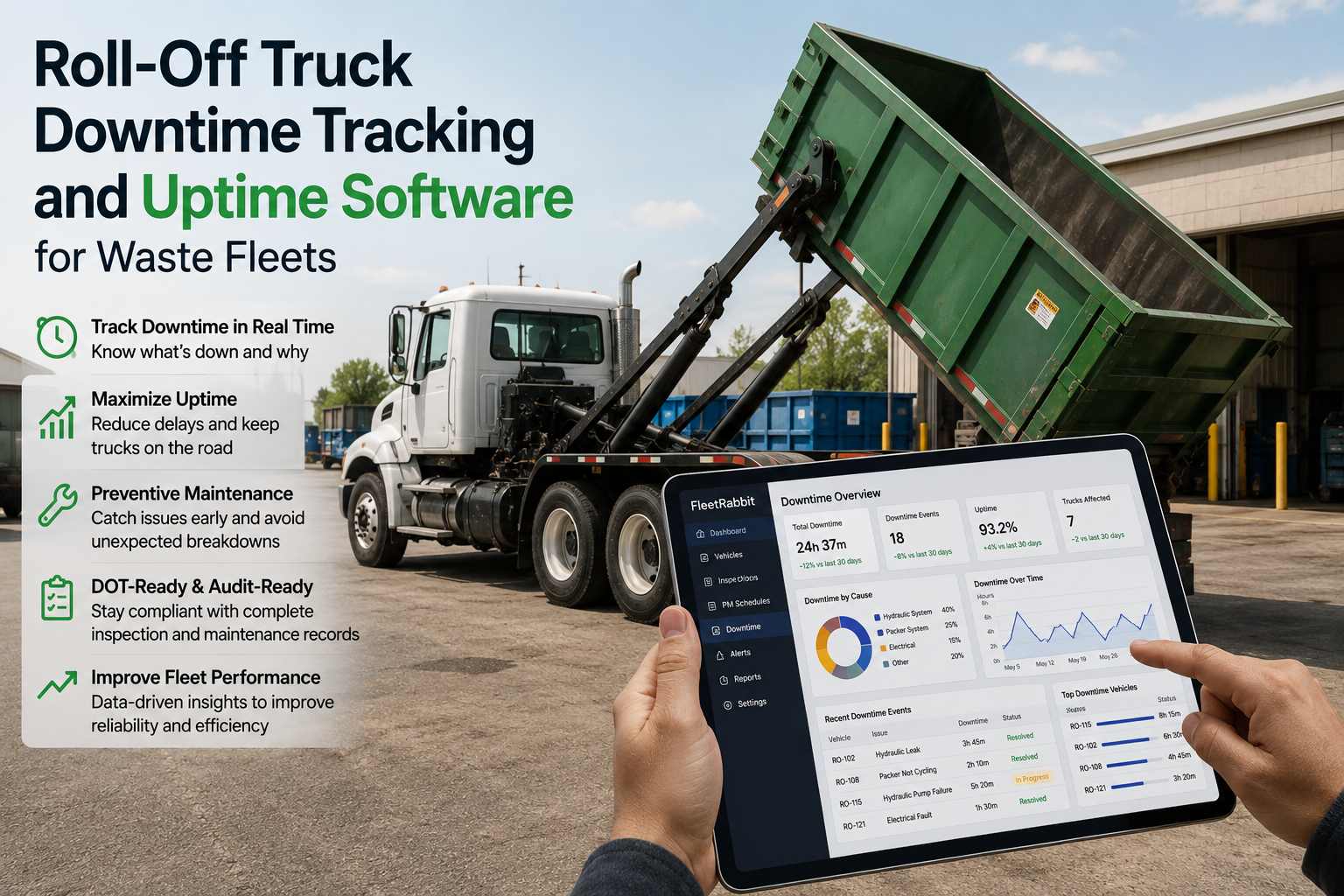
Commercial roll-off haulers, industrial scrap collectors, and construction waste fleet operations manage demanding job schedules under tight margins: hoisting 20-to-40-yard heavy debris containers, navigating abrasive demolition sites, and maintaining continuous route turnarounds. When winch cable fraying, hydraulic hoist pressure drops, frozen subframe rollers, and landfill queue delays are tracked informally on paper clipboards and cab notes, refuse haulers lose visibility into true root-cause bottlenecks, risking unscheduled route stalls, severe commercial customer penalties, and soaring maintenance costs. Fleet Rabbit provides dedicated roll-off truck downtime tracking and uptime management software, unifying auxiliary PTO and engine-hour telemetry, 1-touch field stoppage logging, automated PM triggers, and digital pre/post-trip DVIR workflows into one clean platform. Pinpoint mechanical hoist failures versus customer site delays, maximize commercial container turns, and log downtime events offline across remote transfer stations and landfills with zero cellular coverage. Book a Demo to see Fleet Rabbit roll-off downtime tracking in action.
SECTION 1: INDUSTRIAL SPLIT CONSOLE HERORoll-Off Truck Downtime Tracking & Uptime Software
Differentiate mechanical hoist and cable breakdowns from landfill scale delays, automate PTO-hour PM triggers, and manage photo-verified driver DVIRs across commercial roll-off fleets.
Why Generic Tools Fail Roll-Off Fleet Downtime Tracking
Standard fleet apps track basic road miles and simple vehicle idling, failing to distinguish between productive hydraulic container loading, disposal site bottlenecks, and critical winch or hoist mechanical failures.
Active Hoisting vs. Landfill Scale Blindspots
A roll-off often sits idling with its PTO engaged at a landfill disposal queue or blocked customer site; basic telematics misclassifies this idle as active container handling, masking route and transport bottlenecks.
Unrecorded Winch Cable & Roller Micro-Stoppages
Repeated short delays caused by sticking container hold-down locks, bird-caged wire ropes, or binding subframe rollers get logged verbally, leaving managers without data to overhaul assemblies before major failures.
Disconnected Driver Cab Defect Sheets
Driver notes regarding weeping hoist cylinder rods, torn auto-tarp mesh, or sluggish hydraulic valves left on paper clipboards get lost, delaying parts ordering until trucks break down on commercial job sites.
Demolition Site & Landfill Dead Zones
Demolition zones and rural disposal sites frequently lack cellular data coverage. Cloud-only apps crash, preventing drivers from logging stoppage reasons, pre-trips, or urgent work order requests in the field.
How Fleet Rabbit Powers Roll-Off Uptime & Triage
Fleet Rabbit integrates 1-touch downtime stoppage codes, PTO telemetry, digital inspection forms, and offline sync into one unified waste operations center. Request a 1-on-1 walkthrough.
Real-Time Downtime Categorization
Classify route stoppages instantly—separating winch cable faults, hydraulic leaks, and frozen subframe rollers from customer site blocks and disposal queue delays.
PTO & Hoist-Hour PM Triggers
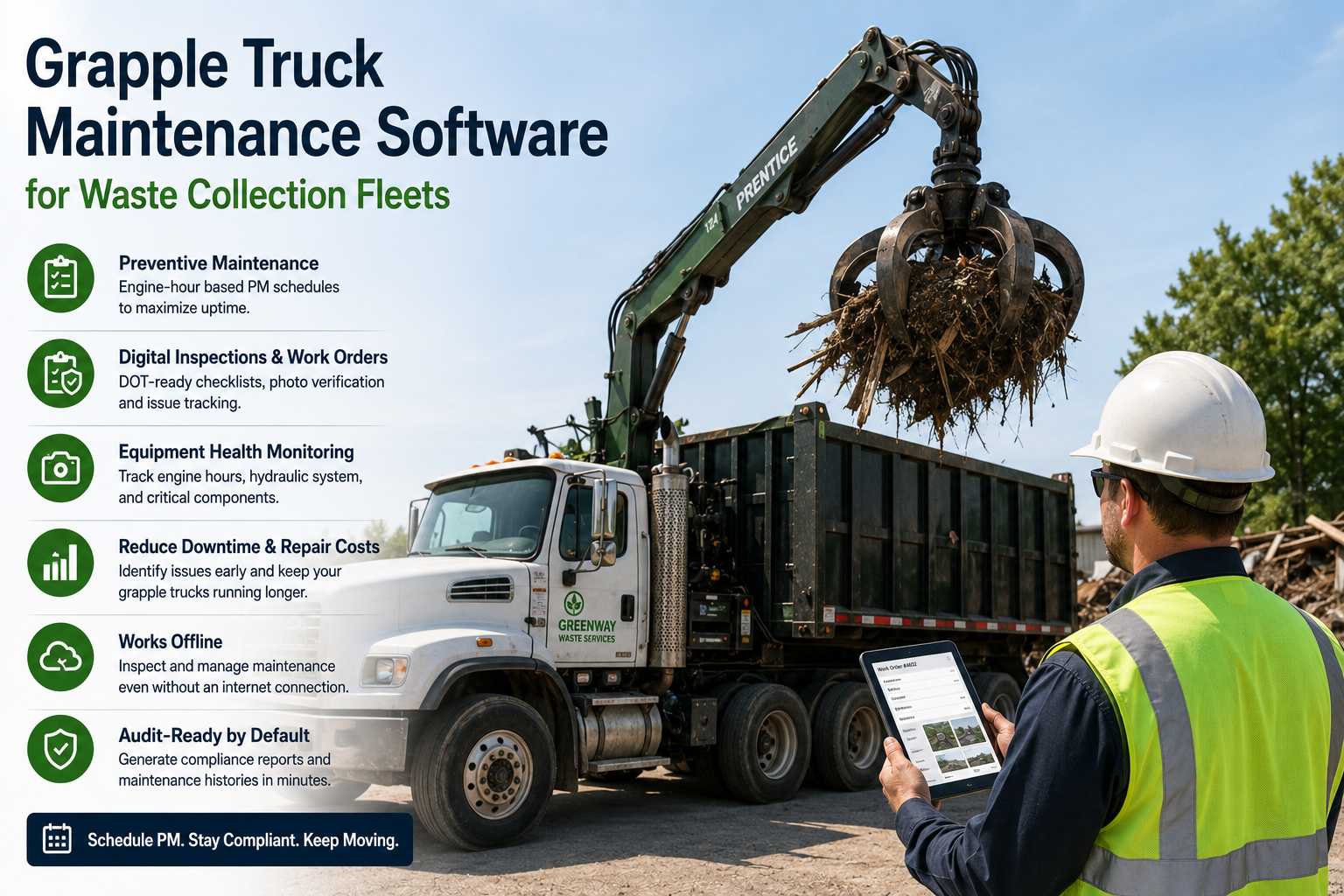
Automatically schedule winch cable replacements, subframe roller greasing, and hoist cylinder seal overhauls based on actual PTO runtime hours.
Pre-Built ANSI Z245.1 Checklists
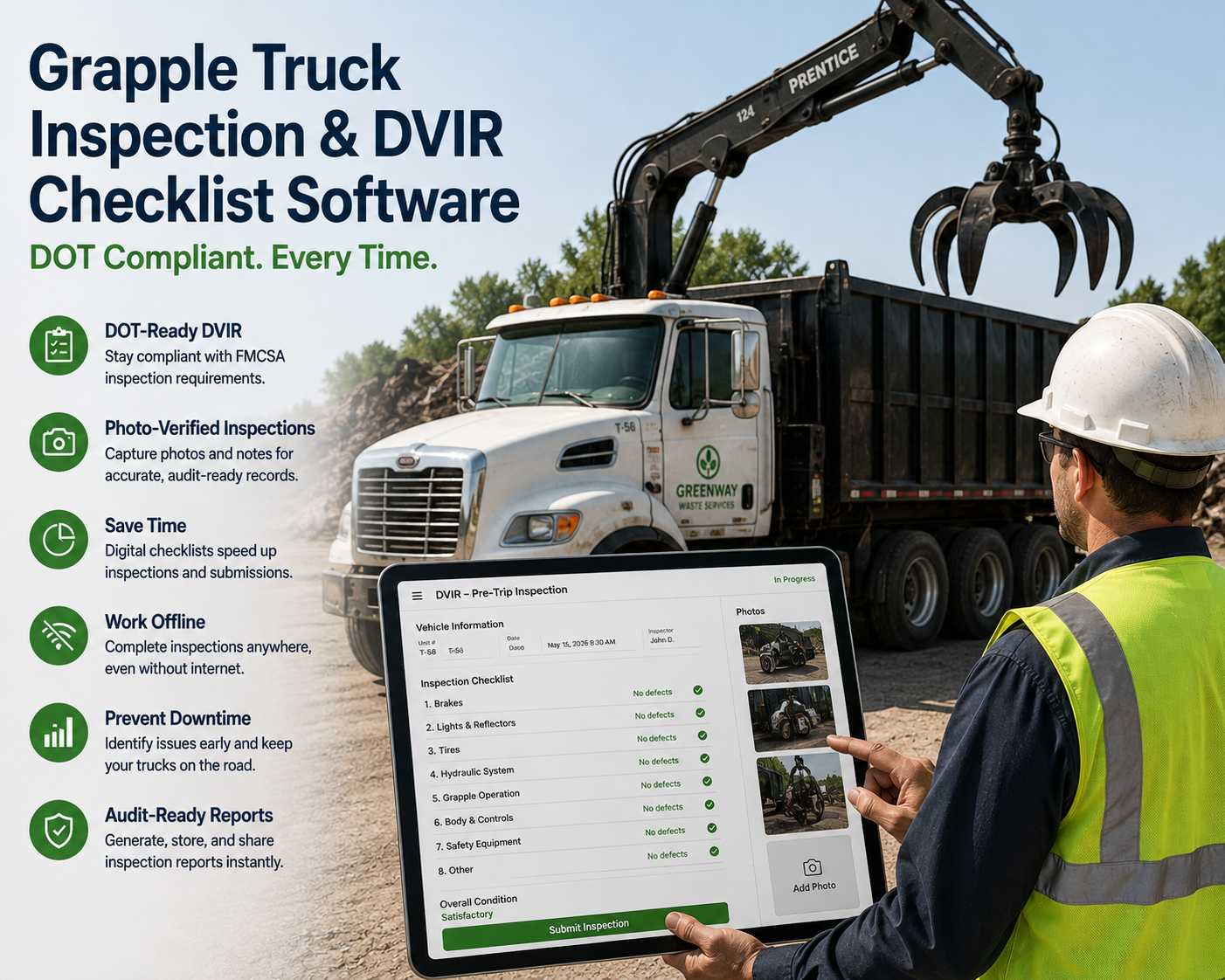
Digital pre/post-trip DVIR forms covering winch cables, safety latches, container hold-downs, auto-tarp systems, hydraulic fluid levels, and rear under-ride guards.
Full Offline Mobile Mode
Drivers record downtime reasons, complete walkarounds, and capture defect photos offline in remote construction sites; data auto-syncs when connection returns.
Closed-Loop Defect Routing
Failed checklist items immediately convert into prioritized repair work orders with attached photos routed directly to evening-shift shop mechanics.
Gated Dispatch Lockouts on Defect
Critical cable wear, leaking hoist cylinders, or failed container locks automatically mark the roll-off truck as 'Not Dispatch Ready' on central staging boards.
Safety, DOT & Environmental Compliance Standards
Fleet Rabbit’s downtime tracking and maintenance workflows are structured to meet statutory waste industry regulations across major operating jurisdictions.
Supports DOT FMCSA Part 396 pre/post-trip DVIRs, ANSI Z245.1 container hoist safety rules, OSHA 1910 machine guarding, and EPA Clean Water Act hydraulic spill prevention records.
Meets provincial Occupational Health and Safety waste equipment machinery rules, National Safety Code (NSC) Standard 13 trip inspections, and environmental fluid containment ledgers.
Aligns hooklift and cable hoist maintenance with LOLER 1998 lifting operation rules, PUWER 1998 work equipment safety directives, and commercial vehicle roadworthiness requirements.
Supports National Heavy Vehicle Regulator (NHVR) heavy vehicle roadworthiness standards, Safe Work Australia waste collection codes, and hydraulic hoist structural safety logs.
Roll-Off Truck Downtime Tracking Software Comparison
A capability comparison focused on commercial roll-off hoists, downtime root-cause tracking, and offline waste fleet functionality. Competitor data sourced from public records as of 2026. Request a technical comparison.
| Capability | Fleet Rabbit | Fleetio | Samsara | Generic Tools |
|---|---|---|---|---|
| Pricing (per vehicle) | $5/month | $4–10/month | $27–60/month | Variable ($$$) |
| Mechanical vs. Site Downtime Tracking | Native & automated | Not available | Not available | Manual entry only |
| PTO & Hoist-Hour PM Triggers | Native & automated | Requires custom setup | Requires custom setup | Manual entry only |
| Pre-Built ANSI Z245.1 Roll-Off DVIRs | Pre-built & specialized | Generic vehicle only | Generic vehicle only | Not available |
| Full Offline Mobile Sync | Full offline mode | Limited | Limited | Limited |
| Free Trial | 14 days, up to 3 assets | 14 days | Demo only | Demo only |
| Contract Terms | Monthly or annual | Annual billing discount | 3-year minimum | Annual / Multi-year |
5-Step Implementation Roadmap
Fleet Rabbit provides an accelerated deployment program engineered for waste haulers, taking your roll-off trucks from paper logs to live downtime tracking in two weeks.
Chassis & Hoist Mapping
Import roll-off bodies, chassis VINs, hoist capacities, reeving cylinder specs, PTO hour meters, and winch cable configurations.
Downtime Reason & Stoppage Setup
Configure customized stoppage codes (winch cable wear, cylinder leak, tarp motor bind, customer site access delay, scale line wait).
Safety & Lockout Configuration
Set pass/fail triggers for critical items (winch cable wear limits, container hold-downs, auto-tarp systems) and automated dispatch locks.
Driver & Mechanic Mobile Rollout
Equip roll-off drivers and shop mechanics with the intuitive offline-first mobile maintenance and inspection application.
Live Operations Board Go-Live
Activate real-time route readiness indicators, root-cause downtime triage queues, and exportable DOT compliance maintenance ledgers.
2-Week Deployment Plan & Results
Modernize roll-off truck downtime tracking and maintenance scheduling with zero disruption to commercial waste operations. Request an onboarding plan.
Week 1: Setup & Configuration
- Audit paper maintenance books, auxiliary PTO hours, and hoist hydraulic specifications
- Set automated PM intervals for winch cable replacements, subframe rollers, and reeving cylinders
- Assign user permission levels for roll-off drivers, shop mechanics, and fleet managers
Week 2: Field Pilot & Go-Live
- Conduct quick 15-minute driver training on offline mobile downtime logging and daily walkarounds
- Test automated work order creation on simulated hydraulic leaks and cable wear faults
- Activate central live readiness board and exportable DOT compliance maintenance ledgers
Eliminate Unscheduled Stalls and Keep Every Roll-Off Truck Rolling
Track mechanical versus operational downtime root causes, automate PTO maintenance triggers, and ensure zero dispatch blindspots. Start today at $5/vehicle/month with a 14-day free trial.
Real-World Operational Results
Proven operational outcomes reported by commercial waste haulers and industrial roll-off contractors. Request the full waste case study.
Mechanical Downtime Reduction — 36-Truck Roll-Off Fleet
A regional waste contractor experienced recurring route stalls caused by unmonitored subframe side roller binding and hoist cylinder packing failures. Fleet Rabbit deployed PTO-hour PM triggers and 1-touch mobile stoppage logging, cutting mechanical route delays by 44% and saving over $58,000 in prevented emergency road calls and towing fees.
Bottleneck Resolution & Faster Triage — 24-Unit Fleet
An industrial demolition hauler struggled to identify why roll-off trucks missed daily container turn targets. Fleet Rabbit's downtime categorization revealed that 32% of downtime was customer site access delays rather than machine faults, allowing dispatchers to adjust billing and contract terms while cutting shop defect triage from 24 hours to under 2 hours.
In commercial roll-off hauling, an idle truck sitting with a snapped winch cable or blown hoist cylinder burns profit every hour. Fleet Rabbit gave our drivers a fast offline mobile app to flag defects and log delays, and gave our dispatchers clear proof of whether delays were caused by customer site issues or equipment repairs.
Frequently Asked Questions
Upgrade Your Roll-Off Truck Downtime Tracking in Less Than 2 Weeks
Automate PTO-hour PM alerts, pinpoint root-cause downtime, and enforce digital safety DVIRs at $5/vehicle/month with a 14-day free trial.