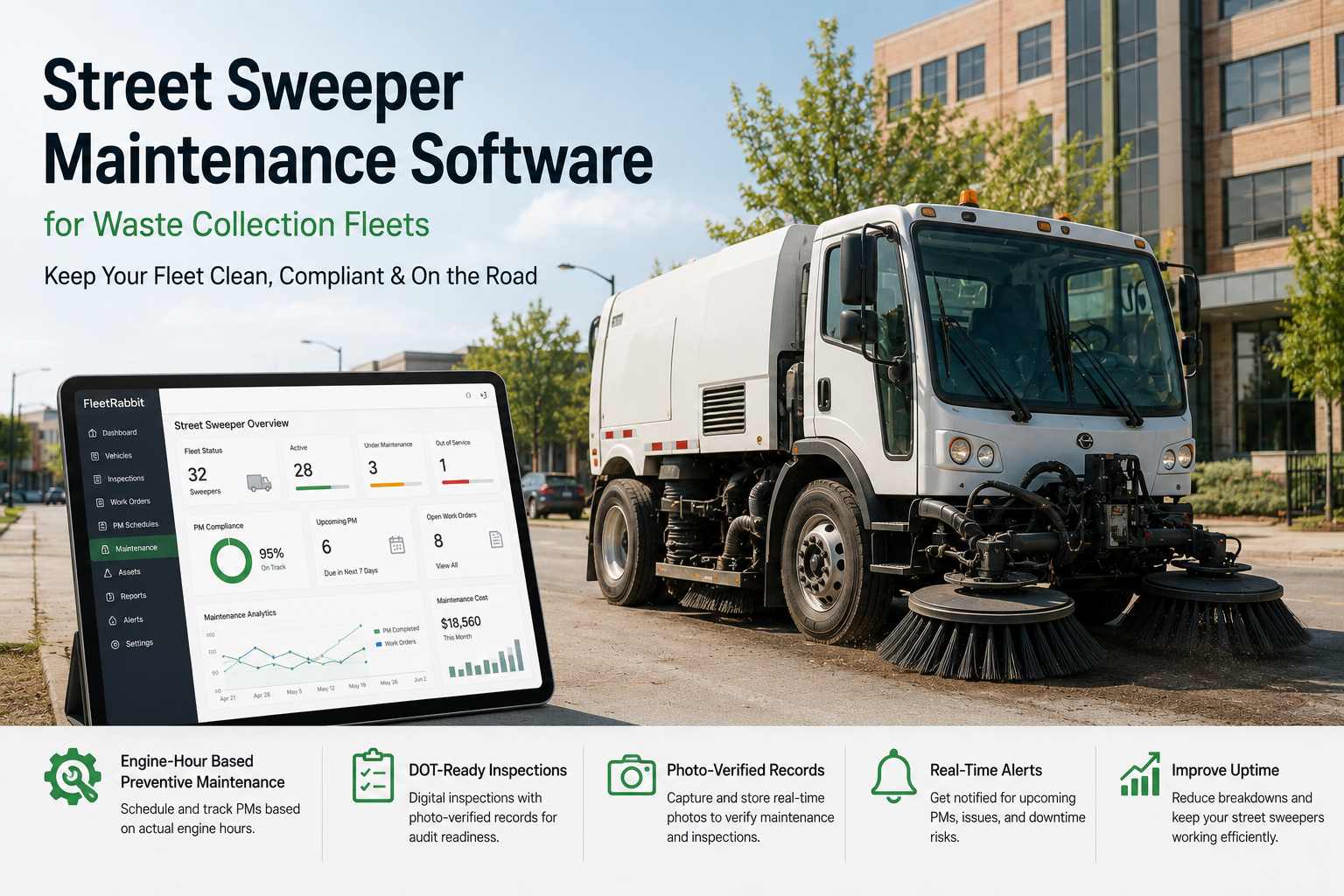
Municipal public works departments, commercial street-sweeping contractors, and waste collection fleet supervisors operate under abrasive, continuous-wear street sweeping schedules: running regenerative air and mechanical broom sweepers across curb corridors while managing severe road dust ingestion, auxiliary engine loads, water spray dust-suppression systems, and heavy hydraulic broom motor wear. When auxiliary engine run-hours, main broom pattern adjustments, gutter broom segment wear, vacuum fan impeller balance checks, and daily driver walkarounds live on paper clipboards and cab sheets, sweeping fleets face unexpected auxiliary engine breakdowns, blown hydraulic motors, water nozzle clogs, and roadside DOT out-of-service violations. Fleet Rabbit delivers specialized street sweeper maintenance software engineered for refuse and municipal fleets, unifying dual-engine telemetry, broom-wear tracking, automated PM triggers, and digital pre/post-trip DVIR workflows into one clean platform. Prevent costly vacuum impeller failures, optimize broom replacement cycles, and capture complete maintenance records offline across remote route zones and dumping yards with zero cellular coverage. Book a Demo to see Fleet Rabbit street sweeper maintenance software in action.
SECTION 1: INDUSTRIAL SPLIT CONSOLE HEROStreet Sweeper Maintenance & Fleet Management Software
Track auxiliary and chassis engine run-hours independently, automate broom pattern and impeller wear PM triggers, and enforce photo-verified DOT inspections across municipal and commercial sweeping fleets.
Why Highway Mileage Schedules Fail Dual-Engine Street Sweepers
Standard fleet management tools track vehicle servicing by odometer miles, failing to measure the extreme dust ingestion, continuous auxiliary engine loads, and intense friction wear unique to regenerative air and mechanical brooms.
Auxiliary Engine vs. Chassis Odometer Blindspots
A street sweeper may cover only 20 road miles over an 8-hour shift while the auxiliary engine runs at constant high RPMs powering the suction fan; chassis mileage schedules miss oil breakdown and air filter soot saturation.
Vacuum Fan Impeller & Housing Wear
Abrasive sand, gravel, and road grit erode vacuum fan blades and rubber scroll liners; without hour-based inspection triggers, imbalanced impellers destroy fan bearings and crack blower housings.
Gutter Broom Angle & Pattern Misalignment
Worn steel tines and improperly adjusted down-pressure gouge asphalt and wear out broom segments prematurely; paper logs fail to track pattern tests, leading to poor debris pickup and citizen complaints.
Depot & Landfill Signal Dead Zones
Sweeper dump yards, transfer facilities, and storm cleanup corridors frequently lack cellular coverage. Cloud-only tools freeze, preventing drivers from completing post-trip DVIRs or submitting urgent defect work orders.
How Fleet Rabbit Powers Street Sweeper Maintenance
Fleet Rabbit synchronizes auxiliary engine telemetry, broom wear records, automated PM triggers, and offline inspection checklists into one unified municipal fleet hub. Request a 1-on-1 walkthrough.
Dual-Engine Hour PM Scheduling
Tracks chassis engine hours, odometer miles, and auxiliary sweeping engine runtime separately to trigger timely oil analysis, valve lash checks, and air filter replacements.
Broom Pattern & Tine Wear Ledgers
Log main pick-up broom sweeping patterns, gutter broom segment wear, and squeegee flap clearances with automated replacement alerts based on sweeping hours.
Pre-Built Sweeper Inspection DVIRs
Digital walkaround forms covering water spray nozzles, vacuum suction hoses, hopper dump door seals, hydraulic motor hoses, and safety strobe beacons.
Full Offline Mobile Mode
Drivers complete photo-verified inspections, check water pump sight glasses, and log fluid additions offline; data auto-syncs securely once connection returns.
Closed-Loop Defect Routing
Failed checklist items immediately convert into prioritized repair tickets with attached photos routed directly to evening-shift bay mechanics.
Gated Dispatch Lockouts on Defect
Critical hydraulic motor leaks, inoperable warning arrows, or failed brake checks automatically mark the sweeper as 'Not Dispatch Ready' on staging boards.
Safety, DOT & Environmental Compliance Standards
Fleet Rabbit’s street sweeper maintenance and inspection workflows are structured to meet statutory municipal and waste industry regulations across major operating territories.
Supports DOT FMCSA Part 396 pre/post-trip DVIRs, EPA Clean Water Act stormwater runoff compliance, South Coast AQMD Rule 1186 (PM10-efficient sweepers), and OSHA machine guarding mandates.
Meets National Safety Code (NSC) Standard 13 trip inspection rules, provincial municipal road equipment safety directives, and environmental dust-suppression washdown reporting standards.
Aligns municipal road sweepers with DVSA commercial vehicle roadworthiness directives, PUWER 1998 work equipment safety directives, and EUnited PM10/PM2.5 particulate emission standards.
Supports National Heavy Vehicle Regulator (NHVR) roadworthiness standards, Safe Work Australia municipal vehicle operating codes, and environmental stormwater debris tracking logs.
Street Sweeper Maintenance Software Comparison
A capability comparison focused on dual-engine sweeping assets, broom wear tracking, and offline field functionality. Competitor data sourced from public records as of 2026. Request a technical comparison.
| Capability | Fleet Rabbit | Fleetio | Samsara | Generic Tools |
|---|---|---|---|---|
| Pricing (per vehicle) | $5/month | $4–10/month | $27–60/month | Variable ($$$) |
| Dual-Engine (Chassis vs. Auxiliary) Tracking | Native & automated | Requires custom setup | Requires custom setup | Manual entry only |
| Broom Pattern & Tine Wear Tracking | Native support | Not available | Not available | Manual logs |
| Pre-Built Sweeper DVIR Checklists | Pre-built & specialized | Generic vehicle only | Generic vehicle only | Not available |
| Full Offline Mobile Sync | Full offline mode | Limited | Limited | Limited |
| Free Trial | 14 days, up to 3 assets | 14 days | Demo only | Demo only |
| Contract Terms | Monthly or annual | Annual billing discount | 3-year minimum | Annual / Multi-year |
5-Step Implementation Roadmap
Fleet Rabbit provides an accelerated deployment program engineered for sweeping operations, taking your sweepers from paper logs to automated maintenance tracking in two weeks.
Chassis & Auxiliary Engine Mapping
Import street sweeper models, chassis VINs, auxiliary engine serials, broom configurations (regenerative air vs. mechanical), and hour baselines.
Dual-Engine & Wear Threshold Setup
Configure thresholds for auxiliary engine oil flushes, vacuum fan impeller balance checks, gutter broom replacements, and water filter cleanouts.
Sweeper DVIR Checklist Setup
Set up digital walkarounds covering water spray nozzles, hydraulic broom motors, hopper dump door seals, vacuum hoses, and traffic arrow boards.
Driver & Mechanic Mobile Rollout
Equip sweeper drivers and shop mechanics with the intuitive offline-first mobile maintenance and daily inspection application.
Live Dispatch Board Go-Live
Activate real-time route readiness indicators, defect triage queues, broom replacement schedules, and exportable DOT compliance ledgers.
2-Week Deployment Plan & Results
Modernize street sweeper maintenance and driver DVIR tracking with zero disruption to active curb sweeping routes. Request an onboarding plan.
Week 1: Setup & Configuration
- Audit paper maintenance books, auxiliary engine hours, and broom replacement cycles
- Set automated PM intervals for impeller wear liners, hydraulic motor filters, and water spray systems
- Assign user permission levels for sweeper drivers, shop mechanics, and public works directors
Week 2: Field Pilot & Go-Live
- Conduct quick 15-minute driver training on offline mobile DVIRs and broom wear photo capture
- Test automated work order creation on simulated hydraulic leaks and clogged water nozzles
- Activate central live readiness board and exportable DOT compliance maintenance ledgers
Eliminate Auxiliary Engine Stalls and Keep Curb Routes on Schedule
Track dual-engine operating hours, automate broom wear replacements, and stop vacuum impeller breakdowns before they cause route cancellations. Start today at $5/vehicle/month with a 14-day free trial.
Real-World Operational Results
Proven operational outcomes reported by municipal public works departments and commercial sweeping contractors. Request the full waste case study.
Auxiliary Engine Failure Elimination — 28-Sweeper Fleet
A municipal street maintenance division experienced recurring auxiliary engine seized bearings and destroyed vacuum fan impellers caused by odometer-based maintenance that overlooked continuous high-RPM sweeping. Fleet Rabbit deployed dedicated dual-engine hour tracking and automated impeller wear inspections, cutting in-service sweeping breakdowns by 46% and saving over $52,000 in emergency engine rebuild costs.
Faster Defect Resolution — 18-Unit Sweeper Fleet
A commercial parking lot and highway sweeping contractor struggled with communication lag between night-shift drivers reporting leaking hydraulic broom motors on paper sheets and morning mechanics ordering parts. Fleet Rabbit converted failed pre-trip items into instant photo-verified work orders, cutting defect turnaround time from 24 hours to under 2 hours.
Street sweepers take more abuse than almost any other vehicle in our public works fleet. An odometer tells you nothing when the auxiliary engine is spinning a vacuum fan at 2,400 RPM in heavy dust for eight hours. Fleet Rabbit gave our shop exact auxiliary engine hours so oil, filters, and impeller bearings get serviced before we suffer a roadside breakdown.
Frequently Asked Questions
Upgrade Your Street Sweeper Fleet Maintenance in Less Than 2 Weeks
Automate dual-engine PM alerts, optimize broom replacement cycles, and enforce digital safety DVIRs at $5/vehicle/month with a 14-day free trial.