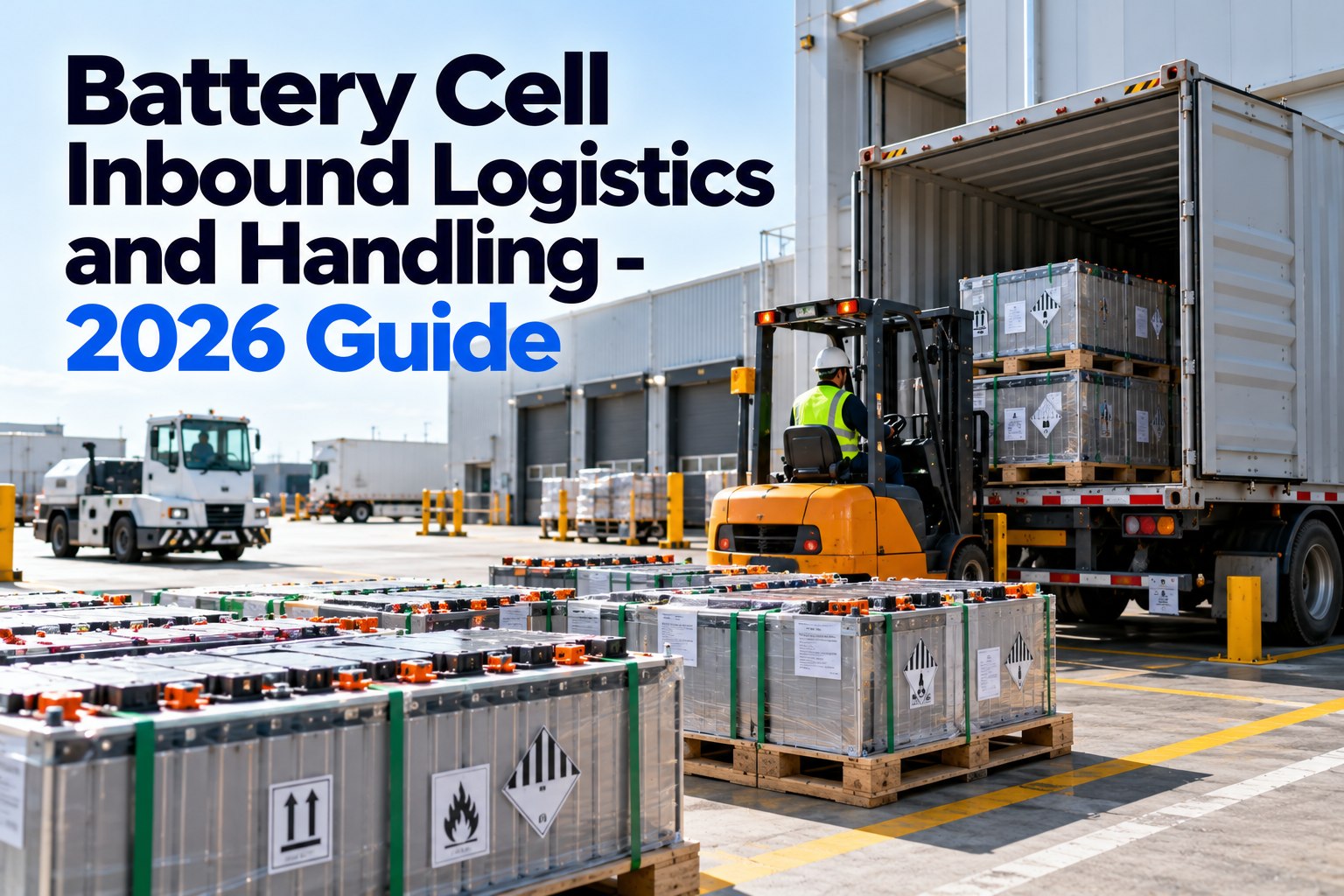
Battery cells arrive at a plant the way most parts do: on a truck, through a gate, across a dock. What makes them different is what happens if one is damaged. A lithium-ion cell that was crushed, punctured or overheated in transit can fail days later, in a rack next to thousands of others. That turns ordinary receiving into a safety step. This guide covers how cells move by road, the state-of-charge rules that differ by mode and by storage, handling constraints at the dock, a three-level damage inspection, and how to quarantine on suspicion without stopping the line. It is general guidance, so check the regulations and your fire authority for your site. To see how receiving, holds and seals work in FleetRabbit, book a short walkthrough with our team.
How the rules change by mode: road, air and damaged cells
In the U.S., lithium cells and batteries are Class 9 hazardous materials under 49 CFR 173.185, and each must be of a type proven to meet the UN 38.3 tests. Most inbound cell volume to a plant moves by truck, where the rules differ from air in two ways that matter at receiving.
| Question | Highway | Air | Damaged or defective cells |
|---|---|---|---|
| State-of-charge limit | No general limit in 173.185 | 30% for standalone lithium-ion batteries (UN3480); 2026 IATA rules extend 30% to batteries packed with equipment | Not applicable: assess and package as damaged |
| Allowed modes | Yes | Yes, under air rules | Highway, rail or vessel only; forbidden by air |
| Packaging | Prevent short circuits and damage | Per IATA packing instructions | One cell per non-metallic inner packaging, non-combustible absorbent cushioning, Packing Group I outer |
| Marking | Class 9 lithium battery label or mark | Class 9 lithium battery label | “Damaged/defective lithium ion battery” in letters at least 12 mm high |
The practical consequence for receiving: a damaged pallet found at your dock can’t simply be sent back on the next air freight. It has to be assessed, repackaged as damaged or defective, and moved by road, rail or sea, which takes time and needs a place to wait safely.
State of charge: the number that matters in transit and again in storage
State of charge (SoC) affects how violently a cell can fail. Air rules cap it in transit, and fire codes and insurers use it again once cells are in storage. The 2024 International Fire Code’s new battery storage section eases several requirements at 30% SoC or below, and FM guidance ties sprinkler protection to a 60% threshold. Ask suppliers to state the SoC on the shipping documents so receiving can record it.
Six handling constraints for cells at the dock
Most transit damage to cells is mechanical, and most of it happens in the last few metres: a tine through a carton, a pallet dropped off a dock plate, a load that shifted on a hard brake. The constraints below come from the hazmat rules and from how receiving docks actually work.
Damage inspection at three levels: trailer, pallet, package
Inspect from the outside in. A problem visible at the trailer doors changes how everything inside should be handled, so don’t start unloading before the trailer-level check is done. PHMSA lists the signs of a damaged or defective battery: swelling, discoloration, leaking or venting, odor or corrosion, loose or damaged wires, and known misuse. Many of them are only visible once packaging is opened, which is why the package-level check happens before stock, not after.
Photograph anything that fails a check, with the trailer, pallet and batch numbers in the record. If the supplier later asks what happened, the answer is a photograph taken at the door, not a description.
Quarantine on suspicion: hold first, decide second
The rule is simple: if anyone suspects a cell or pallet, it goes on hold before anyone debates it. Quarantine is cheap; a damaged cell in a rack is not. PHMSA notes that where a battery’s condition can’t be determined, the shipper should rely on a technical expert or the manufacturer, so build that assessment into the process.
Two details make quarantine work in practice. The hold has to be in the system, not just a sign on the pallet, so the batch can’t be allocated to an order while it waits. And the quarantine area needs its own fire plan: separation from other stock, a defined capacity, and a check with your fire authority, because the 2024 IFC battery storage requirements may apply to it.
Traceability: the receiving record to keep for every cell shipment
When a cell fails months later in a module or a pack, the first question is where it came from and what happened to it on the way. Answering it takes a receiving record created at the dock, not reconstructed afterwards. Keep these fields against every inbound batch, and link them to the trailer and the trip so the whole journey can be read back.
If a cell vents at the dock: the first minutes
A damaged lithium-ion cell can go into thermal runaway with little warning. Signs include smoke or vapour from a package, hissing or popping, a sweet or chemical smell, and heat you can feel through the packaging. Your emergency plan, agreed with the local fire service, sets the response, but most plans share the same first steps: stop work, clear the area, raise the alarm and call the fire service, and don’t try to move a venting pallet unless trained and equipped to do so. The shipping paper’s emergency response information, including the UN number and the emergency phone number, should be easy to hand to responders. Afterwards, every other pallet from the same trailer goes on hold until it has been assessed, because whatever damaged one cell may have damaged its neighbours.
Trailers and the yard: battery loads waiting outside
Inbound battery trailers often wait in the yard for a door. Treat them as a distinct class of load. Record them at the gate so the yard count shows how many battery trailers are on site and where. Park them in a designated area with clear access for emergency vehicles, away from buildings and other trailers where you can. If loaded trailers sit for long periods, ask your fire authority whether outdoor storage rules apply. The 2024 IFC sets a general 20-foot separation from buildings for outdoor battery storage, reducible with added protection. Assign battery trailers to doors first rather than letting them queue, and check the seal before the doors open.
Many plants also move these trailers with electric yard tractors. Those tractors are fleet assets in their own right, with their own battery health, charging schedule and maintenance, and they belong in the same preventive maintenance schedule as the rest of the yard fleet.
Turn damage findings into fewer damaged loads
Each damaged or held pallet is also information about a supplier, a carrier or a lane. Review holds monthly by supplier and carrier, and look for patterns: one carrier whose loads shift, one supplier whose corner protection fails, one lane with consistent seal problems. Share the photographs with the supplier along with the counts. A finding backed by a photograph from the door is much easier to act on than a complaint, and it turns receiving inspection from a cost into a way of improving what arrives.
Where FleetRabbit and Oneflow fit today, stated plainly
From the gate to a released batch, with the evidence at every step
The trucks and trailers that carry cells need the same care as the cargo. Floors, doors and seals are checked on every digital DVIR, and repairs are tracked in fleet maintenance records so a damaged trailer floor is fixed before it damages the next load.