Most loading dock incidents start the same way: a trailer moves when everyone assumed it was fixed in place. It creeps away under forklift braking, a driver leaves early, or a dropped trailer’s landing gear gives way. Vehicle restraints, communication lights and interlocks between the restraint, the door and the leveler exist to stop that, and OSHA has required trailers to be secured during forklift loading for decades. This guide covers the four ways trailers move, the rules that apply, how restraint types compare, how an interlock sequence should work, and what monitoring software can and can’t add on top of the dock equipment. To see how dock door records work in FleetRabbit, book a short walkthrough with our team.
The rule stack: what OSHA and ANSI expect at a dock door
No single rule covers the whole dock. The requirements build on each other, from the basic chocking rule for forklift loading to the industry standard for the restraint itself. Plants in OSHA state-plan states should check their state rule, which must be at least as effective.
The practical reading: chocks and set brakes are the baseline, a properly rated restraint can stand in for chocks where it gives equal protection, and uncoupled trailers need support under the nose. The restraint standard then sets the performance a restraint has to meet.
Hook, barrier, automatic or chocks: how the restraint options compare
| Option | How it holds the trailer | Works best when | Watch for |
|---|---|---|---|
| Hook-style restraint | Engages the trailer’s rear impact guard | Trailers have an intact, standard rear guard | Bent, missing or non-standard guards |
| Barrier-style restraint | Places a barrier in front of the trailer wheels | Rear guards vary or are often damaged | Wheel position and approach angle |
| Automatic restraint | Powered, with communication controls and lights | Busy doors where interlocks and status signals matter | Power, sensors and light faults |
| Mechanical restraint | Manually operated, no hydraulics or power | Lower-volume doors | Relies on the operator every time |
| Wheel chocks | Block the rear wheels with brakes set | Doors without a restraint, or as backup | Not placed, wrong size, icy or oily ground |
| Trailer stands or jacks | Support the nose of an uncoupled trailer | Drop-trailer operations | Not used because the trailer “looks fine” |
Restraint types are described in the ANSI MH30.3 standard and in manufacturer documentation. Ratings, light requirements and installation details vary by product, so check the specification sheet for each door rather than assuming every restraint performs the same.
An interlock sequence where each step waits for the one before it
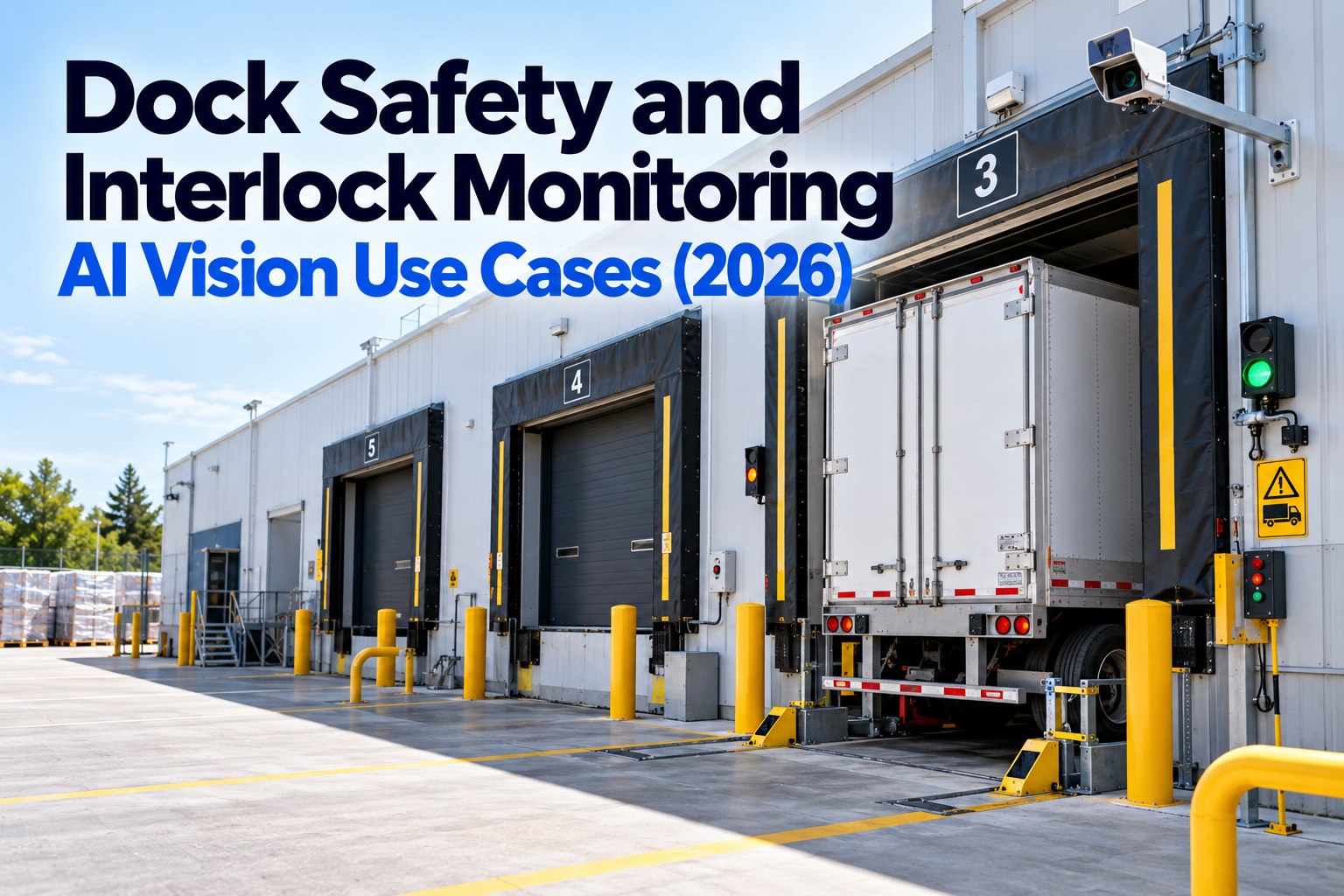
An interlock makes the safe order of operations the only order possible. The door won’t open until the restraint holds the trailer, the leveler can’t deploy until the door is open, and the restraint can’t release until the leveler is stored and the door is closed. Communication lights tell each side what state the door is in: typically red outside means the driver must not move, and green inside means the forklift may enter. The sequence below is a common pattern; the exact logic depends on your dock equipment.
The weak point is the override. Restraints that can’t engage a damaged rear guard, or lights that fail, lead staff to bypass the interlock and fall back to verbal signals. Every override should be logged with who used it and why, and a door that needs frequent overrides needs maintenance, not a workaround.
What dock equipment should do, and what monitoring software should do
The safety interlock belongs in the dock equipment: the restraint, the door and the leveler controls. It must work without a network, a server or a camera. Monitoring software sits beside it and keeps the record, so a manager can see what happened at each door and spot the doors and trailers that keep causing trouble.
Cameras can help with the second column, for example confirming that a trailer is at a door or that a door is open. They should not be the safety interlock. A camera can lose its view, its power or its connection, and a camera that has quietly stopped reporting looks exactly like a door with nothing happening.
Preventing early departure starts with the driver, not the dock
A restraint stops the trailer, but early departures usually begin with a misunderstanding. The driver thinks loading is finished, or never knew a forklift was still inside. The controls that work are procedural as much as mechanical: a clear rule that drivers wait in a marked area away from the trailer while it is being worked; a single release signal, such as the outside light turning green, that drivers are trained to wait for; and, at some sites, key control or glad-hand locks so the tractor can’t move until the dock releases it. For visiting carriers, brief the rule at the gate check-in rather than relying on the driver to know each plant’s system. The same driver walks around the truck before leaving, so the dock release and the pre-trip DVIR naturally happen in the same window.
Inspect the dock door like any other piece of equipment that can fail
Restraints, levelers, lights and seals wear out like any other equipment. A daily check at the start of the shift catches most faults before they lead to an override. Check that the restraint engages and releases fully, that both communication lights work in both states, that the leveler lip deploys and stores cleanly, that chocks and trailer stands are present and in good condition at each door, and that the approach is clear of ice, oil and debris. A failed check should become a repair job with an owner, not a note on a clipboard, and the door should be tagged out of use if the restraint or lights don’t work. Over time, the inspection history shows which doors and which components fail most, which is where to spend on replacement.
Drop trailers and container chassis need their own rule at the door
Live loads have a tractor and a driver attached. Drop trailers and containers on chassis don’t, and that changes the risk. With no tractor coupled, the front of the trailer rests on its landing gear, so the weight of a loaded forklift driving to the nose puts the whole load on two legs that were never designed for repeated impact. OSHA 1910.178(k)(3) notes that fixed jacks may be needed to support a semitrailer not coupled to a tractor and prevent up-ending. In practice, that means trailer stands at every door that takes drop trailers, a rule that a stand is placed before the first forklift enters, and a check of landing gear condition when the trailer arrives. Intermodal chassis deserve the same attention: their landing gear and twist locks should be checked at the gate, because a damaged chassis is far easier to refuse at the barrier than to discover at the dock.
Start with the doors that override most
If you are improving an existing dock rather than building a new one, the override log tells you where to begin. Rank doors by how often the interlock was bypassed and why. A door that overrides because restraints can’t catch damaged rear guards may need a barrier-style restraint. A door that overrides because the lights fail needs a repair schedule. And a door that overrides because loading runs late and drivers are impatient needs a better release process, not new equipment. Fix the top three doors, measure overrides for a month, then move down the list.
When a trailer moves anyway: what to record
Treat every trailer movement at a dock as an incident, even when nobody is hurt. Stop work at the door, make the area safe, and record the door, the trailer and carrier, the time, the restraint and light status, whether an override was in use, and who was inside. Photograph the trailer position and the restraint. Then look for the pattern. One trailer with a bent rear guard is a carrier conversation. The same door three times in a month is an equipment problem. Repeated early departures by visiting drivers point back to the gate briefing.
Where Oneflow fits today, stated plainly
Every trailer at every door, with a record you can stand behind
Dock equipment faults and trailer damage found at the door should land in the same place as the rest of your repairs. FleetRabbit keeps them in fleet maintenance records alongside the tractors and trailers that use the dock.