Attendance in a depot is not an HR record. It is a capacity input and, under the hours-of-service rules, potentially a duty-status question too. 49 CFR 395.2 counts as on-duty time all time at a terminal or facility waiting to be dispatched, unless the driver has been relieved from duty by the motor carrier — so the moment a driver is standing at your gate waiting for a load, the clock the regulator cares about may already be running. A generic attendance app does not know that, and it does not know that your morning plan is limited by the smaller of the trucks in the yard and the drivers who actually turned up. See a shift board build itself and the difference becomes obvious in about five minutes.
A Clock-In Should Prove Somebody Turned Up. Most Only Prove a Button Was Pressed.
For depot and transport managers, shift supervisors and operations leads: what a punch has to carry, why verification must never make a driver wait at a barrier, and why location belongs on the record as a warning rather than as a lock on the door.
No credit card required. Attendance, dispatch, inspections and maintenance on one record.
Verification Runs After the Shift Starts
This is the single design decision that determines whether a depot kiosk survives its first month. A driver at a barrier at six in the morning cannot wait on a computer, and any system that makes them wait gets worked around or unplugged.
Illustrative timings. The principle is that the capture and the verification are separate events: the punch is recorded instantly with everything needed to check it later, the driver is released, and the face check completes against the enrolled photo in the background. A failure becomes an exception a supervisor reviews, not a queue at the gate. Systems that invert this — verify first, admit second — are the ones that end up with a taped-over camera and a paper sheet on a clipboard.
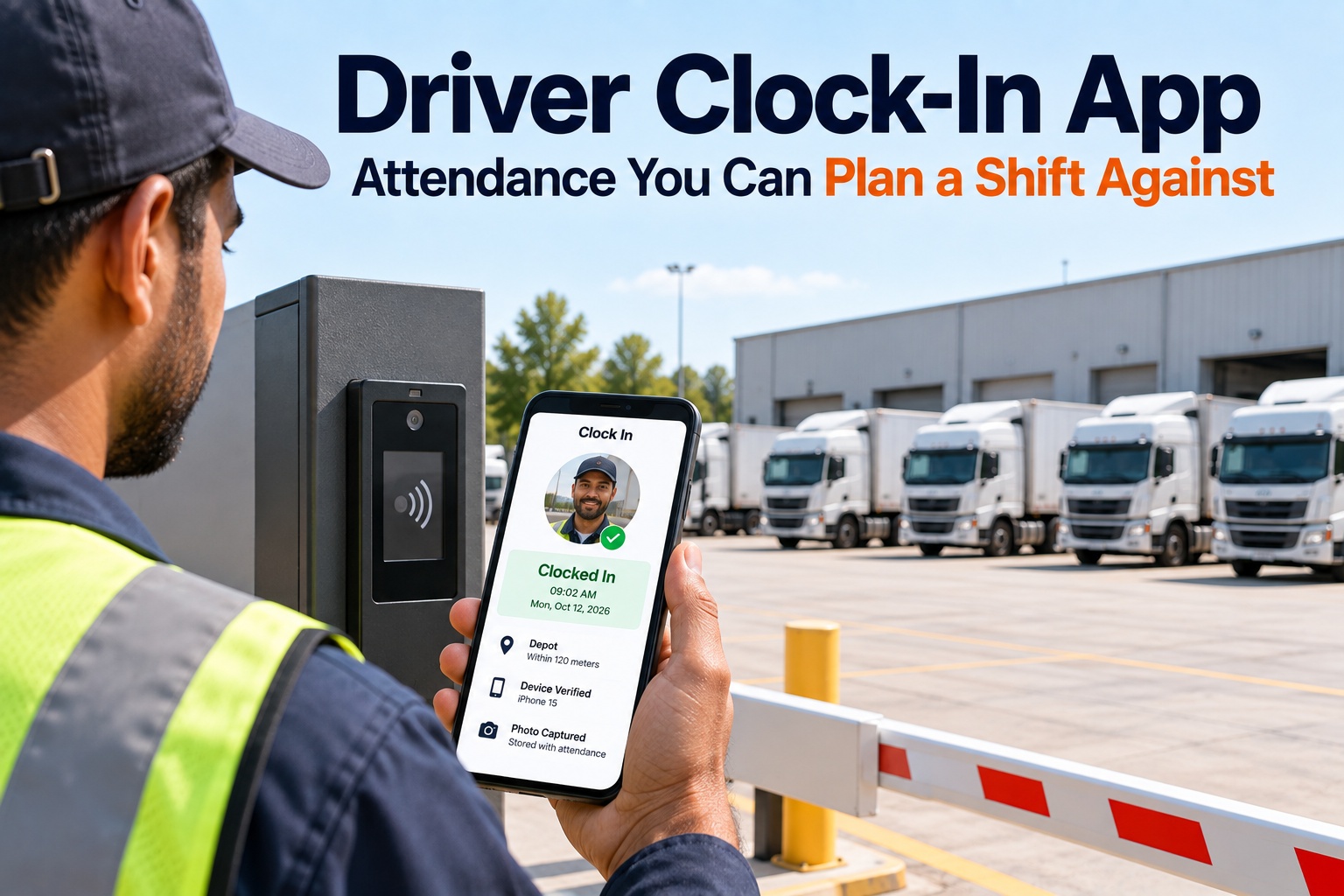
Three Things a Punch Has to Carry
Individually each one is weak. Together they turn a timestamp into something you could show somebody.
Taken at the punch, so the record shows a face and not just an event. This is what turns a clock-in from an assertion into evidence.
Which tablet or handset the punch came from. A punch from an unexpected device is a question worth asking; a punch from the depot kiosk is not.
How far that device was from where it is meant to be. Recorded as a number, not as a verdict.
Where Attendance Meets Hours of Service
Waiting to be dispatched at your facility is on-duty time unless the driver has been relieved from duty
The regulation defines on-duty time as all time from when a driver begins work or is required to be in readiness to work until relieved from work and all responsibility for performing work — and it lists, first, all time at a plant, terminal, facility or other property of a motor carrier or shipper, or on any public property, waiting to be dispatched, unless the driver has been relieved from duty by the motor carrier. Inspecting or servicing a vehicle counts too, as does loading and unloading, and time attending a disabled vehicle.
Can You Build Tomorrow's Plan Before Seven?
Only if you know who is actually here. In thirty minutes we will set up a depot kiosk on one site and show the shift board filling as drivers arrive, with the verification resolving behind it and the plan capped at what is genuinely available rather than what the roster says.
How FleetRabbit Handles This
- The driver taps in at the tablet by the gate
- The punch is stored with a photograph
- The device it came from is anchored to the record
- The distance from where that tablet is meant to be is recorded as a number
- The driver walks away
- Face verification runs against the driver's enrolled photo
- A pass simply appears on the board as verified
- A failure becomes an exception for a supervisor, not a refusal at the gate
- Location anomalies sit on the record as warnings, never as blocks
- Attendance and evidence are readable together — open any punch to see the photo, the device and the distance
What Trustworthy Attendance Unlocks
A verified punch is not the point. It is the precondition for three things that are, and each one fails quietly when attendance is a button press nobody can stand behind.
A fleet list counts trucks that exist and a roster counts drivers who are employed. Neither tells you what can leave this morning. With the gate counting vehicles actually in the yard and the kiosk counting drivers actually verified, the plan can be capped at the smaller of the two — which is the difference between a plan built at six and a plan corrected at seven when two drivers are missing.
The pre-trip check is only as good as knowing who did it. When the verified driver is the one who runs the seven-point certification, the inspection report carries a person as well as a result — and a failed item that raises its own maintenance request is attributable rather than anonymous.
In the workshop the same principle applies to technicians. Clocking on to a job puts those hours onto the work order cost, so preventive maintenance carries real labour rather than an estimate, and a repeat repair can be costed properly the third time it appears.
The through-line is that attendance stops being an HR artefact the moment it is trusted enough to be an input. Until then it is a record nobody references, kept because somebody decided it should be.
Location Is a Warning, Not a Block
Six situations and what should happen in each. Note that the answer is never to refuse the punch. Try the rules on one depot free.
| What happens | What the system should do | Outcome |
|---|---|---|
| Driver at the depot, strong signal, distance near zero | Nothing. It is a normal punch | Recorded |
| Driver at the depot, poor signal, distance reads 400 m | A warning on the record, not a refusal | Recorded, flagged |
| Driver at a customer site starting a shift there | A warning, because it is unusual rather than wrong | Recorded, flagged |
| Punch from a device that is not the depot kiosk | A warning, and worth a supervisor glance | Recorded, flagged |
| Distance of several kilometres, repeatedly, same person | A pattern, and now a conversation | Recorded, flagged, escalated |
| No location available at all | A warning. A missing signal is not misconduct | Recorded, flagged |
A poor signal does not stop somebody who is genuinely at work, it just stops them clocking in — and now you have a person working with no record, which is worse than a record with a warning on it. Every blocked punch also produces an argument at a barrier with a queue behind it, and a kiosk that argues with people gets unplugged within a week. Record everything, flag what is unusual, and let a supervisor decide. The system's job is to make the pattern visible, not to adjudicate at six in the morning.
Attendance Questions Depot Managers Ask
What should a driver clock-in app actually record?
Three things beyond the time: a photograph taken at the punch, the device it came from, and how far that device was from where it should be. A timestamp on its own proves a button was pressed somewhere, which is not something you can plan a shift against or show to anybody. See a punch opened up.
Does clocking in at a kiosk change a driver's duty status?
No, and it should not. The record of duty status lives on the ELD and belongs to the driver. Attendance tells you who is on site and available; it is an operational input, not a log entry. Any product that quietly annotated duty status from a kiosk punch would be creating a compliance exposure rather than removing one. Keep the two records separate, free.
Is waiting at the depot counted as working time?
Under 49 CFR 395.2 it generally is. On-duty time expressly includes all time at a terminal, facility or other property of a motor carrier or shipper waiting to be dispatched, unless the driver has been relieved from duty by the carrier. That makes how long drivers wait at your gate an operational cost and a compliance fact at the same time. Discuss how this affects your depot.
Why not verify the driver before letting them start?
Because it makes a person stand at a barrier while a computer decides about them, at the busiest minute of the day, with a queue forming. Capture instantly, verify afterwards, and surface failures as exceptions. The verification is just as rigorous; it simply does not happen in front of an audience. Try the asynchronous version.
What if the location reading is wrong?
It gets recorded as a warning and the punch stands. Depot gates are frequently poor for signal, and a driver who is genuinely at work should never be prevented from clocking in by a satellite fix. Warnings are for patterns — one anomaly is noise, the same anomaly every morning is a conversation. See how warnings are surfaced.
How does attendance change dispatch?
It caps it. A fleet list tells you how many trucks exist and a roster tells you how many drivers are employed, and neither tells you what can leave this morning. The honest number is the smaller of the trucks actually in the yard and the drivers who actually turned up and verified. See the capped plan free.
What about buddy punching figures?
You will find plenty of them quoted and we have deliberately not repeated any here. The commonly circulated statistics are largely unattributed, undated, or traceable only to vendor marketing material, and a business case built on a number you cannot source will not survive its first review meeting. The argument for photographic attendance does not need them. Build the case on your own data.
Know Who Turned Up Before You Plan the Day
FleetRabbit captures every punch with its photograph, device and distance, verifies afterwards so nobody waits at the barrier, keeps location anomalies as warnings rather than locks, and feeds the verified driver count straight into the day's plan — alongside the same units' inspection records and open work orders.
No credit card required. Start with one depot and one week of shifts.