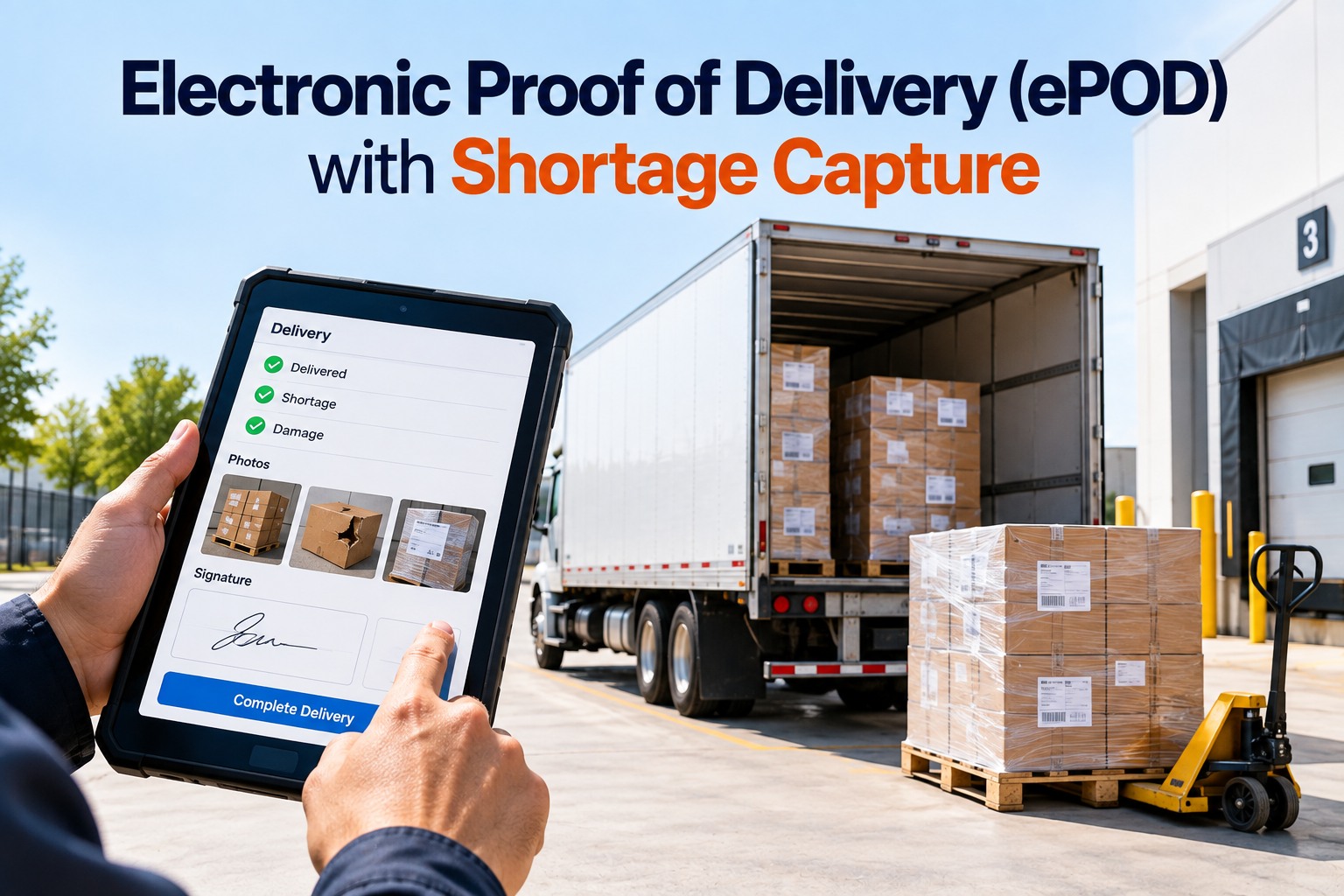
A freight claim is decided by evidence that existed for about ninety seconds. Everything after that is reconstruction. The regulation makes the asymmetry stark: under 49 CFR Part 370 a carrier has 30 days simply to acknowledge a claim, and 120 days to pay it, decline it or make a firm compromise settlement offer in writing — and if it cannot resolve the matter in that time it must keep the claimant updated every 60 days after. Meanwhile the claim itself only needs three things to be validly filed: facts sufficient to identify the shipment, an assertion of liability for the alleged loss or damage, and a claim for a specified or determinable amount of money. That is a low bar to clear and a long window to argue in, and the only period in which anybody could actually have established what was on the pallet closed the moment the driver pulled away. Electronic proof of delivery is not a digital signature pad. It is the discipline of recording the count, the condition and the exception at the stop, against the line they belong to, so that four months later the answer is a record rather than a recollection. This page covers the claim clock, the five things a stop has to capture, what separates a short from a concealed damage claim, and how FleetRabbit puts the evidence on the delivery. See a delivery with its evidence, or start free on one route.
The Evidence Exists for Ninety Seconds. The Argument Lasts Four Months.
For transport managers, delivery operations leads and anyone who handles freight claims: what a stop has to capture, why a signature on its own proves almost nothing, and how an exception recorded against the right line settles a claim that a note on the whole delivery cannot.
No credit card required. Deliveries, exceptions and vehicle records in one place.
The Claim Clock, and the Moment It Depends On
The timeline on the right is generous. The window on the left is not, and it is the one that decides the outcome. Show me a shortage claim.
Deadlines per 49 CFR Part 370: acknowledgment within 30 days of receipt under §370.5, and a written decision to pay, decline or make a firm compromise settlement offer within 120 days under §370.9, with status updates every 60 days thereafter if it remains unresolved. The nine-month filing period commonly applied to cargo claims derives from the Carmack Amendment and the bill of lading terms rather than from Part 370 itself — check the governing contract, because the period is contractual and can differ. The capture window on the left is illustrative.
Five Layers, and Only One of Them Is the Signature
Most ePOD deployments capture the first layer and stop. That proves somebody was there and accepted something, which is rarely the point in dispute.
Who accepted it, at what time, at what location. On its own it proves attendance, not condition.
Line by line against the manifest, entered at the stop rather than reconciled later.
Photographs taken before anything is moved, with the packaging still as delivered.
Short, damaged, refused or over — recorded against the specific line, not as a note on the whole delivery.
Arrival and departure time, GPS position, and the driver who was there.
The Exception Types, and What Each One Needs
An exception recorded against the whole delivery is an argument. An exception recorded against a line is a claim. Swipe the table on mobile.
| Exception | What it means | What has to be captured at the stop |
|---|---|---|
| Over | More goods arrived than were ordered | A count at the stop, against the manifest, with the surplus photographed and the reason recorded |
| Short | Less cargo was received than was ordered | A count noted on the receipt at the moment of delivery — the single most disputed field in freight |
| Damaged | The item is defective, unusable or not according to specification | Photographs of the damage in place, before it is moved, with the packaging and the pallet visible |
| Refused | The consignee would not take it | The reason in the consignee's own words, plus the condition evidence that supports or contradicts it |
| Concealed | Not visible until the packaging was opened | Whatever condition evidence exists from the stop, which is the only thing that separates a carrier problem from a consignee one |
Over, short and damaged definitions follow standard OS&D usage — an overage being more goods received than ordered, a shortage being less cargo received than ordered, and damage being an item found defective, unusable or not according to specification. Concealed damage is the hardest of the five precisely because the stop produced no visible exception, which is why the condition evidence captured anyway is what decides it.
How Long Does a Shortage Claim Take You to Answer?
If the answer involves phoning a driver about a delivery from three months ago, that is the gap. In thirty minutes we will run one of your own disputed deliveries through the capture flow and show you what the record would have looked like — count, condition, exception and context, all attached to the line.
How FleetRabbit Handles This
Each delivery is confirmed at the stop with proof captured there and then, rather than being reconstructed when the trip is settled hours later.
Not remembered afterwards, and not attached to the trip as a general note. The exception sits on the line it belongs to, which is what makes it usable in a claim.
If a captured value cannot be trusted — a poor photograph of a count, an unreadable figure — it is held with the reason attached instead of being written in as though it were certain. A guess in a system of record is worse than a gap.
Proof of delivery and shortages are written back to your ERP as the delivery document, which is where billing and claims already look — with the evidence link alongside, and the exact message kept and replayable.
The delivery sits beside that vehicle's inspection history, its open defects and its work orders, so a claim, a damaged tail-lift and a missed service are visible as facts about the same asset.
Part 370 also obliges the carrier to keep its records straight: §370.5 requires a separate file per claim with a successive claim number, the date of receipt recorded, and the claim file number noted on shipping orders and delivery receipts — or comparable internal procedures that ensure all relevant records are examined and duplicate payments prevented. A delivery record that already carries its own evidence makes that obligation considerably cheaper to meet. Link it to the inspection report and preventive maintenance so the vehicle's condition history sits with it.
Reconstructed Against Captured
The same six questions, answered two ways. Swipe the table on mobile.
| The question a claim asks | Reconstructed later | Captured at the stop |
|---|---|---|
| The count | "I think it was two short" | A line-level count entered at the stop |
| The condition | A photograph taken at the depot the next morning | Photographs taken before the pallet moved |
| Who signed | A name nobody can read | A captured signature with a timestamp and a position |
| When it happened | Reconstructed from the route | The stamp from the moment itself |
| Which line was wrong | The whole delivery is disputed | The exception sits on the line it belongs to |
| Where the evidence lives | In three systems and a phone | On the delivery record, which is what the claim references |
ePOD Questions Transport Teams Ask
What is electronic proof of delivery?
A digital record that a delivery happened and in what condition. The weak version captures a signature; the useful version captures the count against the manifest, the condition in photographs, any exception against the specific line, and the time and place it all happened. The difference only shows up when something is disputed. See both versions side by side.
How long does a carrier have to settle a freight claim?
Under 49 CFR §370.9 a carrier must pay, decline or make a firm compromise settlement offer in writing within 120 days of receiving the claim, and must acknowledge receipt within 30 days under §370.5. If it cannot resolve the claim inside 120 days it has to advise the claimant of the status every 60 days after that. Keep the evidence ready, free.
What does a freight claim actually have to contain?
Less than most people expect. Part 370 sets the minimum as facts sufficient to identify the shipment, an assertion of liability for the alleged loss, damage, injury or delay, and a claim for payment of a specified or determinable amount of money. The low bar is precisely why the defending evidence matters so much. Discuss your claims process.
Is a signature enough proof of delivery?
For proving attendance, usually. For proving condition or quantity, almost never. A signature establishes that someone accepted something at a time and place; it says nothing about whether two cartons were missing or a pallet was crushed. Those are separate captures and they have to happen at the stop. Capture all five layers free.
How do we handle concealed damage?
It is the hardest exception because the stop produced no visible problem, so the argument becomes whether the damage happened in transit or after delivery. What tips it is condition evidence captured anyway — photographs of the packaging as delivered, taken before anything moved. Without them the dispute has no anchor on either side. Review a concealed damage case with us.
Should exceptions be recorded per line or per delivery?
Per line, always. An exception attached to the whole delivery puts the entire consignment in dispute and invites a negotiation. An exception on one line is a specific, provable claim for a specific amount, which is what the regulation asks for anyway. See line-level exceptions.
Can ePOD data reach our ERP?
It should, and as the right document type. Proof of delivery and shortages belong on the delivery document, because that is where billing and claims already look. Filing them somewhere else means somebody has to go and find them, which is how a 120-day clock gets consumed. See the write-back working.
Answer the Claim From the Record
FleetRabbit captures the count, the condition and the exception at the stop, holds anything uncertain rather than guessing it, files the result as the delivery document your ERP already bills from, and keeps it beside the same vehicle's inspection history and open work orders.
No credit card required. Bring one disputed delivery to the session.