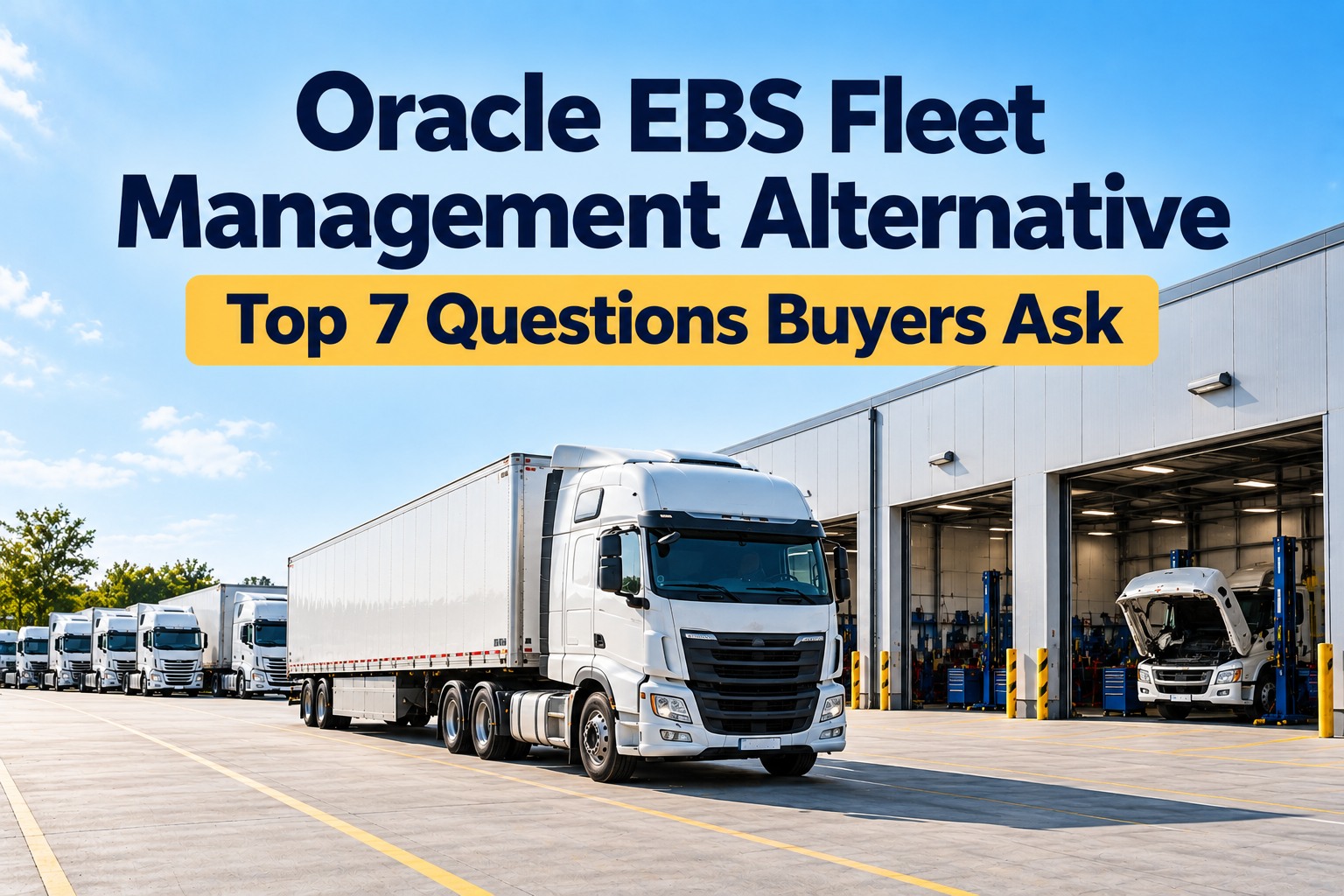
Enterprises running Oracle E-Business Suite are routinely told that fixing fleet maintenance means moving to Fusion first. The timeline behind that argument is worth checking before it reaches a steering committee. Oracle states that Premier Support for E-Business Suite 12.2 runs through at least 2036, delivered under a Continuous Innovation model that ships updates without requiring a major version upgrade — and Oracle's own framing is that this gives customers the ability to leverage their investment "for years to come." If that is the actual runway, then the fleet problem you have this quarter and the ERP decision you will eventually make are two separate decisions running on two separate clocks. Request the integration datasheet.
You Have a Decade. The Fleet Problem Has a Quarter.
Seven questions enterprise buyers ask when extending an E-Business Suite estate rather than migrating — what the support runway actually is, where eAM's boundary sits for vehicles, and what happens to the investment when you eventually do move.
Two Decisions, Two Clocks
Most of the pressure in these conversations comes from collapsing them into one. Separating them changes what a reasonable answer looks like.
Oracle's statement is specific: "Premier Support for Oracle E-Business Suite 12.2 through at least 2036," and with Continuous Innovation this "gives customers the ability to leverage their Oracle E-Business Suite investment for years to come." The phrase at least is Oracle's, not ours. None of this is an argument for staying on EBS indefinitely — it is an argument that the migration date, whenever you choose it, is not a deadline for an operational problem that exists now. Confirm the current Lifetime Support Policy for your own release and module set.
The Seven Questions
In roughly the order they come up, with the answer that usually matters more than the one being asked.
No, and the timeline usually quoted to justify it is softer than it sounds. Oracle states Premier Support for E-Business Suite 12.2 runs through at least 2036, delivered under a Continuous Innovation model that ships updates without a major version upgrade. Oracle's own framing is that this gives customers the ability to leverage their investment “for years to come.”
That removes the forcing function. The fleet question becomes a choice about this year rather than a consequence of an ERP programme.It handles asset maintenance, and plenty of organisations run vehicles in it as assets. The boundary to examine is the same one that applies to any enterprise asset management module: it is built around assets, not around the regulated human operation wrapped around a commercial vehicle. Check Oracle's eAM documentation for the definitive capability list for your release.
The question for evaluation is not whether a truck fits in eAM. It is where the driver, the daily inspection and the roadside event live.Nothing, if the layer was chosen correctly. A system that sits beside your ERP and posts typed facts into it does not care which ERP is underneath. The connection changes at migration; the captured history, the workflows and the device estate do not.
This is the single most important question on the list, and it is rarely asked until after a purchase.Through the same pattern used for any target: facts are captured where they happen, filed as the document type they really are, and posted back on a connection you enable per document type. Write-back starts disabled, and the sandbox builds the identical message and stops before the network so your integration lead reads the real payload.
Ask for a message built against your schema rather than a reference example.Possibly, and that is worth mapping rather than assuming. An EBS estate may include Yard Management integrated with Shipping Execution and Transportation Management, and a shop running eAM. The overlap question is about which system holds the observed fact, not about which has a similarly named screen.
Map the modules you have actually implemented, not the ones you are licensed for.Different orders of magnitude, and more importantly different risk. Extending adds interfaces and leaves the system of record alone. Migrating moves the plan, the money and the master data, and the fleet capability arrives at the end of it rather than at the start.
If fleet is the driver for a migration business case, that is worth testing hard before it reaches a steering committee.Then the coexistence argument is stronger rather than weaker. A capture layer that is independent of the ERP underneath can run across both estates during a transition, which is precisely the period when operational visibility is worst and nobody wants to be configuring a new fleet module inside a programme that is already moving.
Ask how the layer behaves when two ERPs exist at once, because for two or three years they will.Map what you have actually implemented
Licensed and implemented are different lists, and the second one is usually shorter than anybody admits. We will map the modules genuinely in use against where observed facts are captured today — and show you the message that would post into EBS, built against your schema and stopped before the network.
What "Extending" Actually Means in Practice
The word does a lot of work in vendor conversations and rarely gets defined, so here is the concrete version for an EBS estate.
Capture happens at the point the thing occurs — a driver completing an inspection on a handset at the start of a shift, a technician recording a reading in the workshop, a camera or kiosk registering an arrival at the gate. None of that touches EBS. The facts accumulate in a layer of their own, with their evidence attached, and they are usable immediately for operational purposes whether or not anything has been posted anywhere.
Posting is a separate decision, taken per document type. A defect raised on an inspection becomes a maintenance notification in EBS. An odometer or tread reading becomes a measurement against the asset. An arrival becomes a transport document. Each of those connections is enabled individually, after an integration lead has read the message the sandbox produced against your own schema. Until then, nothing posts and everything is still captured.
What does not happen is equally worth stating. No module is deprecated. No master data moves. No process that currently works through EBS stops working through EBS. The estate is unchanged; what changes is that facts arrive in it typed and automatically rather than through somebody re-entering them from a photograph or a paper sheet.
The practical test of whether a vendor means this by "extending" is simple: ask what you would have to turn off. If the answer involves retiring a module you currently rely on, the proposal is a replacement wearing a gentler word, and it should be evaluated with the risk profile of one.
How FleetRabbit Handles This
Four principles, and the first is what makes the decision survive whatever you eventually conclude about the ERP.
The capture layer does not depend on whether EBS or Fusion is receiving the facts. At migration the connection is reconfigured; the history and the workflows carry over intact.
A defect posts as a maintenance notification, a reading as a measurement against the asset, an arrival as a transport document — so your target system receives records it already understands.
Per connection and per document type, after an integration lead has read the message the sandbox built. Capture runs from day one; posting waits for a decision.
The period when operational visibility is worst is the period when a migration is halfway done. A layer that spans both is worth more then than at any other time.
Why Fleet Makes a Poor Migration Business Case
Worth stating directly, because fleet capability is sometimes used to help justify an ERP programme and it does not carry the weight well.
A migration delivers its benefits at the end. The fleet capability arrives after the cutover, which on a realistic enterprise timeline is years from the conversation where somebody first said the workshop cannot answer a compliance question. Everything between now and then is handled exactly as it is handled today, which is to say in spreadsheets.
There is also a sequencing problem. Configuring a new fleet module during a migration means defining your maintenance processes at the moment the organisation has the least capacity to think about them carefully, inside a programme whose scope is already contested. The usual outcome is that fleet gets the configuration it can be given rather than the one it needs, and the gap resurfaces eighteen months after go-live as a change request.
None of which argues against migrating. It argues that the fleet problem and the ERP programme should be allowed to proceed on their own merits and their own timelines, and that a capture layer independent of both is the thing that makes that separation possible.
What This Does Not Do
The same list we give every enterprise evaluation, stated before a contract rather than during an implementation.
- It does not originate transactions in OracleFacts are reported into your system of record. Creating documents there from Oneflow — a transfer order, for instance — is roadmap rather than product.
- The weighbridge is not yet a first-class stageIt is captured, but it does not stand alongside the gate and the dock in the spine the way those do.
- On-site processing catches up after an outageCaptures queue locally and arrive batched carrying the time they were actually taken. Accurate, but not uninterrupted operation.
- Some modules run on sample dataLive monitoring, SLA monitoring and vehicle handover need a wired site and an agreed baseline before they run on anything real.
Questions That Come Up After the Seven
Is EBS really supported until 2036?
Oracle's published statement is Premier Support for E-Business Suite 12.2 through at least 2036, under Continuous Innovation — meaning updates arrive without a major version upgrade. "At least" is Oracle's own wording. Verify against the current Lifetime Support Policy for your specific release and modules before planning against it. Check your own timeline.
Should we just wait and do it all at migration?
You can, and the cost of waiting is every quarter between now and then spent answering compliance questions from spreadsheets. If that cost is tolerable, waiting is rational. If it is the reason this evaluation started, waiting does not address it — it defers it behind a programme that will take years. Price the waiting.
Will this complicate our eventual Fusion move?
It should simplify it. A capture layer independent of the ERP means the fleet processes are already defined, running and generating history before the migration starts — so fleet becomes a connection to reconfigure rather than a module to design under programme pressure. Scope an eAM extension.
Do we need to retire anything we already run?
Generally not. The layer captures observed facts and posts them; what consumes those facts stays where it is. The question worth asking of your own estate is which system is currently the authoritative holder of each fact, because duplication is a problem and addition is not. Map it with us.
How does per-plant or per-site scoping work?
Start at one site. Capture only, write-back disabled, running alongside your existing process for a month. The comparison between what was observed and what was recorded is the business case, and both numbers come from your own operation, which makes it unusually hard to argue with. Pilot it on one plant.
What do we need internally to run this?
Someone who owns the EBS integration and someone who knows what actually happens in the workshop. The second is often harder to find on an org chart than the first, and their account of how things work is usually the more accurate one, alongside whatever the maintenance records currently show. Get both on the call.
Can we see it working before committing?
That is the sensible sequence. A sandbox integration builds the identical message against your schema and stops before the network, so your integration lead reads the real payload rather than a demonstration of one. Nothing posts anywhere until somebody enables it deliberately. Start a sandbox.
Solve the Quarter Without Committing the Decade
FleetRabbit captures what happens at the gate, the workshop and the roadside, files each fact as the document type it actually is, and posts it into EBS on a connection you enable — then carries the same history across to Fusion whenever you decide to go.
One site is enough to start · nothing posts until you switch it on