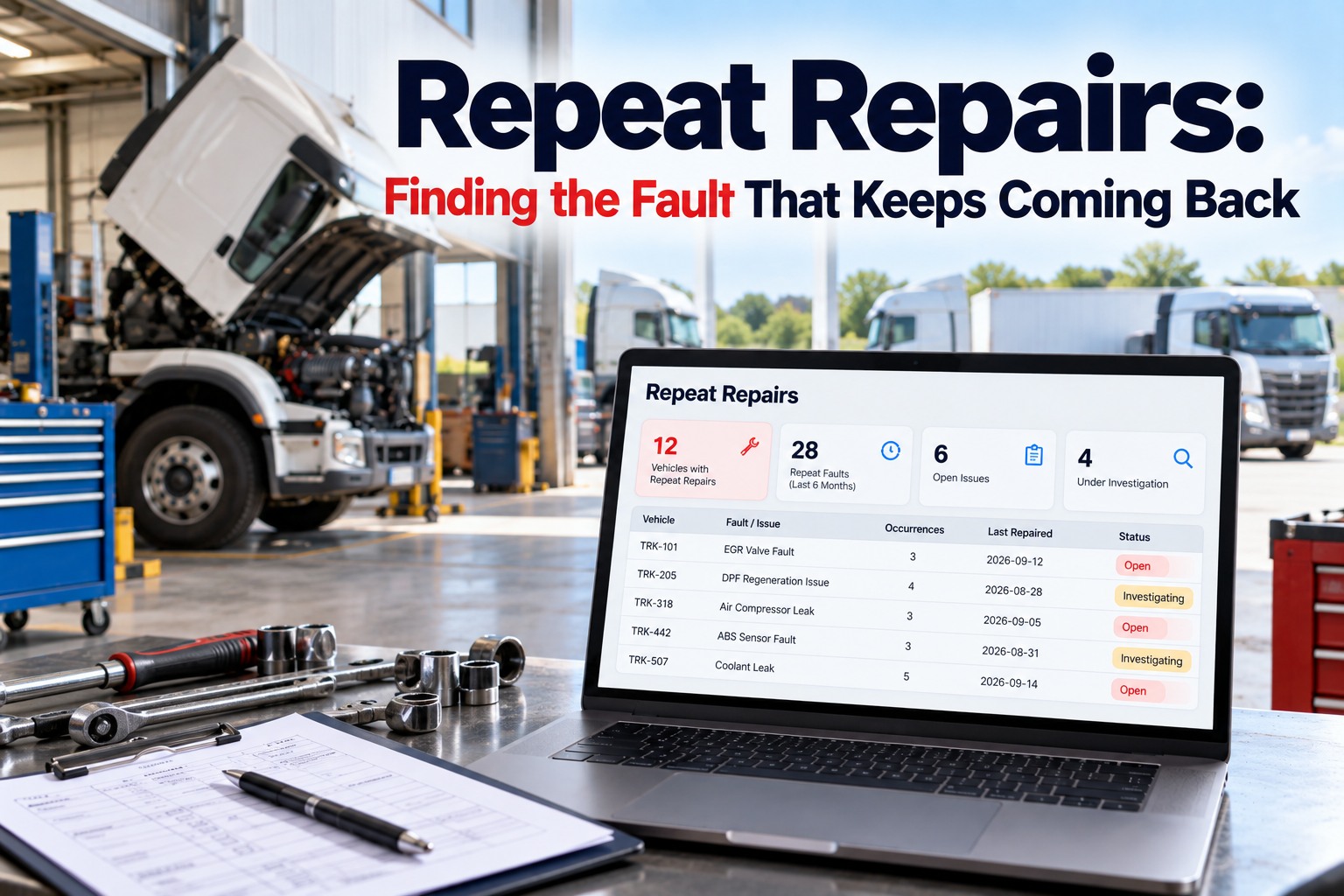
Ask a maintenance manager whether they have a repeat repair problem and most say no. Ask them to produce a list of vehicles that had the same fault three times last year and almost nobody can. Those two answers are the same answer. A repeat repair is only visible if the repair was recorded the same way twice, and in most fleets it was typed by three different people in three different ways — each of them accurate, none of them matching. So the invoices get approved one at a time, every one of them defensible on its own, and the pattern never assembles anywhere a person can see it. The fault is not hiding. The record simply has no way to count it. See what a year of your records is hiding.
The Third Time Is Not Bad Luck. It Is Data You Already Paid For.
For maintenance managers, workshop supervisors and warranty administrators: why free-text repair descriptions make comebacks invisible, how to tell a genuine repeat from a new fault in the same place, and what to do on the second occurrence instead of the fifth.
Why Your Records Hide the Repeat
This is a data-modelling problem before it is an analytics problem, and it is the reason dashboards promising repeat-repair insight so often return nothing on real fleet data. A count can only group what was written identically. Free text never is.
The Technology & Maintenance Council's Vehicle Maintenance Reporting Standards exist for exactly this. Codes are structured as System, Assembly and Component — 013-001-015 identifies front brake linings — using what TMC describes as "universal identifiers or generic terms for the part" rather than a manufacturer's part number. Code Key 33 alone holds more than 34,000 component codes. The payoff TMC names is comparability: "data collected can be compared directly to data collected by others at the same or higher VMRS coding level." If it compares across companies, it certainly compares across two visits by the same truck.
You do not have to adopt all of VMRS to benefit from the idea. What matters is that the repair is filed against a thing rather than described in a sentence. A component picker with three hundred entries will out-perform a free-text box with perfect grammar, every time, because only one of them can be counted.
What a Repeat Actually Costs
The reason repeats survive review is that each invoice is individually reasonable. The cost is not in any one of them — it is in the fact that there are several, and it shows up in five places rather than one.
The only line anybody sees, and usually the smallest of the five.
A technician who does not know it is the third occurrence starts where the first one started. The history is the diagnosis and it was not in the bay.
Three short outages disrupt a schedule more than one longer one, because each lands unplanned on a different day.
Coverage is decided by dates and mileage. Each occurrence that passes unrecorded is a claim that quietly stops being provable.
A driver who reports the same fault three times and sees it return learns that reporting achieves nothing. That cost lands on every future defect report, not just this one.
Only the first of those appears on a repair invoice, which is precisely why cost-threshold reporting misses repeats entirely. A fault that costs a modest amount three times clears every threshold you have set while doing more damage than the expensive single failure that trips all of them.
Not Every Second Visit Is a Repeat
Treating every reappearance as a comeback produces noise and a reputation for crying wolf. The distinction that matters is whether the failure reason is the same, which is what TMC's Code Key 18 technician failure codes capture — two-character codes recording, in TMC's words, "why a mechanic or supervisor thinks a part failed."
Same component, same failure code, same vehicle
The original fix did not hold, or did not address the cause
Same component, different failure code
A different problem in the same place — often the real cause surfacing
Different component, same assembly
One failure is loading another; the assembly is the unit to look at
Same component, different vehicles, no pattern in time
Two trucks needing brake linings is a fleet, not a fault
The second row is the one worth chasing hardest. A component failing repeatedly for different reasons usually means the thing actually failing is upstream, and the part you keep replacing is where the symptom happens to appear. That is a diagnosis you can only reach if the failure reason was recorded at all — which is the argument for making it a required field rather than an optional note.
Even the Law Counts Repetition
There is a useful outside reference point for how many attempts is too many. Consumer lemon-law statutes set a threshold at which repetition stops being treated as ordinary repair and starts being treated as evidence the defect will not be fixed.
"The law presumes a 'reasonable number' of repairs attempts as four" — or when a vehicle "has been out of service for repair at the dealership for a cumulative total of 30 days or more." For a safety defect "likely to cause death or serious injury if the vehicle is driven," the threshold drops to "2 or more attempts."
— Connecticut Department of Consumer Protection, Lemon Law guidance
Read carefully: these are consumer statutes, they vary substantially between states, and commercial vehicle coverage differs or is excluded entirely depending on jurisdiction — take your own legal advice on what applies to your fleet. The transferable idea is the shape of the rule. Repetition alone is treated as proof, and the count drops sharply when safety is involved. A fleet that has no internal threshold at all is holding a looser standard than a consumer gets on a car.
Bring twelve months of repair history
We will run it for repeats and show you the list in the session. Most fleets find something in the first pass — usually a component that has been replaced three or four times on one unit while every individual invoice looked entirely reasonable.
Which Window You Count In Changes the Answer
A single repeat definition will always be wrong for something. The interval between occurrences tells you what kind of problem you are looking at, so it is worth running more than one. Swipe on mobile.
| Gap between occurrences | What it usually means | Where to look |
|---|---|---|
| 30 days | The fix did not hold at all | Treat as a workmanship or diagnosis question first — the cause is usually in the last repair, not the vehicle |
| 90 days | The fix addressed the symptom | The classic comeback window. Look one level up the assembly before ordering the same part again |
| 12 months | A wear or duty-cycle mismatch | The part may be fine and the interval wrong. This is a schedule question, not a repair question |
| Any window, safety item | Different rules apply | Lower the count. Two is a pattern on brakes, steering or coupling, whatever the calendar says |
Notice that the three non-safety rows point at three completely different teams — the workshop, the diagnostic process, and whoever owns the maintenance schedule. A register that reports a flat count without the interval hands all three of them the same undifferentiated list, which is how repeat-repair reporting gets a reputation for being noise.
How FleetRabbit Handles This
Four things, and the first one is what makes the other three possible.
Every job is filed against a component, so two jobs on the same part are the same row in a count rather than two different strings.
The Repeat Repairs register runs against history continuously. You do not have to suspect something before you can find it.
The failure reason is held alongside the component, so a genuine comeback is distinguishable from a new fault in the same place.
Each occurrence keeps its date and mileage, which is what a claim needs and what nobody can reconstruct twelve months later.
What to Do Once You Have Found One
Finding the pattern is the easy half. These are the moves that turn it into a fix rather than a statistic.
- Read the failure codes before the invoicesThe technician's view of why a part failed is the cheapest diagnostic you own, and the one most often left in a free-text box nobody queries.
- Look one level up the assemblyA component that keeps failing is often a symptom of the assembly around it. Repeated linings can be an air-supply problem, not a friction problem.
- Check whether the same person, bay or supplier recursNot to blame anybody — because a pattern tied to a source is the most fixable kind. A batch of parts is a supplier conversation, not a maintenance one.
- Put the occurrence count in front of the approverSomeone approving a third identical job should be told it is the third. Most systems present it as though it were the first.
- Open the warranty question earlyCoverage runs on dates and mileage that are easy to establish now and impossible to establish later. A repeat is the trigger to check, not to wait.
- Escalate on repetition, not on costA cheap fault three times is a worse signal than an expensive fault once. Cost thresholds miss exactly the pattern you are looking for.
Questions Workshops Ask
What counts as a repeat repair?
The workable definition is the same component on the same vehicle with the same failure reason, inside a window you set — ninety days and twelve months are both common, and it is worth running both because they catch different things. Same component with a different failure reason is a recurrence, which is a separate and often more interesting signal. Set your own window free.
Do we have to implement VMRS to do this?
No. You need repairs filed against a selectable component rather than typed as prose. VMRS is the mature standard and brings comparability across operators, but the mechanism that makes counting possible is structured coding of any kind. A short internal component list you actually use beats a complete standard you do not. Talk through the coding depth.
Our history is years of free text. Is it useless?
Not useless, but it will not count reliably. Text matching recovers some of it and misses plenty, and the misses are invisible, which is the dangerous part. The practical answer is to code from today forward so the register becomes meaningful within a quarter, and treat the old text as something to search rather than something to count. Start coding from today.
How does this help a warranty claim?
Claims turn on dates, mileage and showing the same fault recurred. All three are trivial to capture at the time and very hard to reconstruct a year later from invoices. A register that holds each occurrence with its date and odometer reading is a claim file assembling itself. Coverage terms are between you and the manufacturer. See the occurrence record.
Won't this just blame technicians?
It will if you present it as a comeback rate per person, which is why that is the wrong first cut. The useful cuts are by component and by assembly, because those point at causes rather than people. A pattern that genuinely does concentrate around one bay or one supplier is worth knowing, but it is the exception, and looking for it first poisons the data you need. See the component view.
How many occurrences before we escalate?
Set it deliberately rather than by feel, and make it lower for anything safety-related — the consumer statutes cited above drop from four attempts to two on exactly that basis. Two occurrences on a brake or steering component deserves a different response from two occurrences on a cab fitting. Set thresholds with us.
Does it work across vehicles rather than just one unit?
Yes, and that is frequently where the money is. One truck needing the same part three times is a vehicle problem. Nine trucks needing it once each in the same quarter is a parts batch, a spec choice or a maintenance interval that is wrong for how you actually run. Both are patterns; only one of them looks like a repeat on a single unit. Run it fleet-wide free.
Stop Paying Twice for the Same Fault
FleetRabbit's Repeat Repairs register counts jobs by component rather than by description, separates a genuine comeback from a new fault in the same place, and keeps every occurrence with the date and mileage a warranty claim needs.
No credit card required. One vehicle and one year of history is enough to see it work.