Every trip ends with a number somebody has to write down, and the fuel report, the driver payment and the vehicle's service interval all hang off it. The awkward part is that the number has no legal accuracy standard behind it. UN ECE Regulation 39 governs speedometers and odometers, and it holds the speedometer to a hard tolerance — it may never read low, and may over-read by at most ten per cent plus a fixed margin. For the odometer's distance accuracy it sets display requirements and no percentage tolerance at all. So the figure your settlement is built on is an estimate with no floor under it, which is why the only sound way to close a trip is to check it against a second, independent estimate and act on the disagreement.
Two Estimates That Fail in Opposite Directions. The Gap Between Them Is the Only Honest Signal.
For transport managers, settlement and accounts teams and fleet owners: why odometer and GPS distance legitimately disagree, what a five per cent tolerance is actually measuring, and how to close a trip on captured evidence rather than on a number typed at the end of a long day.
No credit card required. Trips, expenses, inspections and maintenance on one record.
The Variance Band, and What It Is Really Measuring
Plot a month of trips as the difference between the two distances and the shape is always the same: a dense cluster around zero and a handful of trips a long way out. The cluster is not error you need to fix. The outliers are the work.
Illustrative distribution across forty-four trips. A tolerance band is a statement about how much disagreement is normal between two approximations, not a claim that either one is accurate to within it. Set it too tight and every trip needs a human; set it too wide and a guessed odometer reading passes through unnoticed. Five per cent is a common starting point — tune it against your own first month rather than adopting it because it appears on a page.
Why the Two Numbers Disagree
This matters because the direction of the disagreement tells you where to look, and because a driver accused of something that is actually a tyre problem stops cooperating with the whole process.
It is driven from wheel speed through electro-mechanical conversion, so everything that changes the rolling circumference changes the reading — tyre wear, under-inflation, a replacement of a different size. A worn tyre turns more times over the same road and the odometer counts every one of them.
Distance is computed between fixes. Between two fixes the vehicle travelled a curve and the calculation measured a straight line, so the longer the sampling interval and the twistier the road, the more distance is quietly lost.
Neither is the truth against which the other is checked. They are two independent approximations of the same journey, produced by two mechanisms that fail in opposite directions — which is exactly why comparing them is useful.
The regulation constrains the speedometer tightly and the odometer's accuracy not at all
UN ECE Regulation 39 sets the speedometer requirement as a formula — the displayed speed must never be below true speed and may exceed it by no more than ten per cent of true speed plus a fixed allowance, tested on tyres of a type normally fitted at the manufacturer's cold pressure plus 0.2 bar. For the odometer it specifies what must be displayed and sets no percentage accuracy tolerance. Fit tyres of a different size or run them worn and nothing in the regulation is violated, while every distance the vehicle records shifts. That is not a defect. It is the reason a second source exists.
What to Do When a Trip Falls Outside
Six patterns, and only one of them is about a person. We will look at your own variance numbers with you.
| What you see | What it usually is | What to do |
|---|---|---|
| Inside the band, trip after trip | Two estimates agreeing within normal error | Settle it. No human time is warranted |
| One trip well outside, then back inside | A route anomaly, a long GPS outage, or a manual entry error | Flag that trip only. Look at the reading, not the driver |
| Consistently high on one vehicle | Tyre wear, under-inflation or a non-standard fitment on that unit | A maintenance signal. Check the tyres before questioning anybody |
| Consistently high across a whole depot | A shared tyre policy or a fitment standard that drifted | Fix the specification, not the settlements |
| Odometer far below GPS | Under-reporting, a fault in the feed, or a reading that was never taken | Never settle a fuel claim on it. Establish the number first |
| A reading that is round, plausible and wrong | A guessed figure entered to close the trip | This is the failure the flag exists to catch, and it will not look odd on its own |
How Many of Last Month's Closing Odometers Were Typed From Memory?
On most fleets nobody can answer that, because a typed reading and a captured one look identical once they are in the system. In thirty minutes we will run a month of your own trips through the variance check and show you which ones would have been flagged.
How FleetRabbit Handles This
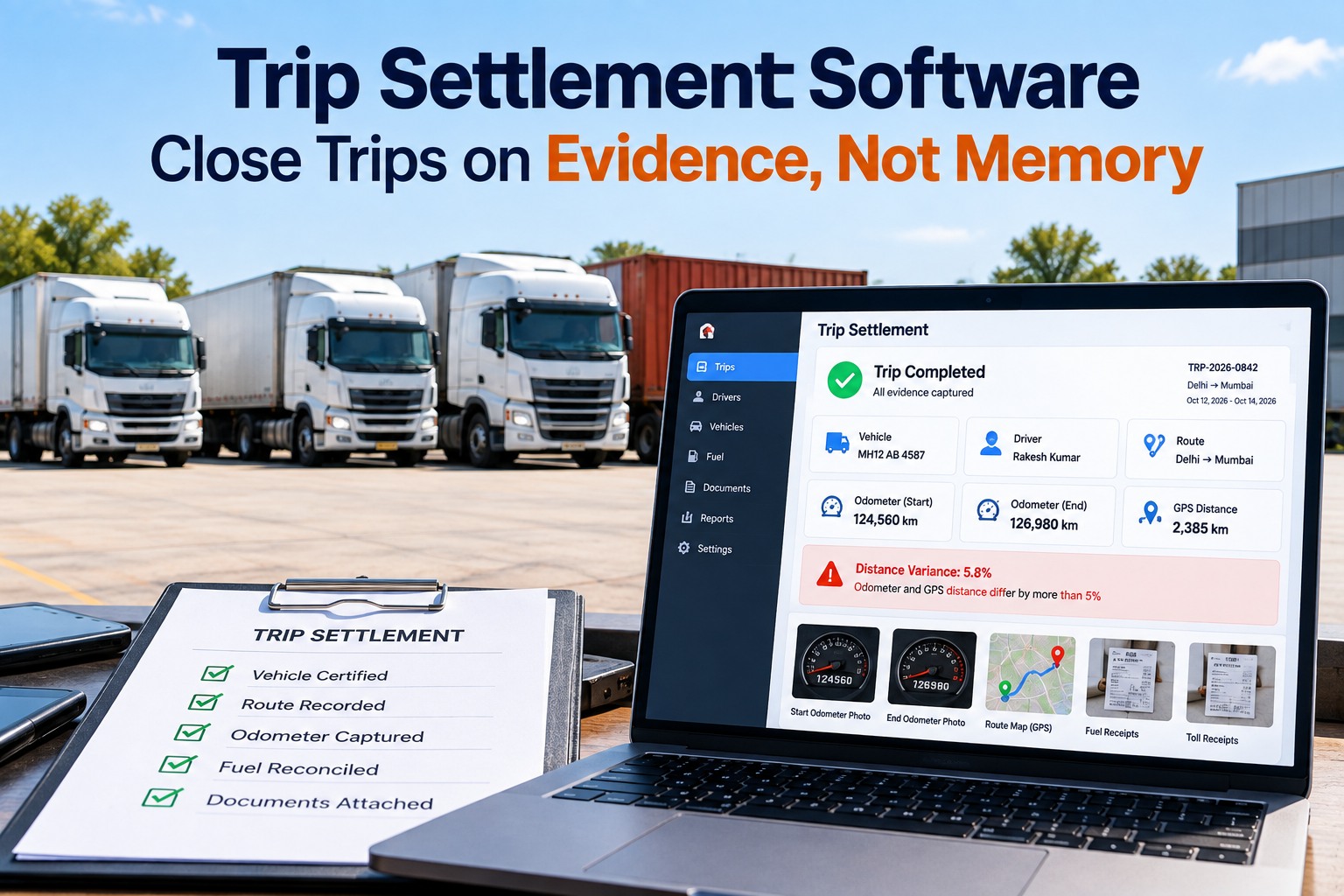
- Driver, vehicle, opening odometer with a photograph, and the start location
- A seven-point certification runs before the vehicle leaves
- Any failed item raises a maintenance request by itself and sends the vehicle to the workshop
- One driver can hold only one open trip at a time
- The route is recorded as it happens rather than reconstructed later
- Each delivery is confirmed at the stop with proof captured there
- Short or damaged lines are recorded against the delivery, not remembered
- Expenses are entered against the trip with the receipt attached
- Closing odometer captured with a photograph and the end location
- If the photograph is poor the reading is held, not trusted
- Odometer distance is compared against GPS distance
- More than five per cent apart and the trip is flagged for the manager rather than passing quietly
What One Soft Reading Corrupts Downstream
A closing odometer is not a settlement field. It is an input to five other calculations, and none of them will look wrong when it is.
The immediate output, and the only place the error is still visible as an error.
Litres or gallons divided by a distance that is wrong. The consumption figure is now wrong in the same direction on every report that uses it, and it looks entirely normal.
Built on the same distance. A fleet comparing vehicles or drivers on this number is now ranking them partly on how their odometers drift.
Distance-based preventive maintenance comes due on accumulated odometer. A unit reading high is serviced early and one reading low is serviced late, and the late one is the expensive mistake.
Where distance by jurisdiction is the return itself. At this point a soft settlement number has stopped being an operational annoyance and become a filing you signed.
This cascade is the real argument for the variance flag. Nobody checks a fuel efficiency figure against the odometer that produced it, because by the time it reaches a report it is simply a number in a column. The only place the error is catchable is at the moment the reading is taken — which is also the only moment it costs nothing to catch.
What a Settled Trip Should Carry
Seven components, each captured where it happens. Set this up free on three vehicles.
| Component | Captured as | Why it matters at settlement |
|---|---|---|
| Vehicle certification | Seven-point check completed before the trip opens | A failed item raises a maintenance request by itself |
| Route | Recorded as it happens | Not reconstructed from the stops afterwards |
| Deliveries | Confirmed at each stop with proof captured there | Shortages sit on the line, not on the trip |
| Expenses | Entered against the trip with the receipt attached | Reconciled rather than remembered |
| Closing odometer | Captured with a photograph | Held if the photograph is poor, rather than trusted |
| Distance check | Odometer against GPS | Flagged past the tolerance, settled inside it |
| Approval | One person, one record | Who approved it, and when |
Speedometer tolerance formula, test tyre conditions and the absence of an odometer accuracy percentage are per UN ECE Regulation No. 39 as published by UNECE. The mechanical explanation for odometer drift — wheel-speed derivation, worn or incorrectly sized tyres, and permissible device error — follows standard telematics guidance, which also recommends re-aligning recorded mileage after a tyre change. Link the trip to the inspection report so a failed certification is visible against the same unit.
Trip Settlement Questions Fleets Ask
What is trip settlement?
Closing a completed journey so it can be paid and reported — reconciling expenses, confirming deliveries, capturing the closing odometer and approving the whole thing. It is where fuel reporting, driver payment and service intervals all get their inputs, which is why a soft number here goes wrong in three places at once. See a trip closed on evidence.
Why do odometer and GPS distances never match?
Because they measure differently and fail in opposite directions. The odometer counts wheel rotations, so worn, under-inflated or non-standard tyres make it read high. GPS calculates between position fixes, so it cuts the corner on every curve and reads low, more so at longer sampling intervals. Small disagreement is expected; large disagreement is information. Track the variance per unit free.
Is there a legal accuracy standard for truck odometers?
For distance accuracy, not in the way people assume. UN ECE Regulation 39 holds the speedometer to a strict formula — never reading below true speed, over-reading by at most ten per cent plus a fixed margin — but specifies display requirements for the odometer without a percentage accuracy tolerance. Check the rules in your own market, and do not assume the number is certified. Discuss what this means for your reporting.
What tolerance should we set?
Five per cent is a reasonable starting point and it is what we flag at by default, but the honest answer is that you should set it from your own first month of data. A fleet on rural routes with long GPS sampling intervals will sit wider than a motorway fleet, and a tolerance that flags a third of your trips will be switched off within a fortnight. Get a month of baseline data free.
What should happen to an unreadable odometer photograph?
The reading should be held rather than accepted. A guessed figure in a fuel report is worse than a missing one, because a gap gets chased and a plausible number does not — it simply becomes part of the average and quietly corrupts everything calculated from it. See how held readings work.
Should a failed pre-trip check stop the trip?
It should at minimum create the work, automatically. A defect that is noticed, noted, and then waits for somebody to remember to raise a job is the most common way a known problem becomes a roadside failure. A failed certification item raising its own maintenance request removes the remembering. Turn failures into jobs automatically.
Can trip data feed fuel and IFTA reporting?
It is the source for both, which is precisely why the closing odometer matters so much. Distance drives consumption figures and jurisdictional reporting alike, so a soft reading does not stay a settlement problem — it becomes a compliance one. Talk through your reporting chain.
Close the Trip on What Was Captured
FleetRabbit certifies the vehicle before the trip opens, records the route and the stops as they happen, captures the closing odometer with a photograph, and flags the trip when the two distances disagree by more than five per cent — with the whole thing sitting beside that unit's inspection history and open work orders.
No credit card required. Bring one month of closed trips.