The most useful thing ever written about yard management came from the Department of Transportation's Inspector General, and it was an admission. Reporting to Congress on driver detention, the OIG stated plainly that accurate industrywide data on driver detention do not currently exist, and that the electronic data which does exist cannot readily discern detention time from legitimate loading and unloading tasks. That is the whole problem in two clauses. Detention is billable, it is measurable in principle, and almost nobody can prove it — because the arrival time is whatever the guard wrote down when he got round to it, and the departure time is a second guess made hours later. The same report quantifies what that costs: detention reduces for-hire truckload driver earnings by an estimated $1,281 to $1,534 per driver per year, cuts carrier net income by $250.6 million to $302.9 million annually, and — the finding that should change how you think about your gate — a 15-minute increase in average dwell time increases the average expected crash rate by 6.2 percent. A yard management system is not a map of where trailers are. It is the instrument that produces the measurement the federal regulator says the industry does not have. This page covers what a gate has to capture, how a live yard count replaces walking the yard, how dwell becomes an invoice line, and what an uncertain plate read should do. See a live yard count, or start with one gate.
Your Yard Already Knows What Is Standing In It. Nobody Wrote It Down.
For yard and site managers, transport managers and warehouse operations leads: how automated gate check-in turns arrivals into a live count, dwell into a defensible number, and detention into something you can actually invoice.
No credit card required. Gate, yard, inspections and maintenance on one record.
"Accurate industrywide data on driver detention do not currently exist."
— US Department of Transportation, Office of Inspector General, reporting to Congress on commercial driver detention. The same report notes that available electronic data cannot readily discern detention time from legitimate loading and unloading tasks.
A Yard Count Nobody Has to Walk
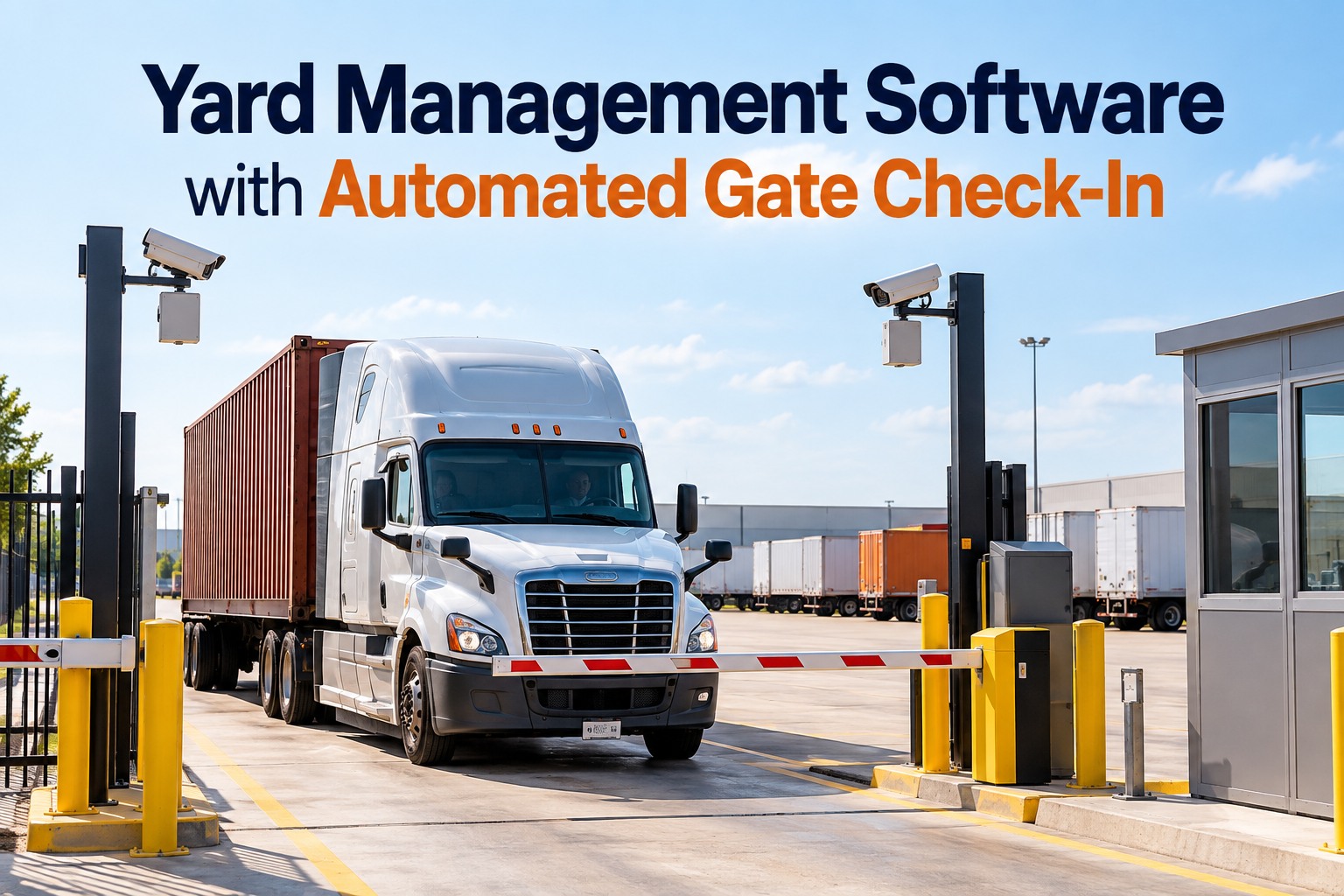
The gate is the only place where every vehicle is guaranteed to pass twice. Read it properly on the way in and on the way out, and the yard count maintains itself. We will walk your own yard through this.
Illustrative layout. What matters is that every number on it came from an event rather than an entry: the slot was assigned when the plate was read, the clock started at that timestamp, and the two units past the free window turned red without anybody reviewing a list. A yard count that depends on somebody updating a board is accurate at the moment it is updated and decaying from then on.
Where the Billable Hours Actually Are
The industry convention is a two-hour free window, and the OIG report uses dwell beyond two hours as its working definition of detention. Plot a month of your own site against that line and the argument stops being a matter of opinion. Start measuring it on one gate, free.
Distribution is illustrative rather than measured. The two-hour convention is the customary grace period described in OOIDA's detention survey and the threshold the OIG analysis works from. Note what the shape implies: the loads inside the window are not a problem and never were, which is why a facility-wide complaint about "slow turnarounds" rarely survives contact with the data. The recoverable money is in the tail, and the tail is small enough that you can only find it if every arrival and departure was stamped.
What an Arrival Record Has to Contain
If it cannot be shown to a carrier, it will not settle a dispute. This is the minimum for a record that ends an argument rather than starting one.
The last line is the one that matters. Dwell is not a field somebody fills in — it is the interval between two captured events, which is why it can be defended.
What Happens When the Camera Is Not Sure
This is the difference between a system a gate guard trusts and one they work around. A read the system cannot stand behind must never be presented as though it could.
The plate matched cleanly. The arrival is stamped, the slot is assigned and the dwell clock starts, with the image stored against it.
The system was not sure. It is shown to the guard with the reason attached, and never guessed at. A held read cannot be selected until a person confirms it.
Nothing legible — obscured plate, glare, a vehicle out of position. The guard enters it manually and the record shows it was entered by hand, not captured.
An uncertain read that gets written in as certain is worse than no read at all, because it looks exactly like a good one for the next six months — right up until a carrier disputes it and the photograph shows a different truck. Hold it, show the reason, and let a person decide. Nobody has ever lost a detention claim because a record said a human confirmed the plate.
How Long Was That Truck On Your Site Last Tuesday?
If the answer involves opening a paper log or asking somebody who was on shift, that is the gap. In thirty minutes we will set up one gate on your own yard, show the live count building itself, and put a month of dwell against the two-hour line so you can see what is actually recoverable.
How FleetRabbit Handles This
Stated as two lists rather than one, because a product that claims a person is no longer needed is a product nobody believes about anything else either.
- The plate is read as the vehicle reaches the barrier
- The arrival is timestamped with the image attached
- The vehicle is parked into a yard slot automatically
- The same capture runs in reverse on the way out
- Dwell is calculated from the entry and exit pair
- Units past the free window turn red without anyone reviewing a list
- Any read the system is not sure of — shown with the reason, never guessed
- Confirming a held plate before it counts as an arrival
- Entering a vehicle the camera could not see at all, recorded as entered by hand
- Deciding what happens to a trailer that should not be on site
- Weighbridge readings, which are recorded where they are entered rather than captured as their own step
Written Down Against Captured
Seven things a yard has to answer, and what each one looks like either way. Swipe the table on mobile.
| The question | Written down | Captured at the gate |
|---|---|---|
| When the truck arrived | Written on a sheet when the guard got round to it | Timestamped at the moment of the read, with the image attached |
| What is in the yard now | Counted by walking it, or guessed | A live count that does not need anyone to walk anything |
| How long a vehicle has been on site | Estimated afterwards from two remembered times | Measured from the entry and exit pair |
| Whether detention is billable | An argument between two people's notes | A duration with a photograph at each end |
| A disputed arrival time | Whoever sounds more certain wins | The carrier is shown the image and the timestamp |
| An uncertain plate read | Typed in as though it were certain | Held with the reason, and confirmed by a person before it counts |
| A trailer nobody can find | A radio call and a walk round | A slot number recorded at entry |
What Detention Is Worth, and Why Most of It Is Never Claimed
Figures from OOIDA's 2023 detention survey. The last three rows explain why the first three rarely turn into revenue. Work through your own exposure with us. Swipe the table on mobile.
| What drivers report | Figure | Note |
|---|---|---|
| Owner-operator under their own authority | $53 per hour | OOIDA's 2023 survey average for detention actually collected |
| Leased owner-operator | $45 per hour | Same survey |
| Company driver | $37 per hour | Same survey |
| Drivers who always chase detention pay | 49% | Down from 53% the year before |
| Drivers who collect none at all | 17% | Because proving it is harder than absorbing it |
| Drivers losing one to two loads a week to detention | 50% | The cost that never appears on an invoice |
Detention rates, collection behaviour and lost-load figures per the Owner-Operator Independent Drivers Association Foundation's 2023 Detention Time Survey, which also reports drivers spending an average of 14.3 hours a week waiting to load and unload. Crash-risk, earnings and carrier-income estimates per the US DOT Office of Inspector General's report on commercial driver detention. Operating cost context per ATRI, whose 2025 update puts the average cost of operating a truck in 2024 at $2.260 per mile, with non-fuel marginal costs at $1.779 per mile — the highest ever recorded. Put gate events next to the inspection report and the preventive maintenance schedule so a unit's time on site reads alongside its condition.
Yard Management Questions Operations Teams Ask
What is a yard management system?
Software that records what enters and leaves a site, where each vehicle or trailer is standing, and how long it has been there. The useful ones capture that from the gate rather than asking somebody to maintain a board, because a manually updated yard is accurate at the moment it is updated and wrong shortly afterwards. See one running on your yard.
How is detention actually calculated?
As time on site beyond a free window, conventionally two hours — the same threshold the DOT Inspector General's analysis works from. The difficulty has never been the arithmetic, it is the two timestamps: if the arrival was written down later and the departure was estimated, the calculation is only as good as two people's memories. Capture both and it becomes a duration with evidence. Start capturing both, free.
Does detention really affect safety?
The OIG analysis found that a 15-minute increase in average dwell time increases the expected crash rate by 6.2 percent, and that every 5 percentage point rise in the share of stops experiencing detention produces a 4.7 percent increase in expected crash rates. Time lost in a yard is time a driver makes up elsewhere, under a clock that does not pause. Discuss the safety case.
Why do so few carriers collect detention pay?
Because proving it costs more than absorbing it. OOIDA's 2023 survey found 49 percent of respondents always attempt to be compensated, down from 53 percent the year before, and 17 percent collect none at all. A claim backed by two timestamps and two photographs is a different conversation from one backed by a driver's recollection. Build the evidence automatically.
Do I need cameras and plate reading to do this?
Not to start. The gain comes from capturing the two events at all, with a time you did not have to remember. Automatic plate reading removes the typing and the transcription errors, and it is what makes the record defensible — but a gate that stamps arrivals and departures reliably is already a large improvement on a sheet filled in at shift end. Talk through the options.
What happens when the plate cannot be read?
It should be held and shown to the guard with the reason, never guessed at. A held read cannot be selected until a person confirms it, and the record shows that a human did so. The alternative — writing an uncertain read in as though it were certain — produces a log that looks reliable and is not, which is worse than an obvious gap. See how held reads work.
Can yard data connect to maintenance and inspections?
It should sit on the same unit record. A trailer that has been standing for three days, a tractor with an open defect and a DVIR from this morning are three facts about the same asset, and they are far more useful together than in three systems. See them on one record.
Produce the Measurement the Regulator Says Does Not Exist
FleetRabbit stamps every arrival and departure with the image beside it, keeps the yard count live, and holds the result against the same unit as the inspection record and the open work orders — so dwell is a measured interval you can invoice from, and a disputed arrival is settled by a photograph rather than by whoever is more senior.
No credit card required. Start with one gate and one month of arrivals.