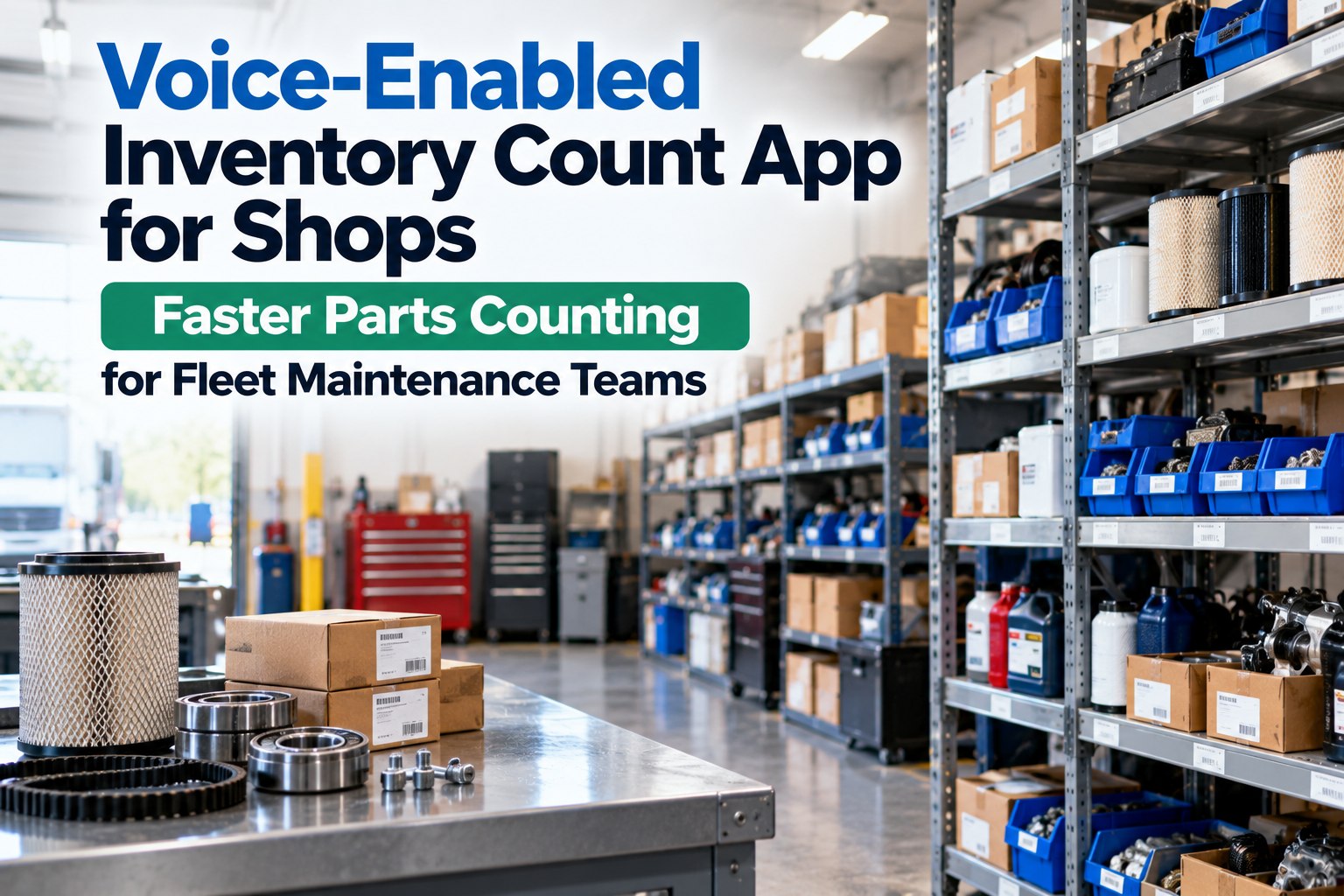
A voice-enabled inventory count app lets parts-room staff call out part numbers and quantities during a cycle count, then writes each count against the right bin and compares it with the system. Nobody types into a spreadsheet or scrolls a scanner menu with greasy hands. For fleet shops, accurate counts are the difference between a part being on the shelf when the truck is on the lift and a day of downtime waiting for an emergency order. Hear a cycle count called out by voice, or read how work orders deduct parts automatically.
VOICE CYCLE COUNTS · FLEET PARTS ROOMS
Count the Shelf Without Touching the Keyboard
Walk the aisle, say what you see, hear it read back. Counts that take minutes instead of hours get done more often, and shops with trusted counts stop ordering the same part twice.
BIN A-14-03
Air dryer cartridge
System48
You said"forty-five"
Variance −3 · recount flagged
Why Counts Slip When Someone Has to Type
Most shops know they should count more often. They count less because the method is slow: find the spreadsheet, scroll to the part, type the number, repeat a few hundred times. A method that fits the work gets used.
← Swipe to see all columns →
Count What Matters Most, Most Often
You do not need to count every part every time. ABC classification ranks part numbers by spend and movement, then counts the important ones more often. As a common rule of thumb, a small share of part numbers carries most of the spend. The shares below are typical midpoints, so your own split will differ.
TYPICAL ABC SPLIT OF A PARTS ROOM
AFast movers and costly parts
Set up your first A-class count by voice
Pick your twenty most expensive or fastest-moving parts and we will walk through counting them aloud.
A Quarter of Counts at a Glance
A count calendar spreads the work thin. Here is a thirteen-week quarter for a parts room with 1,000 part numbers: class A every two weeks, class B monthly, class C once a quarter. It works out to about 38 counts a day, which is roughly an hour of calling out numbers.
15
A counts a day
150 parts every 10 workdays
14
B counts a day
300 parts every 21 workdays
9
C counts a day
550 parts every 63 workdays
How a Spoken Count Works
1
Call the bin
"Bin A-14-03."
→
2
Hear it confirmed
App says the part name back.
→
3
Say the quantity
"Forty-five."
→
4
Read-back
"Forty-five. Correct?" Say yes or fix it.
→
5
Variance check
Compares to the system and flags it.
What to Do When the Count Doesn't Match
Say the system shows 48 air dryer cartridges and you count 45. That is a variance of three units, or 6.25 percent. For a class A part, a variance above 5 percent should be recounted before anyone adjusts the books. These thresholds are a common starting point from cycle counting guides, and they come from general inventory practice rather than fleet shops specifically.
Under 0.5%
Healthy
Record and move on.
0.5% to 2%
Review reasons
Look at the top causes.
2% to 5%
Process problem
Check training, labels, receiving.
Over 5%
Stop and recount
Rebuild the procedure if it persists.
Where the Gaps Come From
Most mismatches are not theft. They are small entry errors that pile up. FleetRabbit's parts inventory guide cites a manual entry error rate of 1 to 4 errors per 100 entries. At 500 transactions a month, that creates 5 to 20 phantom or missing units a month, and one forgotten entry cost a fleet $2,300 in emergency shipping and downtime within a week.
MISMATCHED RECORDS PER MONTH AT 500 TRANSACTIONS
2 errors per 100 entries
10
4 errors per 100 entries
20
Voice-directed picking vendors report faster fulfillment, up to about 20 percent, and fewer mispicks. Those are vendor figures from warehouse operations, so treat them as a direction, not a promise, and measure your own accuracy before and after a pilot.
Keep Parts Counts and Work Orders Telling the Same Story
FleetRabbit deducts parts from stock when they are added to work orders and alerts you when stock runs low. Voice makes the counts that check those numbers quick enough to do routinely.
See automatic stock deduction.
Auto deduction from work orders
Low-stock alerts
Multi-location stock
Spoken counts
Frequently Asked Questions
What is a voice-enabled inventory count app?
It lets parts-room staff say part numbers or bin locations and quantities aloud during a count. The app reads each entry back for confirmation and records the count against the system quantity.
What is a cycle count?
A cycle count checks a small slice of inventory on a rotating schedule instead of shutting down for one big annual count. High-value and fast-moving parts are counted more often than slow, cheap ones.
How often should I count each class?
A common pattern is weekly to every two weeks for class A, monthly for class B and quarterly to twice a year for class C. Adjust it to your shop's movement and the cost of a stockout.
What accuracy should a parts room aim for?
Guides describe 99.5 percent or higher as audit-ready and 97 to 99 percent as healthy. Start by measuring where you are, then tighten counts on the parts that cost you the most when they run out.
How does voice avoid mistakes with similar part numbers?
Read-back confirmation catches mishearing, and counting by bin location instead of long part numbers cuts risk. Test the parts that sound alike in your room before rolling out.
Can I still use barcodes?
Voice and barcodes can work together, with scanning for labels in good condition and voice for the rest. Ask any vendor exactly which methods it supports. See
the voice AI guide for how voice data is structured.
Does it work in a noisy parts room?
Results depend on noise and microphone placement. Pilot it during a busy hour and review the first count's corrections before expanding.
A Shelf You Can Trust Is a Truck Back on the Road
Count a little every day, out loud, and let the system tell you where the numbers drift. Start with your fastest-moving parts.
Free tier for up to 3 vehicles · No credit card required · Counts tied to your work orders
October 3, 2026
By Derek Goes
All Articles