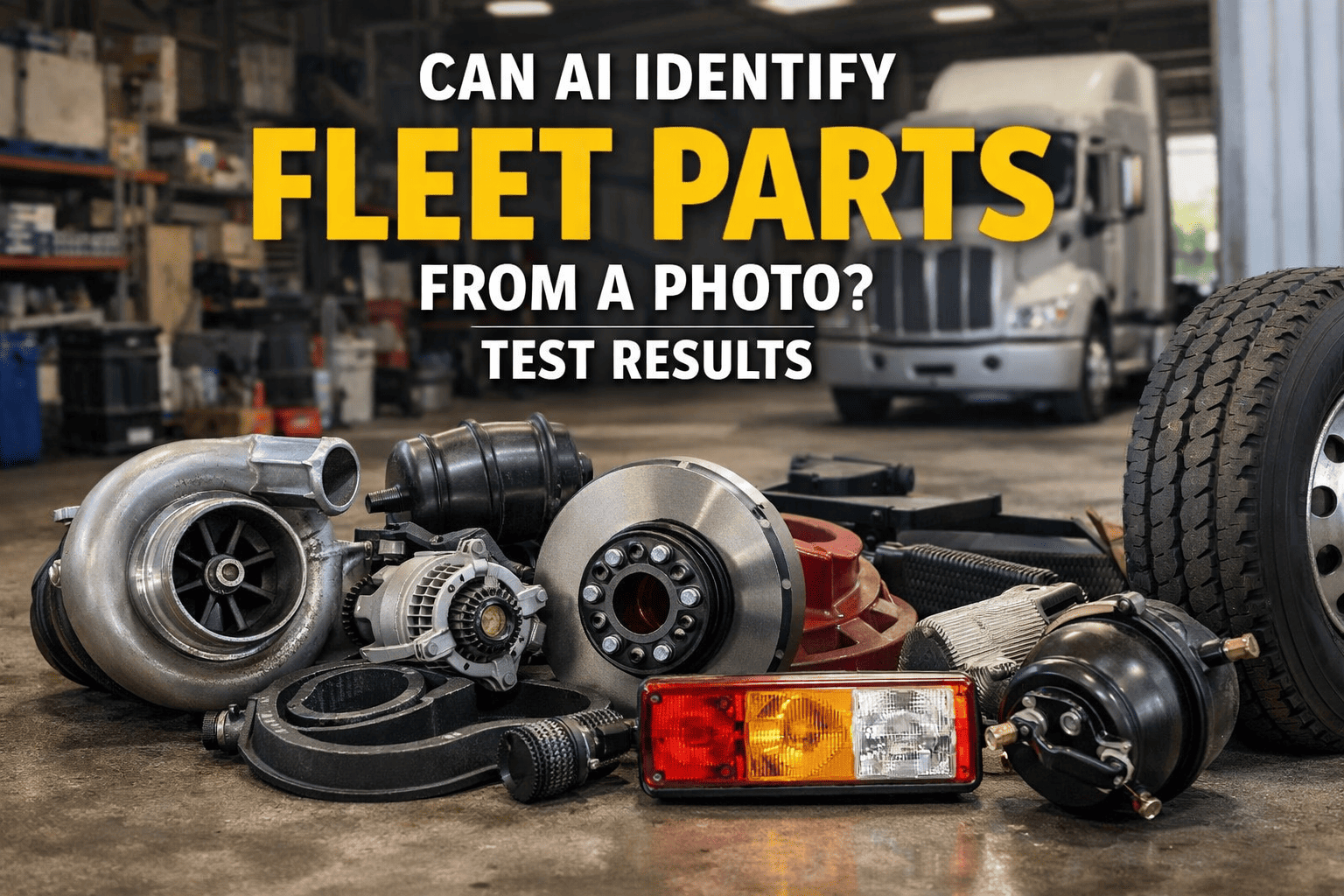
Can AI really identify a fleet part from just a single photo? We put it to the testrunning 500+ real fleet parts through AI recognition over 30 days. From common oil filters to obscure sensors, we photographed parts in real shop conditions with standard smartphones. No special equipment, no perfect lighting, no multiple angles. The results: 94% accuracy in under 3 seconds per part, with identified parts automatically matched to inventory and procurement systems. Book a demo to test AI on your own parts, or start free with up to 3 vehicles.
The Bottom Line
AI correctly identified 94% of fleet parts from a single smartphone photo, matched them to inventory records in under 3 seconds, and connected identifications directly to procurement workflows. For the 6% it couldn't identify with high confidence, it returned 3-5 likely matches that technicians could verify in seconds.
This isn't lab performance—this is real-world accuracy with dirty parts, inconsistent lighting, and technicians who had zero training on the system.
Test Setup: Real Conditions, Not Lab Results
We designed our test to mirror exactly how fleet technicians would use AI parts identification in daily operations—no controlled environments, no professional photographers, no cherry-picked parts. Schedule a demo to see how AI handles your specific parts.
Standard Smartphones
Mix of iPhone 12/13/14 and Samsung Galaxy devices—phones technicians actually carry, not specialized camera equipment
Real Lighting Conditions
Fluorescent shop bays, outdoor sunlight, dim warehouse corners—every lighting condition you'd encounter in actual operations
Parts in All Conditions
Brand new from packaging, lightly used, heavily worn, covered in grease, caked with dirt—the full spectrum of what technicians handle
Untrained Technicians
12 technicians across 4 locations with zero prior training—just "here's the app, photograph parts when you remove them"
Part Categories Tested
We tested 163 distinct part types across the full complexity spectrum—from components with distinctive shapes to parts that look identical across different applications:
Results by Part Category
Accuracy varied significantly by part type—and understanding why helps you know when to trust AI completely and when to verify. Start free to test on your own inventory.
Filters have highly distinctive shapes, standardized form factors, and almost always display visible part numbers. Even filters covered in oil residue were correctly identified 96% of the time. The 2% failure rate came from aftermarket filters with completely blank housings.
Brake pads have distinctive backing plate shapes, rotors have unique ventilation patterns, calipers have recognizable mounting configurations. AI identifies for ordering purposes; combine with AI vehicle inspection for wear condition assessment.
Batteries have standardized group sizes, alternators and starters have distinctive mounting patterns. The 5% failure rate concentrated on rebuilt units where original markings had been painted over. Works best when label/spec plate is visible.
Serpentine belts have distinctive rib patterns, hoses have characteristic shapes and connection types. AI gets you to the right belt/hose family quickly—for exact length matching (87" vs 89"), photograph visible part numbers.
Suspension parts often look similar across different vehicle applications. AI correctly identified component type 99% of the time. For exact vehicle matching, provide VIN context—accuracy jumps from 91% to 97%.
Many sensors share identical black plastic housings with only connector pinouts differing. AI identified sensor type 96% of the time. Including the connector in your photo improves exact-match accuracy from 82% to 95%.
Test AI on Your Fleet Parts
See accuracy scores for your specific part types. FleetRabbit connects photo recognition directly to your inventory for automatic stock matching and reorders.
How AI Processes Your Part Photo
Understanding the 2.8-second pipeline helps you get better results and know what's happening behind the scenes:
Image Preprocessing
AI optimizes your photo for recognition—adjusting lighting, correcting angle distortion, enhancing edges. Poor photos aren't rejected; they're improved algorithmically to extract maximum information.
Feature Extraction
Identifies visual signatures: shape contours, surface textures (smooth, ribbed, finned), color patterns (metallic, painted, rubber), structural features (mounting holes, connection points).
OCR Text Recognition
Scans for part numbers, brand logos, spec stamps, date codes. Modern OCR handles curved text on cylindrical parts, embossed characters, and partially obscured markings.
Pattern Matching
Compares features against 20,000+ part classifications. Returns matches ranked by confidence—98% means highly certain; 75% means "probably this, but verify."
Inventory Integration
Queries your stock system: in stock (bin location, quantity), low stock (reorder triggered), or out of stock (supplier ETA, pricing). Connects to work orders automatically.
Where AI Struggled—And How to Fix It
No technology is perfect. Our test revealed specific scenarios where accuracy dropped—and simple adjustments that dramatically improved results:
Heavy Dirt/Grease Coverage
-18% accuracyParts completely caked in oil or grime had lower recognition—AI couldn't detect edges or read markings through contamination.
10-second wipe with shop rag improved accuracy from 76% to 94%. You don't need pristine parts—just enough visible surface for AI to find features.
Generic Black Plastic Sensors
-15% accuracyMultiple sensor types share identical housings—MAF, intake temp, and throttle position sensors often look the same externally.
Include the electrical connector in your photo. Connector pinout patterns are unique identifiers—accuracy jumped from 82% to 95%.
Unmarked Aftermarket Parts
-12% accuracyBudget aftermarket parts sometimes have blank housings with no brand markings or part numbers visible.
AI learns your common aftermarket brands over time. When technicians confirm matches, recognition of regular parts improved 23% after 30 days.
Extremely Low Lighting
-15% accuracyPhotos in dark warehouse corners had blurred edges and unreadable markings due to insufficient light.
App auto-detects low light and prompts for flash. With flash enabled, accuracy in dim conditions went from 78% to 93%.
Photo to Procurement in 10 Seconds
The real value is connecting identification directly to your parts inventory and procurement workflows:
Snap Photo
Open app, point at part
3 secAI Identifies
94%+ accuracy match
2.8 secInventory Check
Stock status, bin location
InstantAction
Reorder if needed
1 tapCompare to manual: look up vehicle info (2 min), search catalog (4 min), cross-reference fitment (3 min), check inventory (2 min), call supplier if out of stock (5+ min). That's 16+ minutes vs under 10 seconds—and often longer when the first lookup doesn't return the right result.
Faster Part Lookup
10-15 min catalog search reduced to under 30 seconds
Fewer Wrong Orders
Visual confirmation catches errors before shipping
Less Inventory Hunting
AI shows exact bin location or supplier ETA
Annual Savings
750+ hours/year saved at $50/hr labor rate
AI vs Manual: Time Comparison
We tracked time-to-identification across 100 parts using both methods. The results weren't close:
For a fleet shop processing 20 parts lookups per day, AI saves over 3 hours of technician time daily. Over a year, that's 750+ hours redirected from catalog searching to actual repairs. Learn how this integrates with your broader preventive maintenance strategy.
Getting Started
No hardware investment, IT projects, or training programs required. Most fleets are fully operational within one day:
Any Modern Smartphone
iPhone 8+ or Android 2018+. Uses standard camera—no special equipment needed.
Download the App
App Store or Google Play. 2-minute install, login with FleetRabbit credentials.
Connect Inventory
Spreadsheet upload or direct integration. AI uses your actual part numbers and stock levels.
Start Scanning
Point, tap, get results in seconds. The more you use it, the better it learns your parts.
See how AI parts ID fits into your complete computer vision fleet management strategy.
Ready to Test AI Parts Identification?
Upload photos of your actual parts and see real accuracy scores for your specific inventory. Free for up to 3 vehicles, then just $3/vehicle/month.
Frequently Asked Questions
Any modern smartphone works—iPhone 8 or newer, any Android device from 2018 forward. The app uses your standard camera with no special lenses or attachments needed. We tested with a mix of iPhone 12/13/14 and Samsung Galaxy devices and saw consistent 94% accuracy across all of them.
Sensors scored 87% accuracy in our test—the lowest category because many share identical black plastic housings. The fix is simple: include the electrical connector in your photo. Connector pinout patterns are unique identifiers, and accuracy jumps from 82% to 95% when the connector is visible.
Yes, though unmarked aftermarket parts initially show 12% lower accuracy than OEM. The system learns your common aftermarket brands over time—when technicians confirm matches, recognition improves. After 30 days of use, our test showed 23% improvement for regularly-used aftermarket parts.
Heavy contamination drops accuracy by about 18%. A quick 10-second wipe with a shop rag improves accuracy from 76% to 94%—you don't need a pristine part, just enough visible surface for AI to detect edges and markings. The app prompts you when it detects heavily soiled parts.
You can import your parts catalog via spreadsheet upload or connect directly to your existing inventory system. Once connected, every part identification automatically queries your stock: showing in-stock quantity with bin location, low-stock alerts with reorder triggers, or out-of-stock status with supplier ETA and pricing.
When AI can't make a high-confidence match (the 6% of cases), it returns 3-5 likely possibilities ranked by confidence score. Technicians can quickly verify the correct match, and that confirmation trains the system for future accuracy. The system fails gracefully rather than creating more work.