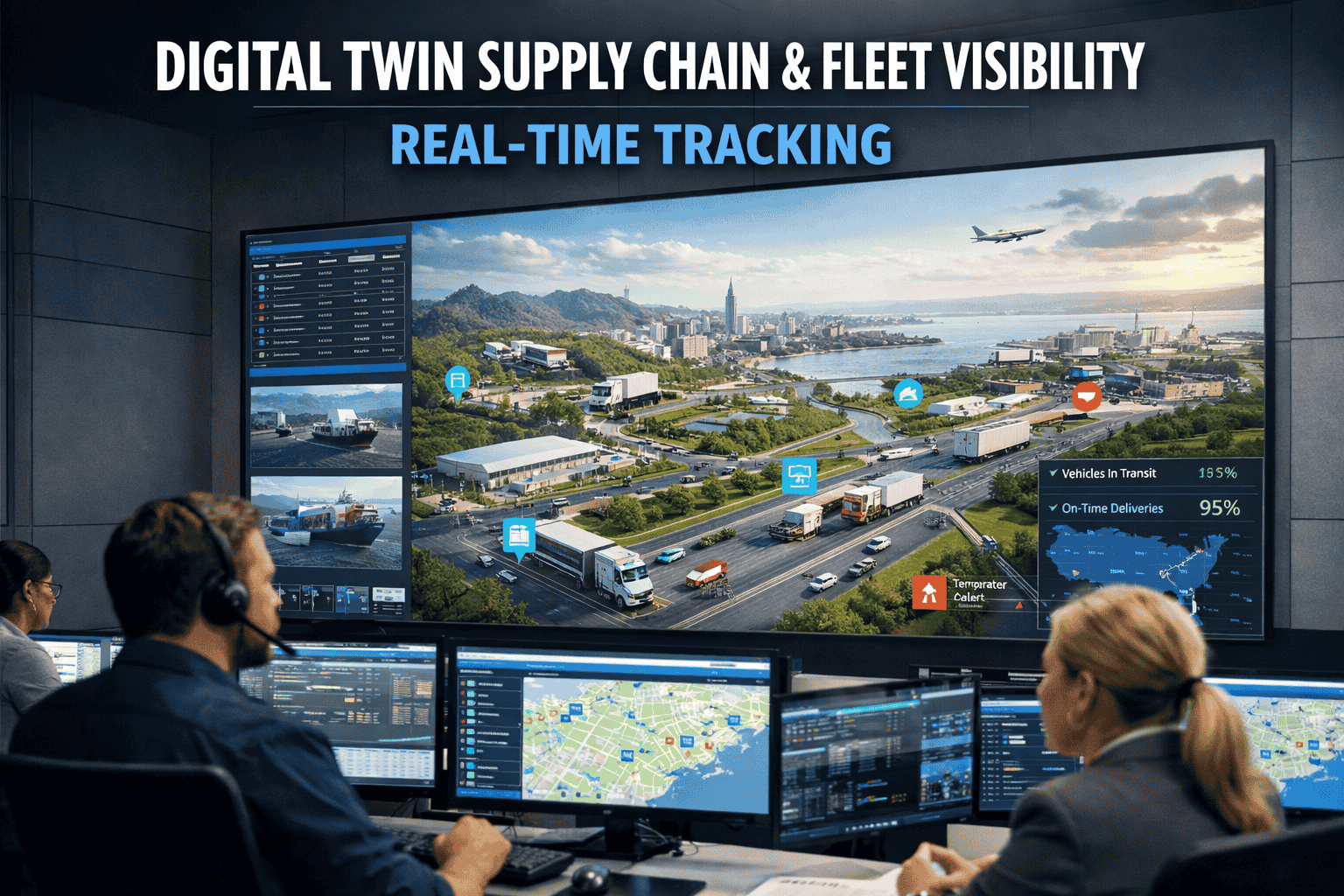
While you're refreshing tracking pages and calling carriers, your competitors are seeing their entire supply chain in real-time—predicting delays 2 weeks before they happen with 85-90% accuracy. The digital twin supply chain visibility market is projected to reach $6.8 billion by 2025 with a 19.5% CAGR, while the broader digital twin market hit $35.8 billion in 2025 and is racing toward $328 billion by 2033. The question isn't whether to adopt this technologyit's how fast you can implement it before you fall behind.
See Everything. Predict Everything. Control Everything.
Digital twin technology creates a live virtual replica of your entire supply chain and fleet—from warehouse to final delivery. Not historical data. Not batch updates. Real-time visibility that lets you simulate, predict, and optimize before problems happen.
- Track every shipment in real-time
- Predict delays before they happen
- Simulate scenarios without risk
Ready to see your supply chain in real-time? Book a personalized demo or start your free trial with up to 3 vehicles.
What Is a Digital Twin Supply Chain Platform?
A digital twin is a virtual replica of your physical supply chain and fleet that updates in real-time. Unlike traditional tracking that shows where shipments were hours ago, digital twins show what's happening now and predict what will happen next. This technology integrates IoT sensors, GPS tracking, AI analytics, and simulation capabilities into one unified view of your entire logistics operation—creating what industry experts call a "living model" of your supply chain.
The concept originated in manufacturing and aerospace, where companies like NASA used digital replicas to monitor spacecraft remotely. Today, the technology has evolved to encompass entire logistics networks, enabling fleet managers to track shipments from origin to destination while simultaneously running simulations to optimize routes, predict disruptions, and test contingency plans without affecting real operations.
Traditional Tracking
- Batch updates every 15-60 minutes
- Discovers problems after they happen
- Siloed data across multiple systems
- Manual exception management
- Generic delivery windows
- Reactive firefighting mode
Digital Twin Platform
- Continuous real-time synchronization
- Predicts delays 2-4 weeks ahead
- Unified cross-modal visibility
- Automated risk mitigation
- Precise ETAs that update dynamically
- Proactive prevention mode
The technology connects data from GPS-equipped vehicles, warehouse sensors, ERP systems, and carrier feeds into a single queryable layer. When a delivery truck encounters traffic, weather disrupts shipments, or a warehouse reaches capacity, these changes propagate through the digital twin within seconds—enabling proactive response instead of reactive firefighting. For fleet-specific predictive capabilities, explore how AI predictive maintenance integrates with visibility platforms to prevent breakdowns before they occur.
Core Technologies Powering Digital Twins
Ready to See Your Supply Chain in Real-Time?
Get a personalized demo showing how digital twin visibility works for your specific operations and fleet size.
How Digital Twins Transform Fleet Visibility
Digital twin platforms create four distinct layers of visibility that transform reactive logistics into proactive supply chain management. Each layer builds on the previous one, creating a comprehensive system that not only shows current state but predicts future conditions and automates responses:
Layer 1: Real-Time Tracking
Live GPS positions, shipment status, and vehicle telemetry updated continuously—not in 15-minute batches. Know exactly where every asset is at any moment, including speed, direction, stops, and environmental conditions. This foundation enables everything else.
Layer 2: Predictive Analytics
ML models analyze 3-5 years of historical patterns combined with real-time factors—weather events, port congestion indices, carrier capacity utilization—to forecast delays before they happen. Modern platforms achieve 85-92% accuracy at 14-day horizons, transforming reactive expediting into proactive rerouting.
Layer 3: Simulation Capability
Test "what-if" scenarios virtually—reroute shipments, adjust inventory levels, change carriers, modify schedules—without disrupting real operations. Run thousands of simulations in minutes to find optimal solutions before committing resources. Make better decisions faster with data-backed confidence.
Layer 4: Automated Response
System triggers actions automatically when conditions change—rerouting vehicles around traffic, alerting customers about delays, adjusting warehouse schedules, notifying procurement to activate backup suppliers—before humans even see the problem. True autonomous logistics operations.
These four layers work together to create what experts call a "control tower" view of your supply chain. Schedule a demo to see how FleetRabbit implements this for fleets of any size, or start free today.
Types of Digital Twins in Supply Chain
Not all digital twins are created equal. The technology comes in four distinct types, each serving different operational needs. Understanding these categories helps you choose the right approach for your fleet:
Component Twins
Virtual replicas of individual parts—sensors, engines, brakes, tires. Monitor specific component health for predictive maintenance. Know when a brake system needs service before it fails on the road.
Asset Twins
Digital models of complete vehicles or equipment, combining multiple component twins. Track overall vehicle health, performance trends, and maintenance needs across your entire asset.
System Twins
Simulate how different assets work together—your fleet operating as a coordinated unit. Optimize route assignments, load balancing, and resource allocation across multiple vehicles.
Process Twins
End-to-end visibility connecting multiple systems—from warehouse to delivery. The complete supply chain digital twin that tracks goods from origin through final mile delivery.
When all four types work together, logistics runs better with easier maintenance, stronger performance, optimized system configurations, and testing that doesn't interrupt daily operations. Most fleets start with asset twins for individual vehicles, then expand to system and process twins as they mature. Learn more about vehicle-level monitoring in our guide to driver behavior tracking.
Key Capabilities of Supply Chain Digital Twin Platforms
Modern visibility platforms combine multiple technologies to deliver comprehensive supply chain intelligence. Here's what a complete digital twin solution provides—and why each capability matters for your fleet operations:
End-to-End Shipment Tracking
Multi-modal visibility from origin to destination—road, rail, ocean, air—in one unified view. Track containers, pallets, or individual SKUs across every handoff point in your supply chain.
Predictive ETA Intelligence
Machine learning calculates precise arrival times that update dynamically based on real conditions. Replace generic "2-4 hour" delivery windows with accurate ETAs that improve customer experience.
Exception Management
Automated alerts when shipments deviate from plan. System identifies root causes and suggests corrective actions before delays cascade through your supply chain and impact customers.
Carrier Performance Analytics
Track on-time rates, transit times, and service quality by carrier and lane. Use historical data to negotiate better rates and allocate freight strategically to top performers.
Inventory Visibility
Real-time view of stock levels across warehouses, in-transit inventory, and inbound supply. Prevent stockouts and reduce expensive safety stock buffers with confidence.
Partner Collaboration
Share visibility with suppliers, carriers, and customers through secure portals. Everyone works from the same real-time data, eliminating phone calls and email chains.
These capabilities integrate with your existing systems—ERP, WMS, TMS—to create a unified logistics command center. Organizations implementing value chain digital twins early have achieved 20-30% higher forecast accuracy, improved long-tail planning visibility, and 50-80% fewer delays and downtime incidents.
Real-World Impact: Digital Twin ROI
Digital twin supply chain visibility delivers measurable business results across operations, costs, and customer satisfaction. Industry research consistently shows significant returns:
Risk Mitigation
Simulations test what-if scenarios like weather disruptions, labor shortages, or supplier failures—helping teams prepare backup plans and reduce delays before they impact operations.
Faster Decisions
Leaders get access to valuable insights in real time, improving reactions to market shifts and enhancing supply chain optimization without waiting for weekly reports.
Predictive Maintenance
Early warnings from AI technology help fix potential equipment failures before they cause disruption—reducing unplanned downtime and extending vehicle life.
Customer Experience
Accurate ETAs and proactive communication about delays improve satisfaction dramatically. Customers receive precise updates rather than generic time windows.
Case Study: Manufacturing Supply Chain Transformation
A manufacturer implemented digital twin visibility connecting order, inventory, and shipment data in real-time. The system synchronized with live feeds including supplier purchase orders, in-transit updates from logistics partners, and warehouse sensor data tracking arrivals and departures. When supplier shipments faced customs delays, the digital twin immediately reflected new estimated arrival times and recalculated projected inventory levels. If delays risked stockouts before replenishment, alerts triggered the procurement team to source components from alternate domestic vendors—preventing production disruption before it could impact the line.
Case Study: Global Logistics Fleet Optimization
A logistics firm managing hundreds of delivery vehicles and distribution points was previously reliant on overnight batch reports that left little time for daily issue response. After implementing a supply chain digital twin combining data streams from GPS-equipped trucks, warehouse sensors, and ERP systems, the transformation was immediate. When a vehicle deviates from its route, the system signals potential delays, triggers re-routing recommendations, and updates delivery estimates for customers—improving transparency and reliability throughout the logistics network.
Calculate Your Visibility ROI
See what real-time supply chain visibility could save your operation in a personalized analysis tailored to your fleet size and routes.
Supply Chain Visibility Use Cases
Digital twin technology enables visibility and optimization across every stage of the supply chain. Here are the primary applications transforming fleet and logistics operations:
Warehouse Operations
Digital twins improve warehouse operations by simulating storage layout, traffic flow, and picking paths. Optimize configurations virtually before implementing changes physically. Reduce congestion and maintain accurate inventory levels in real-time.
Route Optimization
Virtual modeling of traffic patterns, fuel usage, and delivery windows helps logistics teams build smarter, more efficient routes. Test dozens of configurations digitally before selecting the most efficient for implementation.
Fleet Maintenance
Simulate brake wear, tire degradation, and engine stress under various load and weather conditions. Schedule maintenance before component failures create safety hazards or strand vehicles on the road. Reduce unplanned downtime by predicting issues weeks ahead.
Customer Communication
Proactive updates keep customers informed with accurate delivery predictions. When delays occur, automated notifications explain the situation and provide updated ETAs—before customers start calling to ask where their shipment is.
For compliance-related visibility requirements, review our comprehensive FMCSA compliance guide to ensure your tracking implementation meets all regulatory standards.
Getting Started: Implementation Roadmap
Successful digital twin implementation follows a phased approach—start focused, prove value, then scale. Industry experts recommend 12-18 months for full enterprise deployment, but cloud-based platforms like FleetRabbit can deliver initial value in weeks, not years:
Pilot Phase (Weeks 1-4)
Start with a focused challenge—one high-value route, one problem warehouse, or one critical supplier lane. Connect GPS tracking, integrate with your TMS, and demonstrate clear ROI before expanding. Identify a "quick win" that creates learning and builds organizational support for broader deployment.
- Select high-value pilot use case
- Deploy basic GPS and tracking
- Define success KPIs upfront
Expansion Phase (Months 2-3)
Extend to cross-modal integration—connecting warehouse operations, carrier networks, and customer systems. This stage unlocks more sophisticated optimization use cases like dynamic routing, load balancing, and predictive capacity planning. Build on pilot learnings to refine your approach.
- Integrate with ERP/WMS/TMS
- Enable predictive analytics
- Train operational teams
Enterprise Scale (Months 4-6)
Build a comprehensive logistics data mesh where operations, customer service, finance, and planning all benefit from shared digital twin capabilities with appropriate access controls. This is when the full value of simulation and automated response capabilities emerge.
- Full fleet deployment
- Automated exception handling
- Partner portal sharing
Common Implementation Pitfalls to Avoid
- Data Quality Issues: AI and digital twins need clean, real-time data. Audit existing data sources before deployment and implement data-cleansing practices.
- Scope Creep: Avoid trying to simulate the entire enterprise at once. Start focused and scale iteratively.
- Change Management: Operational teams may resist modeling-driven decisions initially. Involve warehouse managers and dispatch teams early.
- Integration Complexity: Many shippers juggle 5+ different tech solutions. Plan integration carefully with clear API requirements.
FleetRabbit's platform is designed for rapid deployment—most fleets see value within 30 days, not 12-18 months. Our approach focuses on practical visibility that delivers immediate ROI while building toward comprehensive supply chain intelligence. Check our DVIR requirements guide to ensure your implementation includes proper inspection documentation.
Market Trends: The Future of Supply Chain Visibility
The digital twin market is experiencing explosive growth, driven by AI advances, IoT proliferation, and increasing supply chain complexity. Understanding these trends helps you make informed technology investments:
Market Growth Acceleration
The global digital twin market is projected to grow from $35.8 billion in 2025 to $328.5 billion by 2033—a 31.1% CAGR. The logistics-specific segment (Digital Twin in Logistics) is expected to reach $25.2 billion by 2035.
AI Integration Deepening
75% of large enterprises are now investing in digital twin technology specifically to scale AI solutions across operations. AI-driven platforms can reduce operational costs by up to 15% while accelerating deployment by 60%.
Real-Time Becoming Standard
Multimodal shipment visibility platforms are growing at 13.7% CAGR as global shippers abandon siloed carrier-portal tracking for unified API-driven telemetry networks spanning all transport modes.
SME Adoption Expanding
Cloud-based platforms are democratizing access. SME fleet operators can now implement digital twin visibility for $800-1,500 per vehicle over five years—far less than previous enterprise-only deployments.
Don't Get Left Behind
The competitive gap is widening. Fleets with digital twin visibility are outperforming those without. See how easy it is to get started.
Why FleetRabbit for Supply Chain Visibility
FleetRabbit brings digital twin principles to fleet management at a price point that works for operations of any size—without enterprise complexity or 18-month implementations. Our platform delivers the visibility capabilities that matter most:
Real-Time Fleet Tracking
Live GPS visibility into every vehicle with instant alerts for deviations, delays, or exceptions. Always know where your fleet is—updated continuously, not in batches.
Predictive Analytics
AI-powered insights predict maintenance needs, delivery times, and potential issues before they impact operations. Shift from reactive to proactive fleet management.
Compliance Built-In
Digital DVIRs, HOS tracking, and FMCSA compliance automation—all integrated with your visibility platform. Stay compliant without extra effort.
Simple Pricing
Free for up to 3 vehicles. Scale to any fleet size at $3/vehicle/month. No contracts, no hidden fees, cancel anytime. Enterprise capabilities at SME prices.
Transparent, Predictable Pricing
No surprise fees. No long-term contracts. Start free and scale when you're ready.
Frequently Asked Questions
Supply chain visibility shows current status—where shipments are now. Digital twins go further by creating a virtual replica that enables simulation and prediction. A digital twin lets you test "what-if" scenarios, predict delays before they happen, and automate responses—transforming reactive monitoring into proactive management. Think of visibility as a dashboard; digital twin is a flight simulator.
Modern platforms achieve 85-92% accuracy at 14-day horizons by analyzing 3-5 years of historical patterns combined with real-time factors like weather, traffic, and port congestion. Accuracy improves over time as the system learns your specific supply chain patterns. Most fleets see significant ETA improvement within the first 30 days of deployment.
Most platforms work with existing GPS and telematics devices already in commercial vehicles. FleetRabbit integrates with standard ELD hardware or provides simple plug-in devices. Advanced IoT sensors can add capabilities like temperature monitoring and asset tracking, but basic visibility works with current equipment—no major hardware investment required to get started.
Not anymore. Cloud-based platforms like FleetRabbit bring visibility capabilities to fleets of any size. SME operators can access predictive analytics and real-time tracking that was previously enterprise-only—at accessible price points starting free for up to 3 vehicles. The technology has been democratized; the competitive advantage is now available to everyone.
FleetRabbit deploys in days, not months. Basic GPS visibility and tracking works immediately upon device activation. Predictive capabilities improve as the system learns your patterns—most fleets see meaningful predictions within 30 days. Full supply chain integration with ERP/WMS/TMS typically takes 2-3 months depending on complexity, but you'll see ROI long before then.
Industry research shows 10-40% efficiency improvements, 20-30% better forecast accuracy, and 50-80% reduction in delays and downtime. Poor data quality alone costs businesses an average of $12.9 million per year according to Gartner—visibility platforms address this directly. Most fleets see positive ROI within the first quarter of deployment through reduced expediting costs, better asset utilization, and improved customer satisfaction.
FleetRabbit provides API integrations with major ERP systems (SAP, Oracle, NetSuite), warehouse management systems, and transportation management systems. We support standard data formats and can work with your existing telematics hardware. Our team handles integration during onboarding—you don't need IT resources to get started.
Digital twin visibility lets you predict and prevent supply chain disruptions. Free for up to 3 vehicles—see measurable value in your first week of deployment.