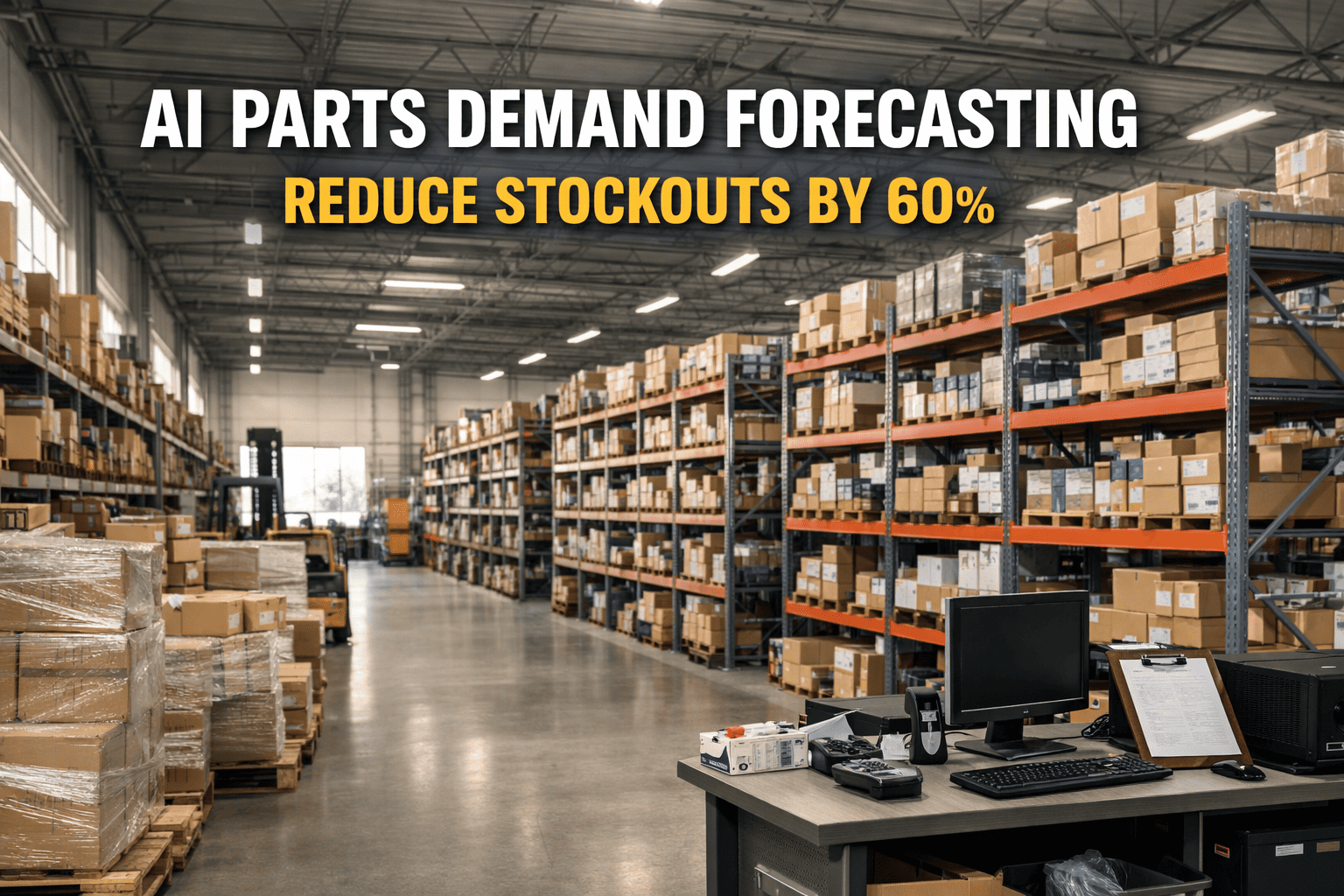
Fleets carry 15–30% more inventory than they need, yet still run out of critical parts at the worst moments. That's not a budget problem. That's a forecasting problem — and AI just solved it. By leveraging AI-driven demand forecasting fleets can predict part shortages before they happen. This not only reduces unnecessary inventory but also ensures timely maintenance and operational continuity. With machine learning, predictive analytics, and real-time data, inventory optimization becomes smarter and more efficient. Say goodbye to stockouts and wasted resources, and hello to streamlined fleet operations.
Why Every Fleet Manager Has a Parts Problem (Even the Good Ones)
You already know the feeling. A truck goes down Thursday night. Your tech checks the parts room — no brake caliper. You call three suppliers, none have it local. You pay $280 in emergency freight just to get the truck moving by Monday. Meanwhile, three shelves over sit 14 air filters nobody's touched in 8 months.
This isn't bad management. It's what happens when parts decisions are made with spreadsheets, memory, and guesswork — instead of data. And in 2026, with supply chains still volatile and parts costs rising, fleets doing it the old way are paying a serious price.
What AI Parts Demand Forecasting Actually Does
AI forecasting doesn't replace your parts manager — it gives them a superpower. Instead of reacting to what's already broken, the system predicts what will be needed before the vehicle even shows symptoms.
AI forecasting works best when it's connected to real-time maintenance data. See how FleetRabbit Predictive Maintenance feeds live failure signals directly into parts demand predictions — so your inventory moves before the breakdown happens.
The Real Cost Breakdown: Manual vs. AI-Driven Parts Planning
Most fleet managers know stockouts are expensive. But the full picture is worse than you think.
5 Signals Your Fleet Needs AI Parts Forecasting Now
Spreadsheet chaos is the root cause of most parts failures. See how FleetRabbit Auto-Deduction Inventory eliminates manual logging entirely — every part used on every work order is tracked automatically, keeping your forecasting data clean and accurate.
What AI Looks at to Predict Your Parts Demand
Good forecasting isn't magic — it's signals. Here's what the AI actually analyzes across your fleet:
How FleetRabbit's AI Parts Forecasting Works in Practice
Here's a real-world scenario showing the difference FleetRabbit makes:
See AI Forecasting in Action for Your Fleet
Book a 30-minute demo — we'll show you exactly what FleetRabbit would predict for your fleet's top 10 parts needs based on your vehicle types and age.
Parts forecasting is only as good as the maintenance data feeding it. See how FleetRabbit Fleet Analytics turns your raw maintenance history into clean, structured signals that power more accurate AI predictions over time.
Key Features to Look for in AI Parts Forecasting Software
AI parts forecasting is one part of a complete maintenance picture. See how FleetRabbit's Full Maintenance Platform connects parts inventory, work orders, DVIRs, and HOS compliance into one system — so nothing falls through the cracks.
What's Your Fleet Losing Every Month Without AI Forecasting?
Quick math most fleet managers never do — until they see the number staring back at them.
Which Parts Does AI Forecast Best? (And Why It Matters)
Not all parts behave the same way. AI forecasting categorizes your inventory by demand pattern — and handles each one differently.
From Signup to First AI Prediction — In 5 Days
Most fleet managers assume AI takes months to set up. With FleetRabbit, you're running live predictions inside a week — without replacing a single piece of hardware.
What Fleet Managers Say After Switching to AI Parts Forecasting
"We had 4 emergency freight orders in one month — cost us over $1,200 just in shipping. After FleetRabbit, we've had zero in the last 3 months. The AI literally told us to stock brake calipers 2 weeks before 3 trucks needed them."
"We were carrying $40,000 in parts inventory and still running out of what we needed. FleetRabbit showed us we had 60% overstock on slow-movers. Cut our inventory value by $12,000 and haven't had a stockout since."
"Setup took less than a day. By day 3 we already had our first forecast — it flagged 6 parts across 4 vehicles that needed restocking. Two of those vehicles had breakdowns the previous quarter. The AI connected the dots we never could."
Stop Guessing. Start Predicting.
Every fleet that switches from reactive to AI-driven parts planning sees the same result: fewer breakdowns, less emergency spend, and a parts room that actually matches what your fleet needs. FleetRabbit makes it accessible at $3/vehicle/month — with a free tier to get you started today.
Frequently Asked Questions
Modern AI fleet maintenance systems achieve 85–95% accuracy in predicting component failures and associated parts needs. Accuracy improves over time as the model trains on your specific fleet's patterns — vehicles with 12+ months of maintenance history typically see the highest prediction precision. FleetRabbit generates initial predictions within 72 hours of connecting your telematics data.
Yes — and it often delivers the biggest ROI for small-to-mid fleets. With 10–20 vehicles, one or two unplanned breakdowns a month can consume a disproportionate share of your maintenance budget. AI forecasting catches those failures before they happen. FleetRabbit's free tier covers up to 3 vehicles, with paid plans starting at $3/vehicle/month — making it accessible at any fleet size.
FleetRabbit connects to your existing telematics in minutes and begins generating initial forecasts within 72 hours. Full deployment — including parts room setup, auto-deduction configuration, and reorder workflows — typically takes 5 days. You don't need to replace your existing telematics hardware or ELD. The platform integrates with 200+ telematics providers.
The AI uses telematics data (engine diagnostics, mileage, sensor readings), your existing maintenance and repair records, parts usage history, and vehicle age/specification data. The more historical data available, the more accurate the predictions. Even with limited history, FleetRabbit uses fleet-wide pattern data from similar vehicle classes to generate useful forecasts from day one.
In most cases, yes — on two fronts. First, you eliminate emergency freight costs (typically $150–$400 per event) by having parts on hand before breakdowns occur. Second, you reduce excess inventory holding by 25–30%, freeing up capital that was tied up in slow-moving stock. Industry data shows parts inventory optimization via AI saves an average of 25% on stock holding costs while simultaneously reducing stockouts by up to 60%.
FleetRabbit's reorder triggers can be configured to fire purchase orders to your existing primary and secondary suppliers based on your preferred lead times and pricing arrangements. You keep your supplier relationships — FleetRabbit simply automates the timing and quantity decisions based on predicted demand, ensuring orders go out with enough lead time to avoid emergency situations.