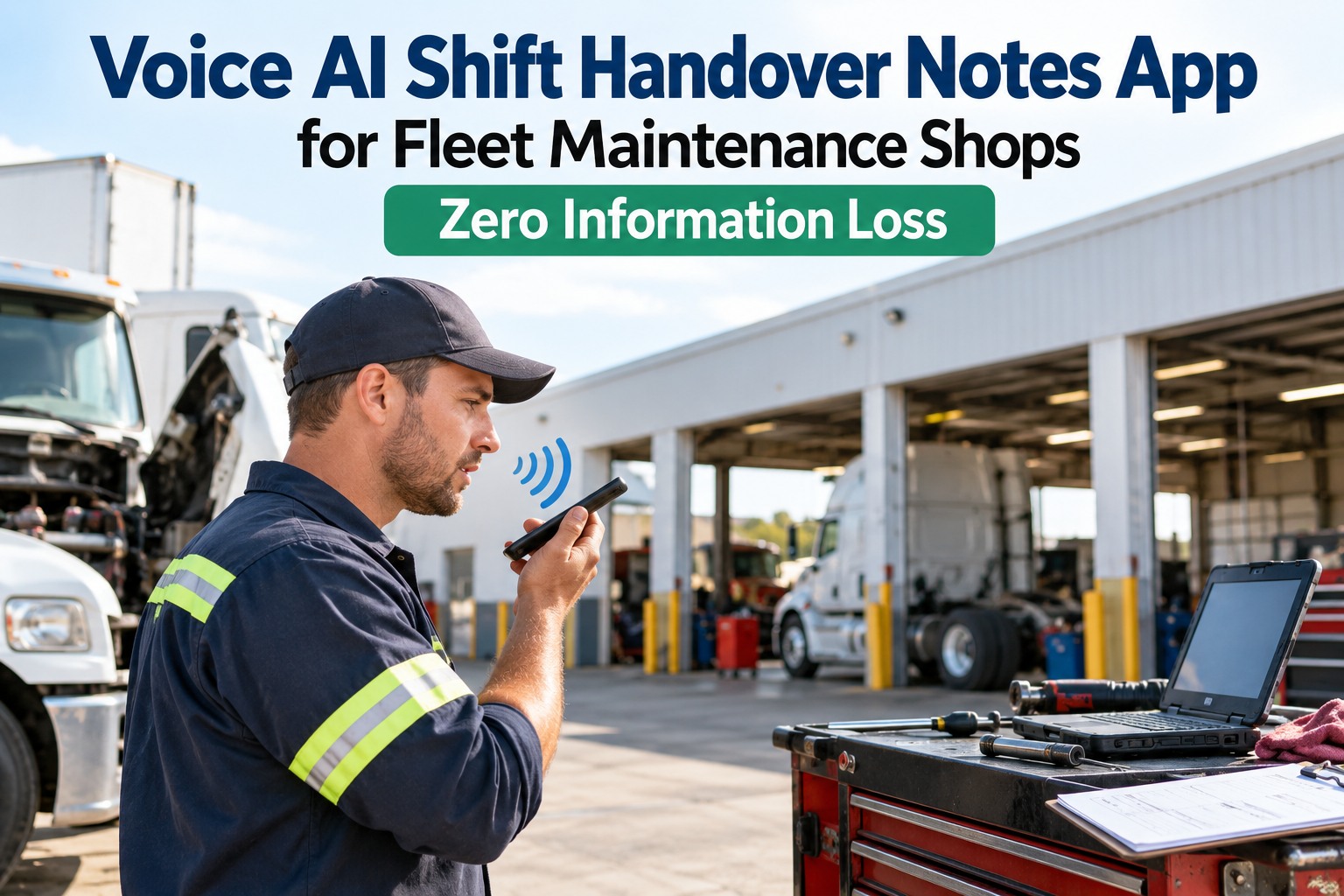
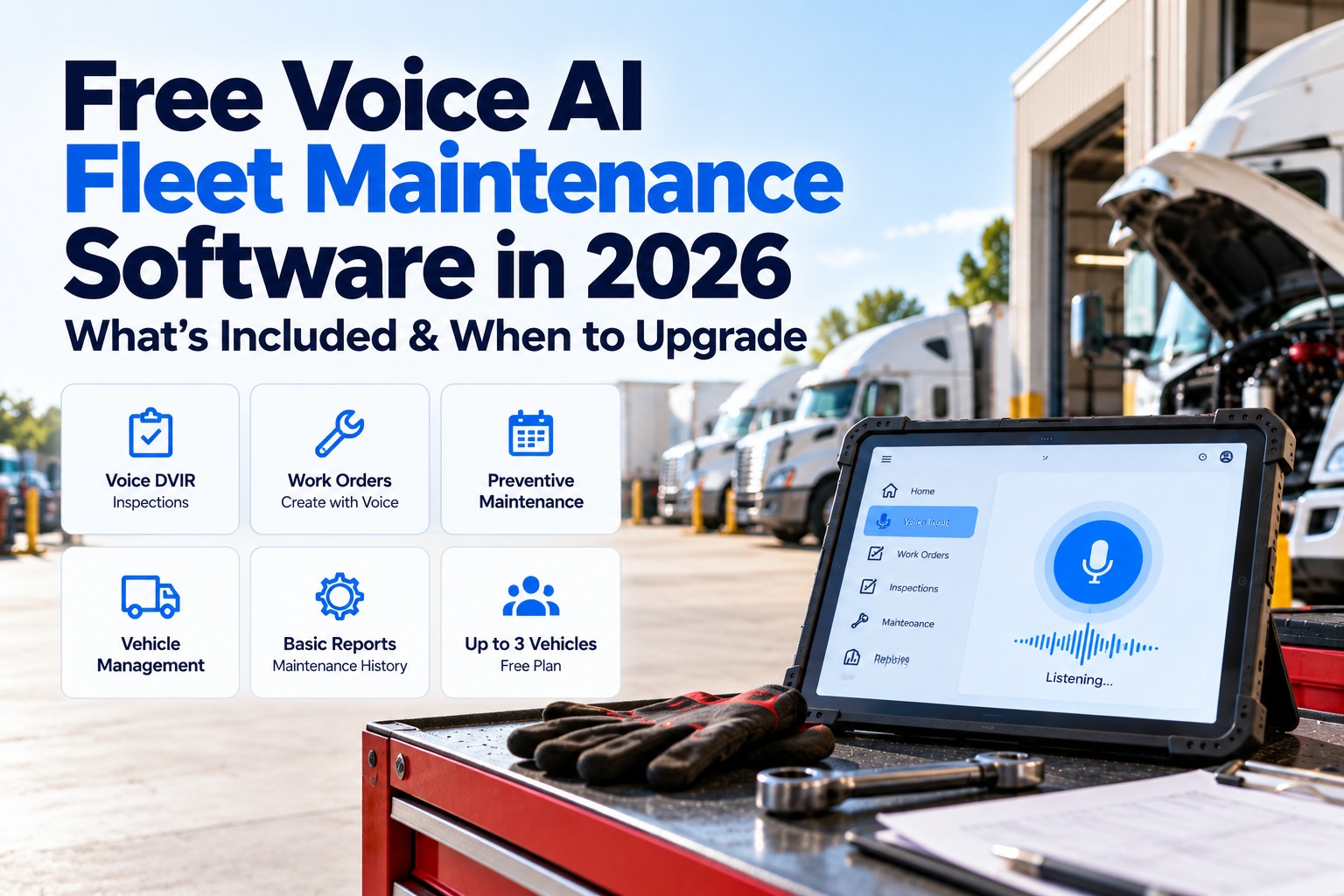
A voice AI shift handover notes app lets the outgoing technician talk through what is open, what was found and what comes next, then turns that spoken summary into a structured note tied to each work order. For fleet shops, that matters because the people holding the knowledge are leaving: ATRI reports that 44% of truck technicians are considering other jobs and 65% of shops are understaffed. Hear a spoken handover turn into work-order notes, or read how voice AI works for fleet technicians.
VOICE SHIFT HANDOVER · FLEET MAINTENANCE SHOPS
The Next Shift Shouldn't Start With "So, What Happened to Unit 214?"
Sixty seconds of talking at the end of a shift can replace a hallway conversation, a sticky note and a guess. Here is how to make every handover complete, searchable and attached to the work order.
WHAT THE TECH SAYS
"Unit 214, brake chamber on the rear axle is replaced, the slack adjuster still needs a new pin, parts are on order, don't release it."
▼ becomes
Unit214
DoneBrake chamber, rear axle
OpenSlack adjuster pin
StatusHold: do not release
What Disappears at the 3 p.m. Shift Change
A shift change is a control point, not a conversation. When the only record is a spoken update or a scribbled note, the next shift restarts diagnostics, orders parts twice or releases a truck that was supposed to stay down. The staffing numbers make it worse: every departure takes unwritten knowledge out of the building.
44%
of truck technicians are considering other jobs
65%
of shops were understaffed in 2025
19.3%
average technician vacancy rate, about one in five seats
16.5%
average annual technician turnover in 2024
DAY SHIFT KNOWS
- Which fault code came back twice
- The part that is on backorder
- The driver who said it only pulls when cold
?
NIGHT SHIFT RECEIVES
- A work order that says "in progress"
- A keys-on-the-hook note
- Whatever someone remembers
Nine Things Every Handover Note Should Carry
Good handover notes cover the same nine categories regardless of shop size. Voice makes each one a single spoken sentence, so nothing gets skipped because typing was a hassle.
1
Open work orders
"WO 4471 is half done, waiting on a seal."
2
Carry-over work
"I got through the rear axle, front is untouched."
3
Unit status
"Unit 214 is down. Unit 98 can run but watch the leak."
4
Safety issues
"Lift 3 locks sticking, tag it out."
5
Downtime events
"Unit 61 sat six hours, suspect the wrong part shipped."
6
Parts and materials
"Need two air dryer cartridges, ordered, arriving Thursday."
7
Temporary repairs
"Clamped the hose. Needs a proper replacement this week."
8
Vendor work
"Unit 33 is at the dealer, they promised Friday."
9
Follow-ups with an owner
"Marcus, please re-torque the wheel on 207 after its first run."
Hear the nine categories get filled by voice
Bring one real shift's worth of open work and watch it become a note the next shift can act on.
A Sixty-Second Handover, Start to Finish
The routine fits into the last few minutes of a shift. The technician talks, the system structures it, and the incoming tech or supervisor confirms.
0:00
Open the shift summary
One tap on the phone, no typing, gloves on.
0:10
Talk through each open job
Unit, what is done, what is left, what is blocking.
0:45
Flag holds and safety items
"Do not release" and tag-outs get called out first.
1:00
Note lands on the work orders
Each item attaches to its unit and job, ready for the next shift.
WHAT WAS SAID
"Okay so 214 is basically done on the brakes but the pin for the slack adjuster wasn't in the kit so that's on order, and 98 is leaking a little from the dryer, I'd keep an eye on it, and the lift on bay 3 is acting up."
WHAT THE NEXT SHIFT SEES
- Unit 214: hold, brakes done, slack adjuster pin on order
- Unit 98: monitor, air dryer leak, recheck next shift
- Bay 3: safety flag, lift acting up, tag out
Where Paper, Texts and Hallway Chats Break Down
Verbal-only updates, outdated paper notes and disconnected work orders are the usual failure points. Here is how each method holds up when someone is off sick or a shift runs long. Swipe the table horizontally on mobile.
← Swipe to see all columns →
What Each Person Does at Shift Change
OUTGOING TECH
Talk it out
- Dictate every open job before clocking out
- Say "hold" or "safe to release" explicitly
- Name the part that is blocking the job
- Assign each follow-up to a person
INCOMING TECH
Read before touching
- Open the summary before picking up a wrench
- Confirm holds and safety flags first
- Reply on the note if something does not match
- Skip diagnostics that are already finished
SHOP SUPERVISOR
Check the gaps
- Confirm every open work order got a note
- Review stalled jobs each morning
- Chase parts and vendor promises
- Spot units that keep returning
Roll It Out in One Working Week
Handovers only work when they become a habit. A short pilot on one shift makes the habit easy to build.
MON
Pick the pilot shift
Choose the shift with the most carry-over work.
TUE
Teach the script
Unit, done, left, blocked, owner.
WED
Run side by side
Voice note plus the old method.
THU
Drop the old method
The voice note is now the record.
FRI
Review the numbers
Compare against the metrics below.
Handover completion rate
Open work orders with a note at shift end, divided by all open work orders.
Repeat diagnostics
Jobs where the second shift redid work the first had finished.
Stalled work orders
Work orders untouched for more than 24 hours with no stated blocker.
Keep What Your Best Technician Knows When the Shift Ends
When technicians come and go, the shop's memory should stay. FleetRabbit's voice AI turns spoken notes into structured work-order records, so repairs, holds and follow-ups carry over from one shift to the next.
See how voice becomes a work order.
Hands-free notes
Attached to work orders
Holds and safety flags
Searchable history
Frequently Asked Questions
What is a voice AI shift handover notes app?
It is software that lets an outgoing technician speak a handover summary instead of typing it. The AI turns the speech into a structured note covering open work orders, work completed, parts, holds and follow-ups, so the next shift can pick up without a verbal briefing.
Why do shift handovers fail in fleet maintenance shops?
Common causes are verbal-only updates, paper notes that go stale, work orders with missing next steps and no shared view of repair status. Each one forces the next shift to rediscover what the last one already knew.
What should a handover note include?
Open work orders, carry-over work, unit status, safety issues, downtime events, parts needed, temporary repairs, vendor work and follow-up actions with a named owner. The nine-item list above is a good template.
Does voice dictation work in a noisy shop?
FleetRabbit reports 94% accuracy in high-ambient-noise testing and offline capture that syncs later. Pilot it in your loudest bay first to see how it performs in your environment, and
see the voice AI guide for fleet technicians.
Is a voice note a legal record?
A handover note is an internal maintenance communication. Driver inspection reports follow the DVIR rules in 49 CFR 396.11, and repair certifications remain separate records. Keep both, and link the handover to the work order it affects.
How long does it take to dictate a handover?
A shift with three to five open jobs usually takes about a minute of speaking. The time saved comes from the incoming shift skipping the briefing and the repeated diagnostics.
Can handover notes help with technician turnover?
Yes. ATRI reports average technician turnover of 16.5% and a 19.3% vacancy rate, so a new or temporary technician often walks into jobs half done. A written, searchable handover gives them the context the departing technician carried in their head.
How much does it cost to try voice handovers?
Make the Last Minute of Every Shift Count
One spoken summary protects the work done, the work left and the truck that must not leave the bay. Give your next shift a record, not a rumor.
Free tier for up to 3 vehicles · No credit card required · Voice notes tied to your work orders
October 3, 2026By Sam Parker
All Blogs