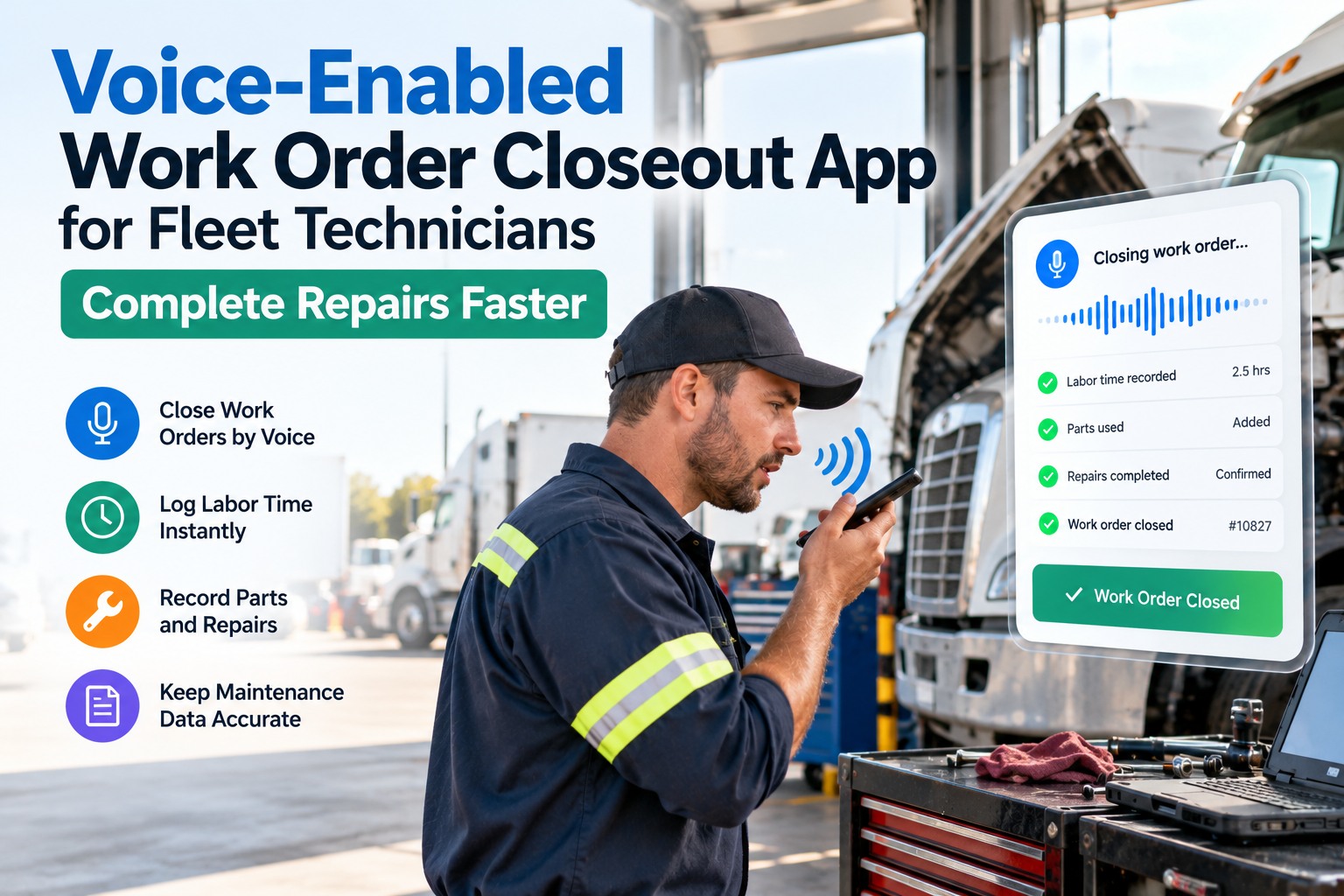
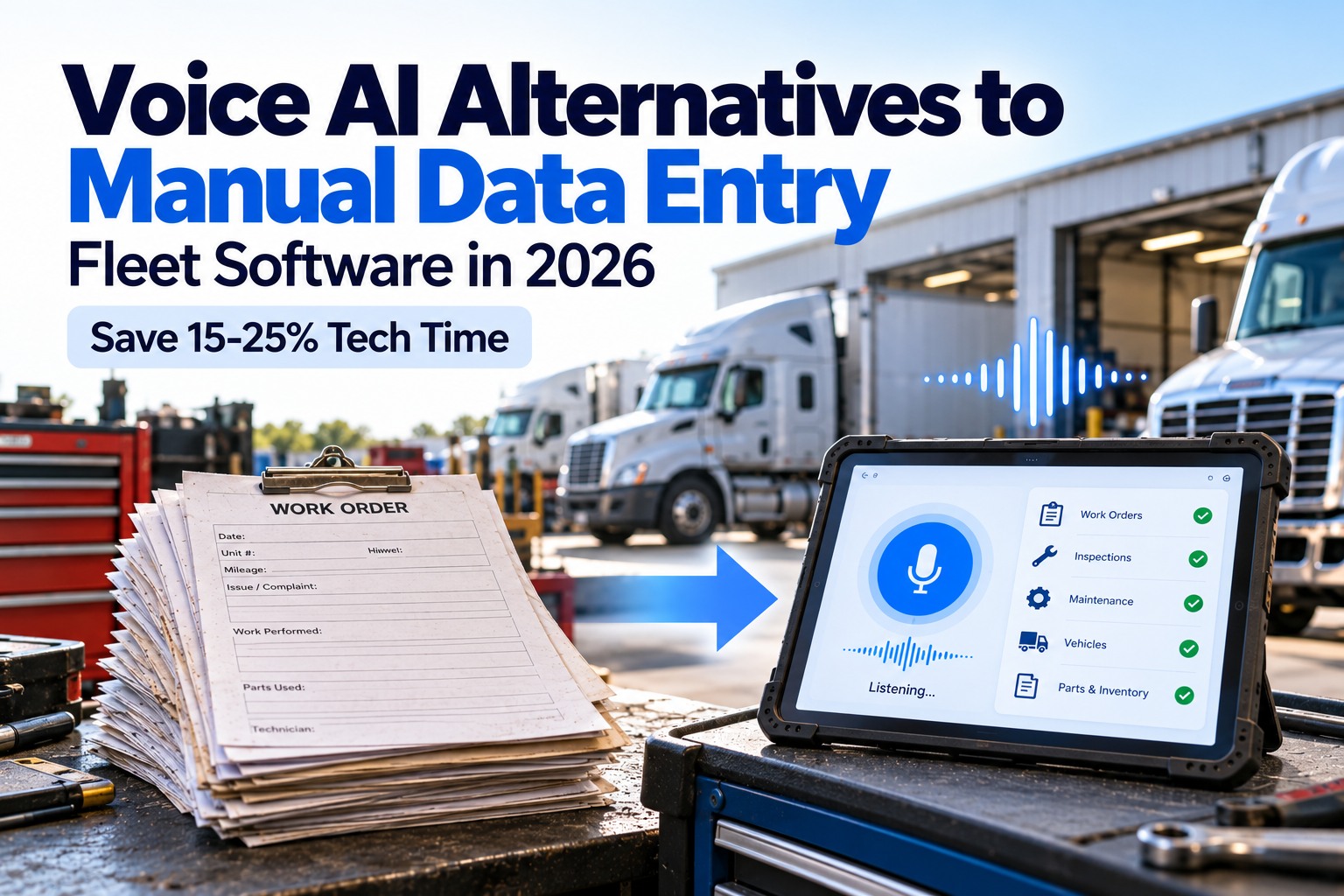
A voice-enabled work order closeout app lets a technician finish a repair by talking: cause, correction, parts, labor time and any follow-up are spoken once, then written into the work order record. The finish line is where records go wrong, because it comes after the hard part of the job and gets done last or not at all. Watch a work order close by voice, or read how voice becomes a work order.
VOICE WORK ORDER CLOSEOUT · FLEET TECHNICIANS
The Repair Isn't Finished Until the Record Says So
Technicians finish the wrench work and then face a screen full of fields. Let them say what happened in under a minute and move to the next truck with a complete closeout behind them.
WO #4471CLOSED BY VOICE
Unit214
Labor1.33 hrs
Parts2 items
Follow-upRecheck stroke
Closeout Is the Stage Everyone Skips
A work order moves through the same stages on every job. Reporting, assigning, diagnosing and repairing all happen because the truck is in front of someone. Closeout happens after the work is done, which is why it is the stage most likely to be rushed, left blank or filled in days later from memory.
Reported
A driver or inspection flags the defect.
Assigned
A technician and a bay are lined up.
Diagnosed
The cause is found and parts are identified.
Repaired
Hands-on work gets finished.
Closed out
Cause, parts, labor and sign-off are recorded. This is the step that goes missing.
Counted
Cost per mile, parts usage and repeat-repair reports draw on the record.
68%
One maintenance-software guide reports that 68% of CMMS work orders in an average facility are closed with incomplete data. Missing labor hours, parts and causes do not hurt on the day. They surface months later, when nobody can say what a repair really cost or why it came back.
The Closeout Form, Filled In by Talking
Eight fields make a closeout complete. Typed on a phone with greasy gloves, each is a chore. Spoken, each is a sentence the technician would say to a colleague anyway. Here is what a single job sounds like and what lands in the record.
Bring a messy work order and close it out loud
Pick one real repair from last week. We will show how it would have been captured by voice in about a minute.
Say the Time Any Way You Like
Labor time is the field technicians round, guess or skip. Spoken durations are natural, so the app should convert whatever the technician says into decimal hours the system can total.
"An hour and twenty minutes"
→
1.33 hr
"Forty-five minutes"
→
0.75 hr
"Two and a half hours"
→
2.50 hr
"Quarter to nine to ten-fifteen"
→
1.50 hr
What Breaks Downstream When Closeouts Are Thin
Every missing field removes a number from a report someone else depends on. With repair and maintenance running about 21.5 cents per mile in ATRI's latest cost study, the cost figures only mean something when the records feeding them are complete.
MISSING
Labor hours
Repair cost per unit cannot be totaled.
MISSING
Parts used
Inventory counts drift and invoices disagree.
MISSING
Cause
The same failure returns and looks new.
MISSING
Follow-up flag
A temporary fix gets forgotten.
Close It in the Language Your Crew Thinks In
23.7%
Nearly a quarter of the driver workforce is Hispanic
DataUSA's 2024 profile of driver/sales workers and truck drivers, a workforce of about 3.5 million, puts the Hispanic share at 23.7%. Shops with bilingual crews know that writing detailed repair notes in a second language leads to short, vague entries. Speaking the note in the language a technician is most comfortable in gets more detail into the record. Test any app on your own crew's speech before you commit.
- Have two or three technicians dictate real jobs in their preferred language
- Check that parts names and part numbers come through correctly
- Check that numbers and times convert to the right values
Three Ways to Close a Work Order
PAPER TICKET
Closed on Friday
Handwritten at the bay, typed in by someone else days later. Details fade, handwriting gets misread.
Fast to start, slow to count
TYPED ON A SCREEN
Closed at the desk
Accurate when done, but the tech walks back to a terminal or thumbs through fields with dirty hands.
Complete only if time allows
VOICE AT THE BAY
Closed before the next truck
Spoken while the details are fresh, parsed into fields, ready for review.
Complete while it is still true
Live in Days, Not Quarters
A closeout app only helps when technicians actually use it. A short rollout that starts with one crew keeps the change small and the feedback quick.
Day 1
Connect your vehicles and open work orders
Day 2
Give two technicians the voice flow and a one-page script
Day 3
Review the first ten closeouts with the crew and fix wording
Make Every Closed Work Order Count Toward the Next Decision
FleetRabbit's voice AI turns spoken repair narration into structured work order records, with labor time, parts and next steps routed into the rest of your fleet system.
See what voice AI does for technicians.
Cause and correction
Labor time in decimals
Parts to inventory
Follow-up flags
Frequently Asked Questions
What is a voice-enabled work order closeout app?
It is software that lets a technician complete a work order by speaking. The app turns the narration into structured fields such as cause, correction, parts used, labor time, downtime and follow-up actions, then records the sign-off.
What fields should a closeout include?
Failure or complaint, cause, correction, parts used, labor hours, downtime duration, a next-action flag and technician sign-off. Photos help for audits and disputed repairs.
How does the app handle labor time spoken aloud?
It converts spoken durations such as "an hour and twenty minutes" into decimal hours (1.33) so labor can be totaled. Review the converted value before submitting, especially for jobs that span several sessions.
Does voice work in a loud shop?
Accuracy depends on microphone placement, noise and speaker habits. FleetRabbit reports noise-cancelling processing tuned for shop environments, so run a pilot in your loudest bay and review the first closeouts.
Read the voice AI guide for technicians.
Can technicians dictate in Spanish?
Many crews are bilingual, so language support should be tested, not assumed. Ask the vendor which languages are supported, then have your own technicians dictate real jobs and check parts names, numbers and times.
Who reviews the closeout before it is final?
Technicians confirm their own entries, and a supervisor can scan closed jobs for missing parts or labor. A voice note should be read back on screen, never accepted blind.
How quickly can a fleet start?
FleetRabbit describes go-live within about 72 hours and needs no extra hardware. A three-day pilot with one crew is a sensible way to start.
Finish the Job, Then Finish the Record
The next truck is waiting, and so is a report that needs complete data. One minute of talking connects the two.
Free tier for up to 3 vehicles · No credit card required · Live in about 72 hours
October 3, 2026By Emily Parker
All Blogs