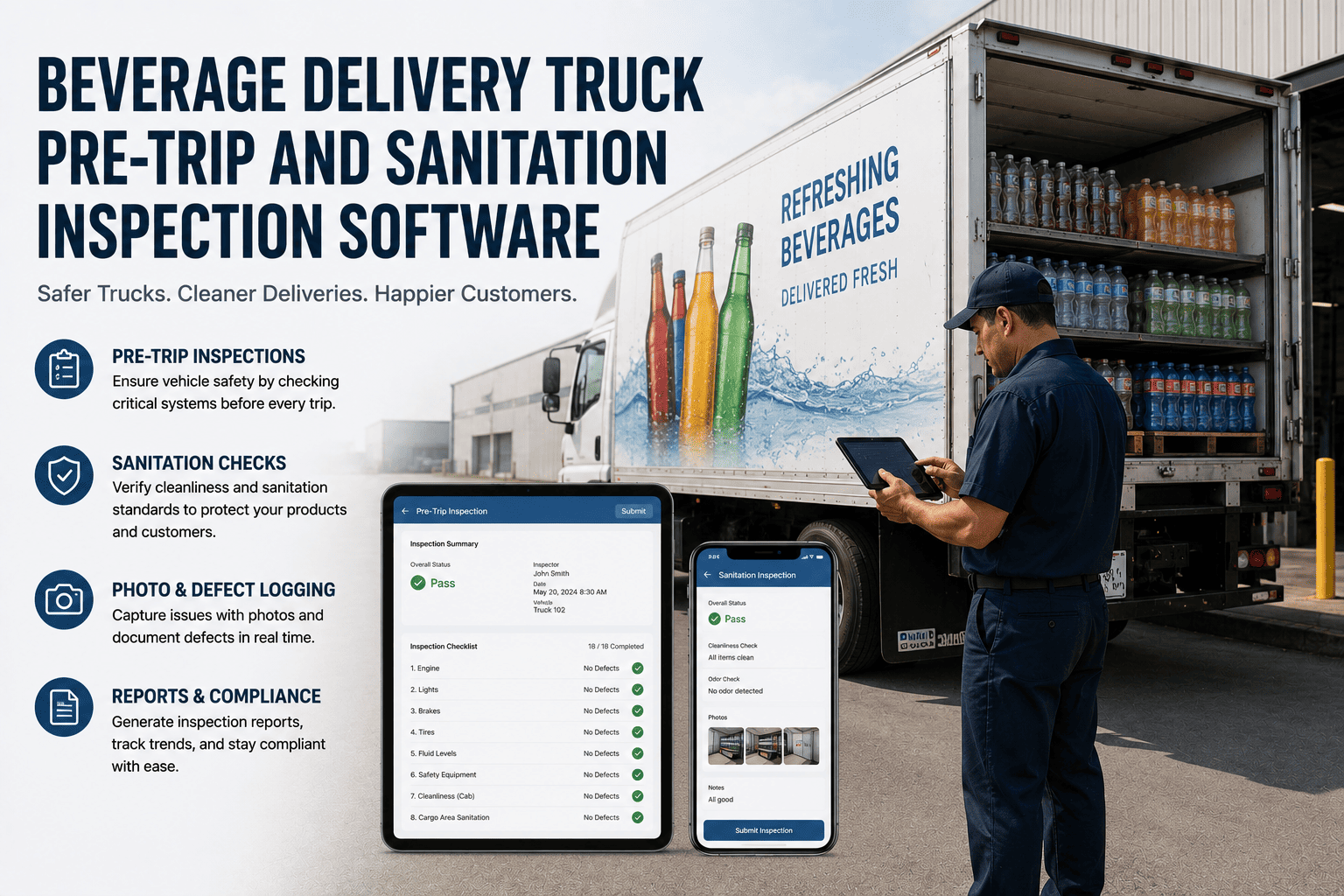
A driver in Ohio gets pulled over for a routine DOT check. The officer asks for that morning's pre-trip inspection report. The driver hands over a paper form — the signature line is blank. The truck gets placed out of service on the spot, the beverage delivery is delayed, and the customer waiting on that load isn't interested in excuses. The total cost of one missing signature ends up running into thousands of dollars once fines, lost revenue, and a damaged account are added up. Beverage delivery truck pre-trip and sanitation inspection software exists to make sure that blank line never happens again — and to prove, every single day, that the truck and the trailer it's pulling were both fit to carry product.
Two inspections, one truck, two very different regulators
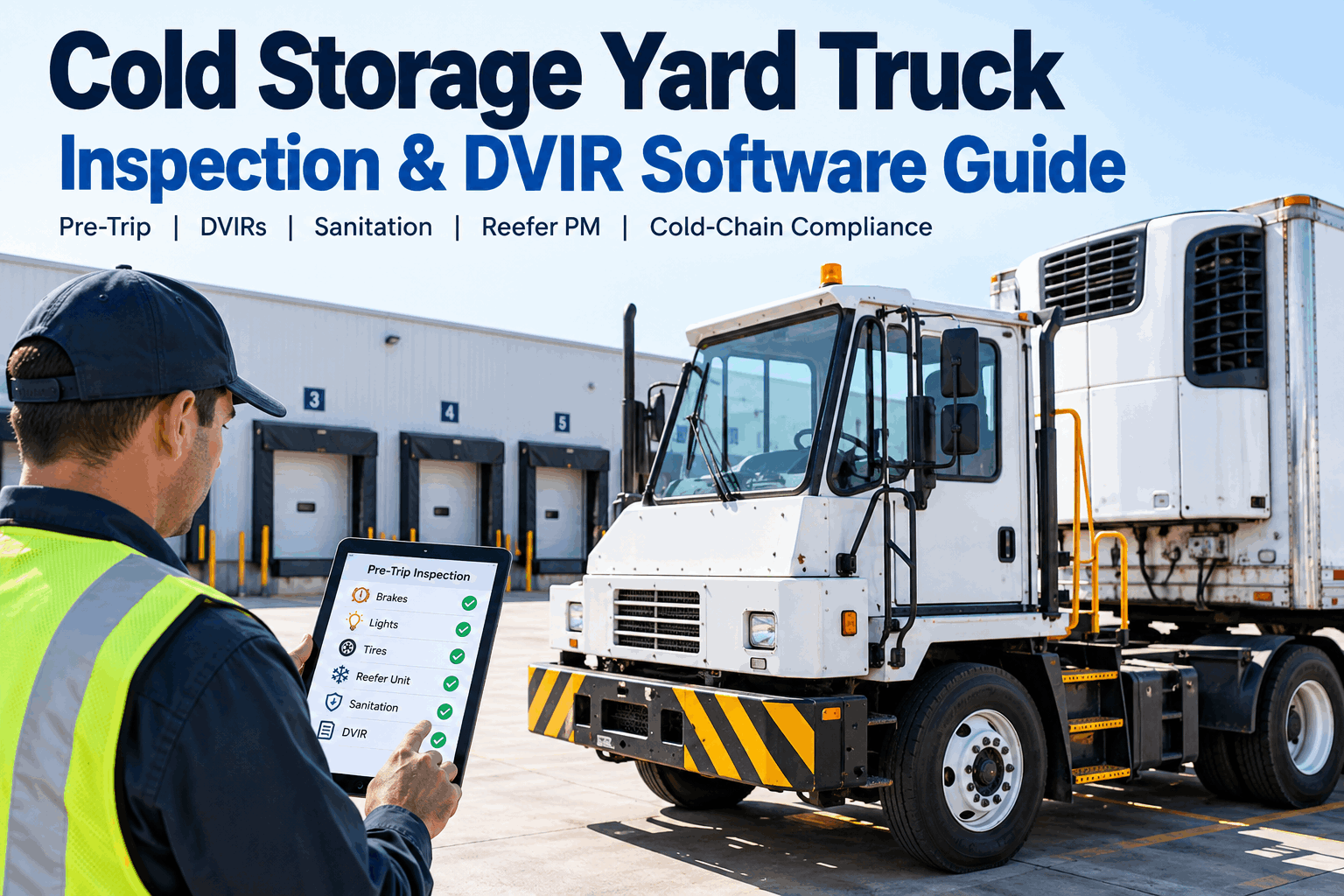
A beverage delivery truck answers to two separate compliance frameworks at once, and most fleets only build a process for one of them. DOT's Federal Motor Carrier Safety Regulations require a pre-trip inspection confirming the vehicle is safe to operate — brakes, lights, tires, coupling devices. FSMA's Sanitary Transportation Rule requires something entirely different: proof that the trailer's interior, refrigeration unit, and product-contact surfaces are clean enough to carry consumable goods without contaminating them. A truck can pass one and fail the other completely. Fleets running these as two disconnected paper processes can sign up to see both checklists run from the same driver app, on the same trip, in one workflow.
DOT pre-trip inspection
Brakes, tires, lights, coupling devices
Confirms the vehicle is safe to operate
Governed by FMCSA regulation 396.11
FSMA sanitation inspection
Interior surfaces, refrigeration unit, wash-out records
Confirms the trailer is clean enough for product
Governed by the Sanitary Transportation Rule
What a paper DVIR actually proves — and what it doesn't
A driver who completes a paper inspection form in under a minute hasn't necessarily inspected the vehicle — they've signed a piece of paper. A large share of roadside violations trace back to a defect that existed at the last pre-trip inspection and simply wasn't recorded, because a paper checklist rewards speed over thoroughness and gives a driver no reason to slow down. There's no way to verify a flagged issue was actually fixed before the truck left the yard, and no searchable trail if a DOT auditor or a customer's food safety team asks for history across a fleet.
Paper inspection
Completion time
~60 seconds, often unverified
Defect follow-up
No link to a work order
Audit trail
Manual filing, easy to lose
Digital inspection
Completion time
6-8 minutes, guided, photo-verified
Defect follow-up
Escalates straight to a work order
Audit trail
Searchable, exportable in minutes
That difference matters more than it looks. A guided mobile inspection with photo capture and GPS timestamps forces a complete walkaround instead of a signature of convenience, and a flagged defect connects directly to a maintenance work order instead of a note that might get relayed at the end of a shift. Distributors still relying on paper checklists for either inspection type can book a demo and time a real driver completing both inspections on a phone.
What a sanitation inspection actually needs to check
Product-contact surfaces
Interior walls and floors checked for residue, odor, or biofilm left over from a prior load.
Refrigeration unit condition
Reefer performance confirmed as clean and functioning before product is loaded, not assumed.
Allergen wash-out records
Documented proof of cleaning between loads, especially critical when switching between allergen-containing and allergen-free products.
Photo evidence
Visual confirmation attached to the record, giving an auditor something to check beyond a driver's signature.
Electronic signature
A legally binding digital sign-off, tied to the driver, the vehicle, and the exact timestamp of the inspection.
One-click export
Every sanitation record retrievable instantly when an FDA inspector or a retailer's food safety auditor asks for it.
Never hand an inspector a blank signature line again
Guided pre-trip and sanitation inspections, photo evidence, and audit-ready records for every beverage delivery truck in the fleet.
Electronic DVIRs are now unambiguously the standard
As of March 2026, FMCSA's final rule explicitly authorized electronic DVIRs under federal regulation, closing off any remaining question about whether a digital signature holds the same weight as a paper one. Paper inspections remain technically legal, but they're at a clear disadvantage the moment an audit happens — a fleet showing up with searchable, photo-verified digital records finishes an inspection in a fraction of the time it takes to dig through filing cabinets. Beverage distributors that haven't made the switch yet can sign up to see a fully compliant digital DVIR running against their current fleet before their next audit.
The same platform that handles inspections can generate the maintenance side of the record automatically. A defect flagged during a pre-trip walkaround escalates straight into a work order, and a sanitation issue caught before loading gets logged and resolved before the truck ever leaves the yard — closing the exact gap that turns a missed checklist item into a roadside violation or a rejected load. Fleet managers weighing whether that connection is worth the switch can book a demo and see a flagged defect move from inspection to work order in real time.
6-8 min
typical time for a guided digital inspection with photo evidence, versus a rushed paper form
March 2026
FMCSA's final rule explicitly authorized electronic DVIRs under federal regulation
One click
to export a complete sanitation and inspection record for an FDA or DOT audit
Frequently asked questions
Are electronic DVIRs legally accepted, or do we still need paper backups
Electronic DVIRs are explicitly authorized under federal regulation as of FMCSA's March 2026 final rule, and digital signatures are legally binding under the E-SIGN Act, so a paper backup is not required for compliance.
Is a sanitation inspection the same thing as a DOT pre-trip inspection
No. A DOT pre-trip inspection confirms the vehicle is mechanically safe to operate, while an FSMA sanitation inspection confirms the trailer's interior and product-contact surfaces are clean enough to carry consumable goods — a truck can pass one and fail the other.
Does a driver have to file a DVIR if no defects are found
For property-carrying commercial vehicles, a DVIR is only required when a defect is found, though the physical pre-trip inspection itself remains mandatory regardless of outcome, and many fleets still require a daily digital record as company policy.
How does a flagged defect actually get resolved with digital inspection software
A defect flagged during the inspection escalates directly into a work order in the same system, creating a documented chain from the finding to the repair, rather than relying on a driver relaying the issue verbally at the end of a shift.
Can allergen wash-out records be documented alongside standard inspections
Yes. Digital sanitation checklists can capture wash-out confirmation with photo evidence and an electronic signature specifically for allergen-containing to allergen-free product transitions, which is a common focus area during FSMA audits.
How long does it take to get a beverage delivery fleet onto digital inspections
Most fleets get drivers running guided digital pre-trip and sanitation checklists within days, since the software runs on a driver's existing phone and doesn't require new vehicle hardware to get started.