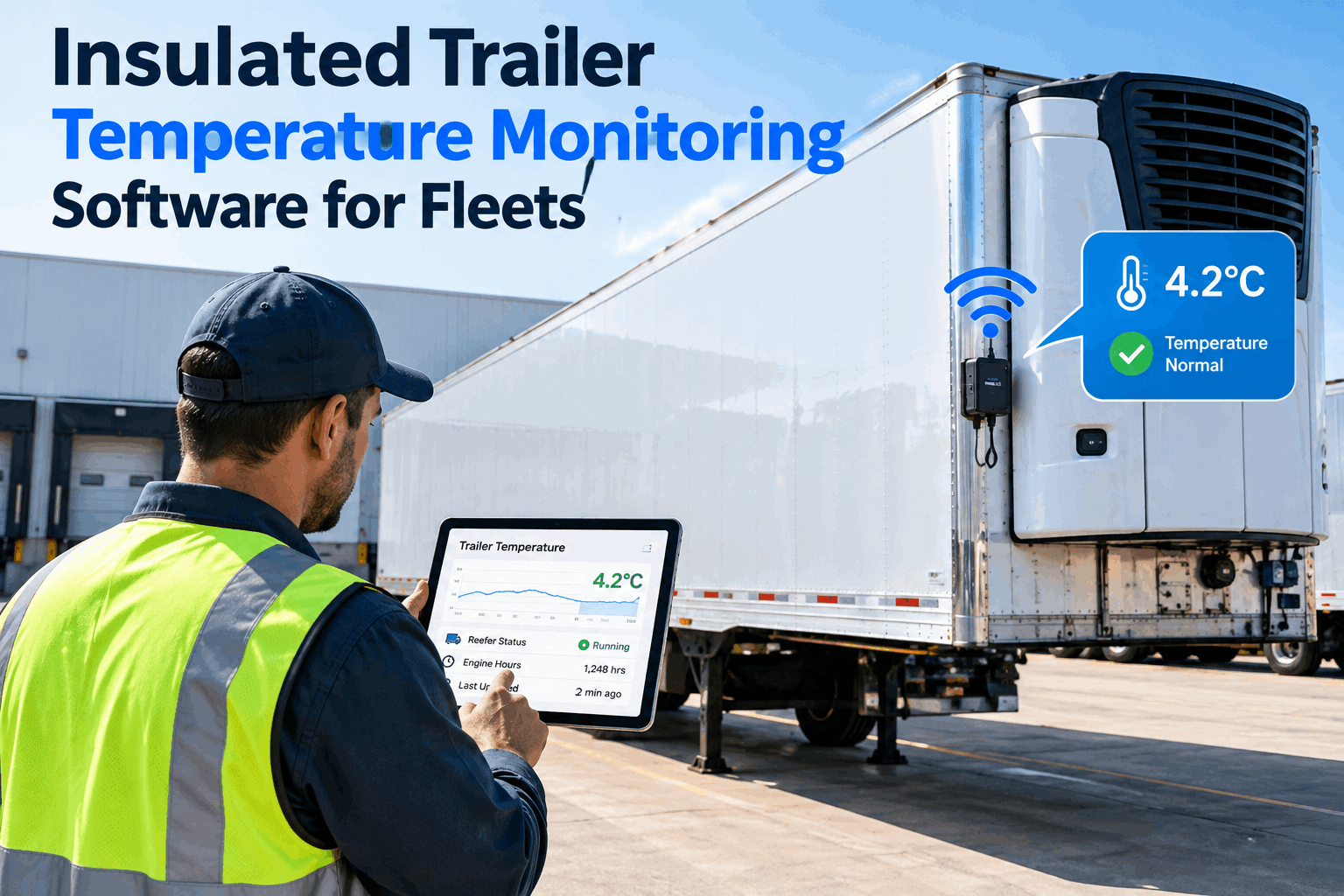
An active reefer unit fails loudly. It stops running, throws a fault code, and someone eventually notices the noise has gone quiet. An insulated trailer doesn't get that warning. A cracked panel, a door seal that's lost its grip, or insulation that's absorbed moisture over a season of use all degrade performance silently, and the only way anyone finds out is by watching the temperature curve slowly lose its margin. Monitoring isn't a nice-to-have here, it's the only alarm system this equipment has. See how FleetRabbit watches that curve for you.
Insulated Trailer Temperature Monitoring Software for Equipment That Fails Quietly
Track temperature continuously, catch a slow insulation problem before it becomes a real excursion, and keep supplemental cooling on its own PM schedule.
Two Different Ways a Trailer Stays Cold
Not every refrigerated trailer works the same way. Some rely on a full active reefer unit running continuously. Others depend mainly on insulation and the product's own thermal mass, sometimes with a smaller supplemental cooling system that tops things off rather than running the show. That second category is where insulated trailers live, and it changes what actually needs watching.
Active reefer system
- Runs continuously to hold setpoint
- A failure is usually obvious, fast
- Monitoring confirms it's working
Insulated trailer
- Relies on insulation performance and thermal mass
- A failure is gradual and easy to miss
- Monitoring is often the first sign something's wrong
What Silent Degradation Actually Looks Like
Insulation doesn't announce its own decline. It loses effectiveness a little at a time, and the causes are rarely dramatic: a door that's been slammed one too many times, a small crack that let moisture into the panel over a season, a gasket that compressed unevenly and stopped sealing all the way around. None of that trips an alarm on its own. It just quietly shortens how long the trailer can hold temperature once conditions get tough.
Catch a slow insulation problem before it's a fast one
Continuous temperature logging built to flag a shrinking margin, not just a hard excursion. Free for your first three vehicles.
Two Alert Levels Beat One
A single alert threshold set right at the limit only tells you after the problem has already arrived. A second, earlier threshold catches the trend while there's still time to act, whether that means tightening the route, checking the door seal at the next stop, or simply being ready for a delivery that might run close to the edge.
Temperature alerts are available where your telematics or sensor provider supplies temperature data. Set your own thresholds to match what you're hauling.
If There's a Supplemental Unit, It Still Needs PM
A trailer that leans on insulation rather than a full active system often still carries some supplemental cooling, and that equipment needs its own preventive maintenance just like a full reefer unit would. It's easy to under-service a system that's "just backup," but a supplemental unit that isn't working when it's actually needed removes the one active defense the trailer has left.
What the Record Should Show
FSMA's sanitary transportation rule touches on temperature control during food transport. Confirm exact requirements with your compliance team.
What FleetRabbit Gives an Insulated Trailer Fleet
Frequently Asked Questions
It relies mainly on insulation performance and thermal mass rather than a full active cooling system running continuously, sometimes with a smaller supplemental unit. Its failures tend to be gradual rather than sudden.
An active system usually signals its own failure quickly. Insulation degrades silently, so temperature data is often the earliest, and sometimes the only, signal that something is wrong.
Common causes include worn door seals, moisture that gets into a panel, and physical damage from loading impacts, all of which shrink how long the trailer can hold temperature.
An early-warning threshold catches a trend while there's still time to respond, rather than only alerting once the load is already at the limit.
Yes. Start free with three vehicles and scale up as your fleet grows.
Watch the Curve Before It Becomes a Problem
Continuous monitoring, tiered alerts and supplemental-unit PM in one place, built for equipment that won't warn you itself.