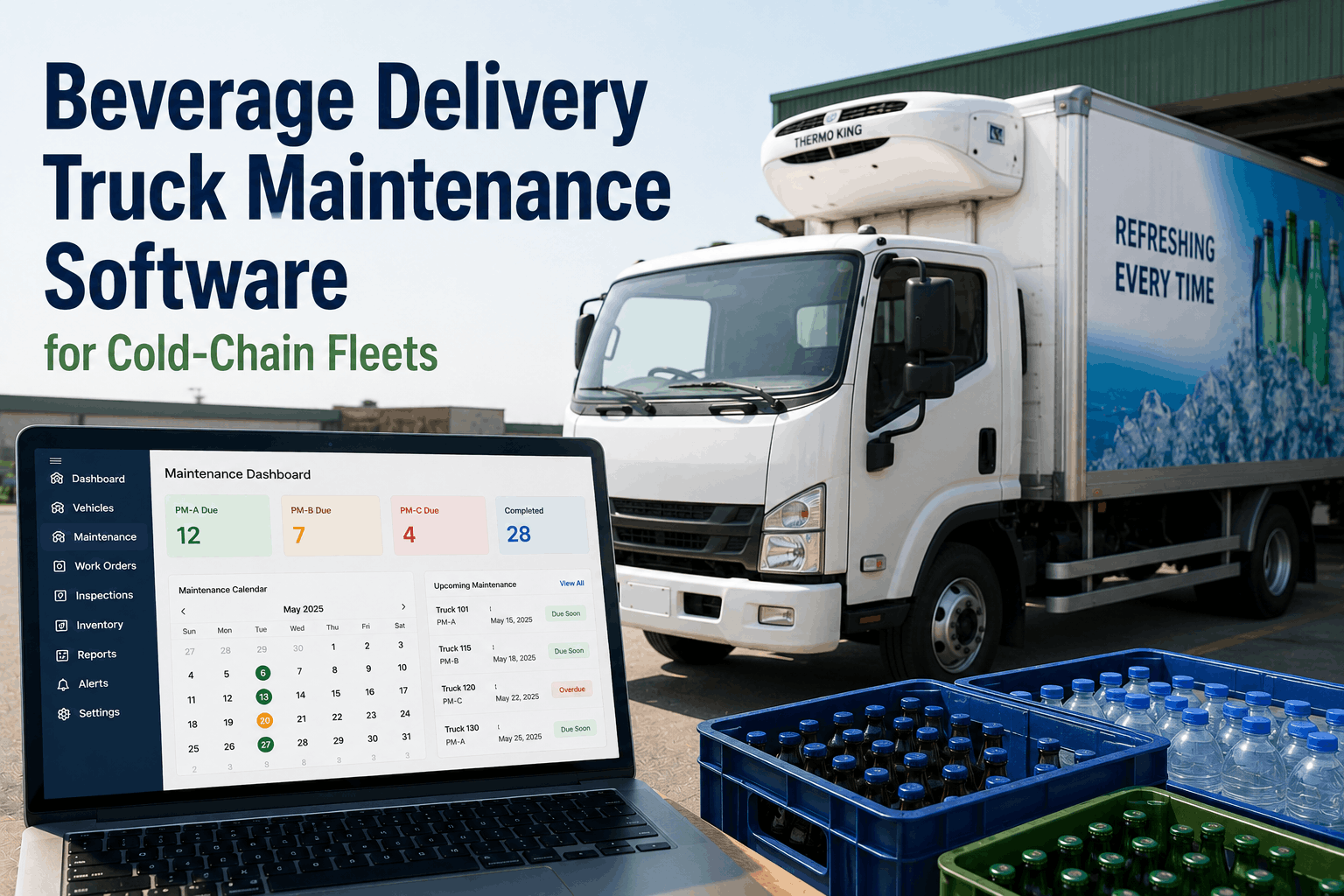
A beverage delivery truck does not spoil like a produce trailer or a dairy tanker. It spoils in small doses, one door opening at a time, across fifteen to thirty stops a day, with a reefer unit that runs on engine hours rather than a calendar. That single difference is why so many distributors track their trucks perfectly and still lose pallets, and it is exactly the gap that beverage delivery truck maintenance software built for cold-chain routes is meant to close.
Why beverage routes wear out reefers differently
A dry van fleet worries about mileage. A beverage delivery fleet has to worry about mileage, engine hours, and door-open time all at once, because the reefer unit on a beverage truck almost never gets to idle in one steady state. It cycles hard after every stop, working to pull the box back down to temperature before the next case of product goes in warm from the loading dock. That cycling is what actually wears out compressors and clutches, not the odometer, which is why fleets that only schedule maintenance by mileage tend to get surprised by reefer failures mid-route. If your team has not looked into signing up for engine-hour based reefer tracking yet, this is usually the first blind spot worth fixing.
What a compliant beverage route actually looks like, checkpoint by checkpoint
Instead of one origin-to-destination temperature reading, a beverage delivery route needs a record at every meaningful checkpoint. This is the structure that holds up during a distributor audit or a retailer chargeback dispute.
Distributors who piece this together manually, stop sheet by stop sheet, usually find the gaps only after a claim comes in. Distributors who book a demo of a route-level cold-chain view tend to find the gaps before the product ever leaves the warehouse.
See your reefer fleet's real condition, not just its odometer
Engine-hour PM, live temperature data, and audit-ready records in one dashboard built for beverage routes.
Engine hours versus the calendar: two very different maintenance triggers
Reefer service scheduled every 30, 60, or 90 days regardless of how hard the unit actually worked. A truck running a light suburban loop and a truck running twenty urban stops a day get treated the same, which either wastes service visits on the light route or under-services the heavy one.
Service triggers off actual reefer run time and compressor cycling, so the truck that works harder gets serviced sooner, and the truck that idles less does not sit in the shop for no reason. This is the model most cold-chain-aware fleets are moving toward, and it is the default inside FleetRabbit.
Where FSMA traceability actually touches your maintenance data
FSMA's food traceability rule requires distributors handling foods on the FDA's Food Traceability List to capture key data at critical tracking events and produce sortable records on request. Enforcement timing for the rule has shifted, most recently pushed out to July 2028, but retailers and grocers are increasingly asking for this data ahead of any federal deadline, and your maintenance history is part of what proves the cold chain held. A refrigeration unit maintenance log, a temperature deviation record, and a calibration record are not the traceability system itself, but they are exactly the kind of supporting document an auditor or a retailer partner will ask a distributor to produce.
Clipboard tracking versus a connected cold-chain fleet
| What you need | Paper and spreadsheets | FleetRabbit |
|---|---|---|
| Reefer service trigger | Fixed calendar interval | Live engine-hour based scheduling |
| Temperature record | Manual spot checks | Continuous, automatic capture |
| Audit prep | Days spent pulling files | Full trip history in minutes |
| Deviation response | Discovered after the fact | Flagged in real time |
Every distributor tells us the paper column used to feel manageable until the first chargeback dispute forced someone to reconstruct three weeks of stop sheets by hand. That is usually the point where a team decides to book a demo instead of building the next audit binder manually.
What uptime actually means for a beverage route
Uptime on a beverage delivery truck is not just "the truck started this morning." A truck that starts but has a reefer running warm is not really up, it is a liability moving down the highway. Real uptime tracking for cold-chain fleets watches three things together: whether the vehicle is drivable, whether the reefer is holding its set point, and whether the last PM was completed on schedule. A distributor that only tracks the first one is flying with two blind spots, and those are usually the two that end up in a claim. Teams that want all three in one view generally start by choosing to sign up and connecting their existing reefer telematics rather than replacing hardware outright.
Stop reconstructing cold-chain records after the fact
Get engine-hour reefer PM, real-time temperature alerts, and FSMA-ready documentation working together.
Frequently asked questions
How is beverage delivery maintenance different from general refrigerated trucking.
Beverage routes involve far more stops and door cycles per day than a typical long-haul reefer run, which puts more wear on the compressor and clutch relative to the miles driven. Maintenance scheduling built around mileage alone tends to under-serve these trucks.
Does FleetRabbit replace our existing temperature sensors.
No. FleetRabbit connects to your existing reefer telematics and sensor data and turns it into engine-hour PM scheduling, deviation alerts, and audit-ready records, without requiring a hardware swap.
Do we need this if the FSMA 204 deadline has been pushed back.
Federal enforcement timing has shifted, but many retailers and grocery partners are already asking distributors for this level of record-keeping ahead of any federal deadline, so waiting on enforcement dates is a risky strategy on its own.
Can this work across a mixed fleet of straight trucks and trailers.
Yes. Engine-hour PM scheduling and temperature tracking apply the same way whether the reefer is mounted on a straight truck or a pulled trailer.
How long does it take to get set up.
Most distributors are live within days rather than months, since the platform connects to data you are already generating instead of asking you to rebuild your process from scratch.