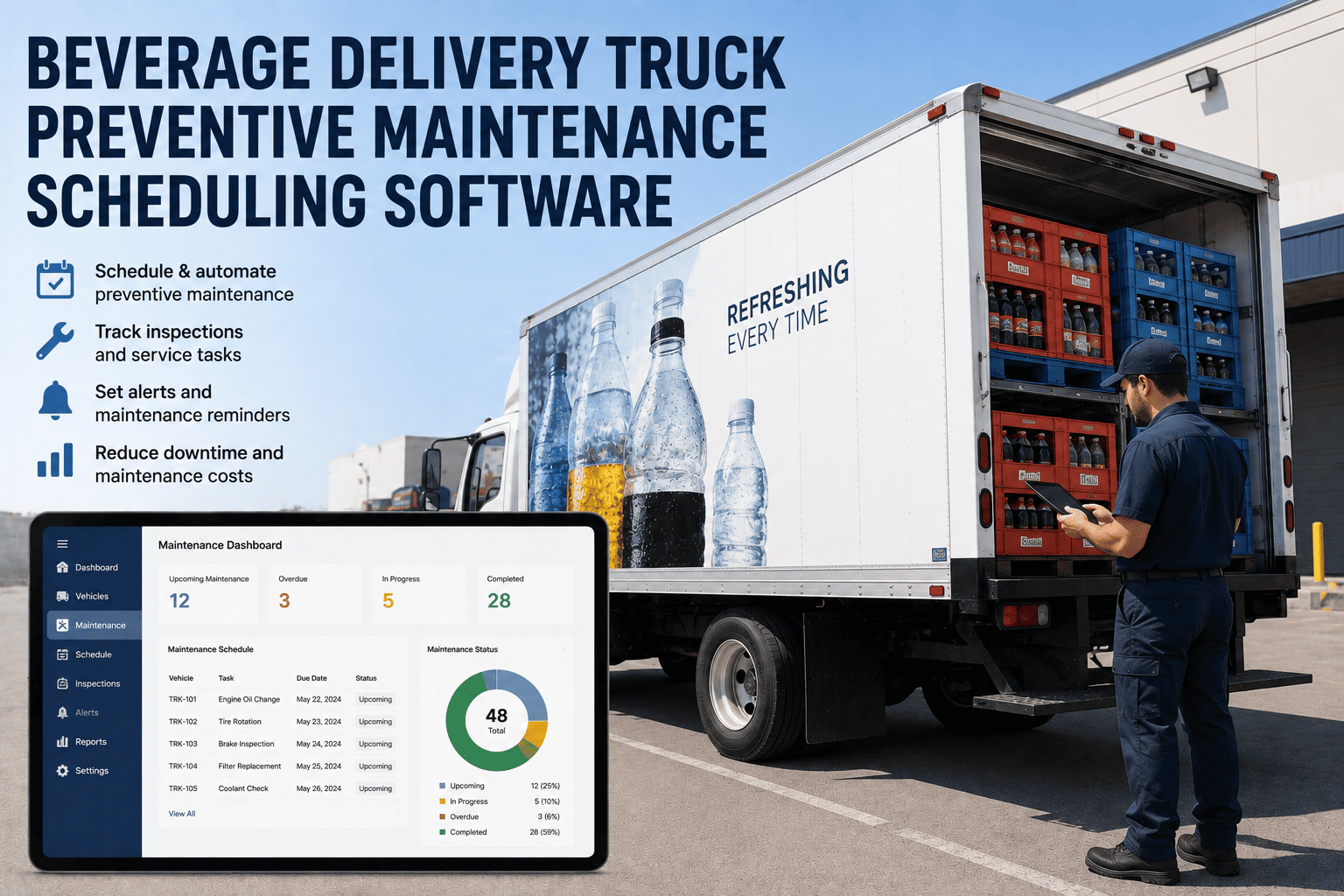
A beverage delivery truck rarely sees an open highway. Most of its day is spent in short hops between accounts, eighteen or twenty stops packed into a couple hundred miles, engine off and on, liftgate down and up, brakes worked hard at low speed in a loading zone. That duty cycle wears a truck in a completely different pattern than a long-haul tractor covering the same mileage on an interstate, which is exactly why beverage delivery truck preventive maintenance software has to schedule around stop count and engine hours, not just odometer readings. For routes carrying chilled product, the reefer unit adds a second wear pattern running on its own clock, often for longer than the engine itself.
Why a DSD route wears a truck differently than a highway mile
Direct store delivery routes compress a full day of mechanical stress into a short mileage total, which is exactly what a standard, mileage-only PM schedule misses. Fleets that want to see this mapped against their own routes can sign up and connect a truck in an afternoon.
Brakes and suspension
Repeated low-speed stops and starts load brake components far more than the same mileage covered at highway speed, wearing pads and rotors faster than a mileage interval would predict.
Engine and transmission
Short hops rarely let the engine and transmission reach full operating temperature, which increases wear per mile compared to sustained highway running.
Liftgate and PTO
A liftgate cycled at every stop accumulates real mechanical wear that has nothing to do with how far the truck traveled that day.
Reefer unit
On chilled routes, the reefer often runs through every stop and every loading dock wait, logging hours well beyond what the tractor's mileage would suggest.
Engine-hour reefer PM for routes that never look like a road trip
A beverage reefer unit doesn't shut off between stops. It holds temperature at the dock, during the driver's break, and often overnight at the depot, which means a truck logging a modest 150 miles a day can still put two or three hundred engine hours on its reefer over a month. A maintenance interval built around a tractor's drivetrain has no relationship to that number, and by the time a mileage-based schedule calls for reefer service, the unit may already be running well past the point where a compressor issue was quietly building.
Scheduling reefer PM against actual engine hours instead catches that wear on the unit's own timeline. Beverage distributors running mixed fleets of reefer and dry-box trucks can book a demo to see engine-hour tracking running against their current reefer roster.
Illustrative comparison for a chilled DSD route, where dock time and overnight hold push reefer engine hours well past what mileage alone would suggest.
Schedule maintenance around how the route actually runs
Stop-count brake tracking, engine-hour reefer PM, and DOT-ready records, all built for delivery routes rather than highway miles.
One schedule for a fleet that isn't all the same truck
Most beverage distributors run a mixed fleet: dry-box trucks for shelf-stable product alongside reefer-equipped trucks for anything that needs to stay cold. Managing both under one maintenance plan only works if the plan actually understands the difference between them.
Distributors trying to manage this split across separate spreadsheets or a generic fleet tool usually end up with one side of the fleet under-tracked. Bringing both truck types into a single schedule, with the right trigger for each, is what a purpose-built platform can do that a generic one can't, and it's worth seeing directly. You can sign up to bring your first few trucks of each type in.
Keeping DOT and FSMA records in step with the route
A beverage delivery fleet answers to two separate sets of expectations at once. DOT wants proof that every truck was inspected and maintained on schedule. For chilled routes, FSMA-aligned customers and auditors want proof that temperature held throughout transit, not just that the reefer was serviced at some point. Beverage delivery truck preventive maintenance software ties both records to the same vehicle history, so a single dashboard can answer either question without a fleet manager stitching together separate systems.
That combined record becomes especially useful during a new account onboarding, when a retail buyer or distribution partner asks for documentation before the first load ever ships. Distributors preparing for that kind of review can book a demo to see how the compliance record builds itself in the background.
Stop guessing when the next reefer or brake job is due
Route-aware preventive maintenance for mixed beverage delivery fleets, dry-box and reefer-equipped alike.
Beverage delivery truck maintenance, common questions
Why doesn't a standard mileage-based PM schedule work for beverage delivery routes
DSD routes pack a full day of stops, idling, and liftgate cycles into a relatively short mileage total, so mileage badly understates the actual wear on brakes, the transmission, and any mounted equipment compared to the same distance driven on a highway.
Does reefer PM still matter if the truck only runs cold on part of its route
Yes. Even a partial cold route can accumulate significant reefer engine hours, especially with dock time and overnight hold included, and those hours are what actually drive compressor and component wear, not the portion of the route spent cold.
What is engine-hour based PM and how is it different from mileage based
Engine-hour PM schedules service based on how long an engine, whether the truck's or the reefer's, has actually run, rather than how far the vehicle has traveled. For duty cycles with a lot of idling or short hops, hours reflect real wear far more accurately than mileage does.
Can this handle a mixed fleet of dry-box and reefer trucks
Yes. Each truck type can run its own schedule and triggers, brake and stop-count tracking for dry-box trucks, engine hours and temperature compliance added in for reefer-equipped trucks, all visible from the same dashboard.
Does this replace our DOT inspection and DVIR process
No. It captures and stores that documentation alongside maintenance and, where relevant, temperature history, so a complete compliance picture is available in one place rather than replacing the inspection process itself.
How quickly can we get this running on our delivery fleet
Most distributors connect their first trucks within a day using existing telematics and reefer data. You can sign up and add trucks directly, or book a demo and have someone walk through your specific route structure first.