The phone call usually comes with less than 48 hours notice. A retail customer's quality team wants your cold chain audit file for the last quarter. Or SQF's unannounced audit window lands on a random Tuesday. Or the FDA shows up asking for records within 24 hours. In that moment, the fleets that stay calm are the ones who never had to build a file from scratch, because the file already existed. That's the entire idea behind cold chain audit package software: instead of assembling proof after the request lands, the proof assembles itself with every load.
24hrs
Window the FDA gives you to produce traceability records once requested
12mo
How often an SQF-certified facility faces recertification, plus unannounced checks
0%
Warning most audits give before the request for your records shows up
An Audit Package Is Not the Same Thing as "We Have Records Somewhere"
Plenty of distributors technically have the data an auditor wants. It's just scattered: temperature readings in one system, sanitation logs in a binder, pre-cool checks on a driver's phone, and delivery confirmations in a completely different tool. When a customer or a certification body asks for a cold chain audit package, they're not asking whether the data exists somewhere. They're asking whether you can hand them one organized, dated, complete file that tells the whole story of a shipment. That distinction is where most food distributors lose time, and occasionally lose points, during an audit.
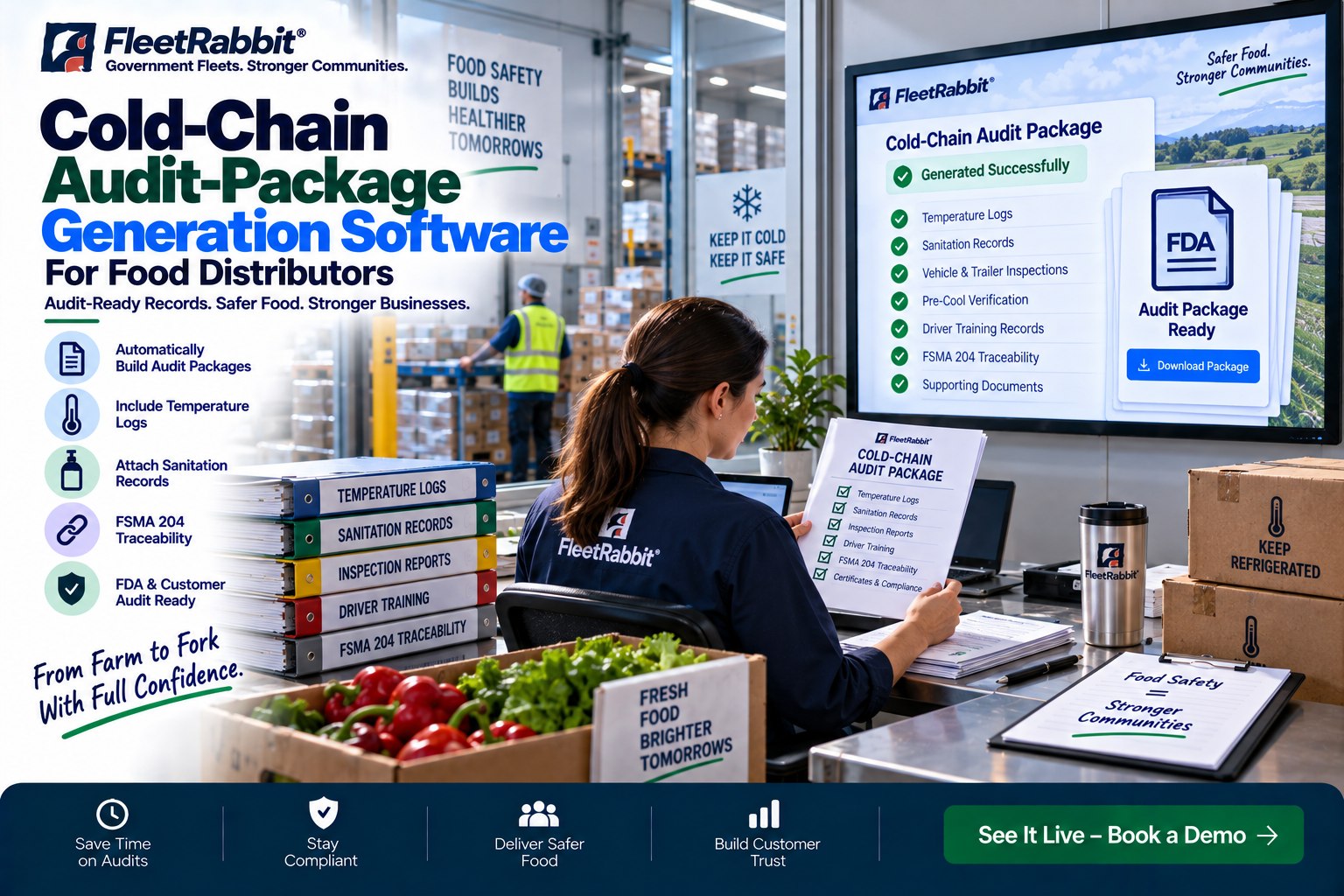
A proper package pulls together everything tied to a specific load or a specific date range: pre-cool verification, continuous temperature history, trailer sanitation records, chain-of-custody handoffs, and any corrective actions logged along the way. Building that by hand, load by load, is exactly the kind of work that eats an entire week before a scheduled audit and becomes nearly impossible during an unannounced one. Distributors who've been through that scramble once usually book a demo the next time an audit date gets circled on the calendar.
| Who's Asking | What They Expect in the Package | Notice You Usually Get |
|---|---|---|
| FDA (FSMA 204 / routine inspection) | Key Data Elements at every Critical Tracking Event, produced fast | As little as 24 hours |
| SQF / BRCGS certification body | Full food safety and cold chain records, including unannounced windows | Sometimes none |
| Retail or brand customer | Shipment-level temperature and sanitation proof for their own supplier file | Days, not weeks |
Why GFSI-Benchmarked Standards Raise the Bar Further
If your distribution business carries SQF, BRCGS, or another GFSI-recognized certification, the audit package expectation gets stricter. SQF-certified facilities go through annual recertification, and the program includes unannounced audit components, meaning the facility is expected to be audit-ready year-round rather than scrambling the week before a scheduled visit. That standard doesn't leave room for a documentation process that depends on someone remembering to update a spreadsheet. It requires the package to already be current, the moment someone asks for it.
This is also why so many food safety teams stop treating documentation software as optional once they've been through a GFSI cycle. The cost of catching a gap during your own internal review is a checklist item. The cost of catching that same gap mid-audit is a nonconformance, a corrective action plan, and sometimes a delayed certificate. Teams that want to see whether their current process would hold up under an unannounced window often sign up and run a sample audit pull against their own last thirty days of loads.
What belongs inside a complete cold chain audit package
Your next audit package, already built
Every load generates its own file automatically. When the request comes in, you're exporting, not assembling.
FSMA 204 Adds a Deadline to a Problem You Already Have
The FDA's Food Traceability Rule, FSMA 204, was originally due for compliance in January 2026. Following a 30-month extension the FDA proposed in 2025, enforcement has moved to July 20, 2028. Distributors handling foods on the Food Traceability List, including leafy greens, soft cheeses, shell eggs, and certain seafood, will be expected to capture Key Data Elements at every Critical Tracking Event and hand them over within 24 hours of a request. That 24-hour window is the part that turns "we'll get to it eventually" into a genuine operational risk. A manual audit package that takes three days to assemble doesn't meet a 24-hour standard, no matter how complete it eventually ends up being.
The extended deadline gives distributors real runway, but only if it's used to build the habit early rather than to push the problem further down the calendar. Fleets that start capturing Critical Tracking Event data automatically now will walk into 2028 with years of clean records behind them, instead of a rushed six-month buildout. If you want to know exactly where your current process would fall short of that 24-hour standard, it's worth taking the time to book a demo and walk through a real request scenario.
How the Package Actually Gets Built, Load by Load
The reason manual audit prep takes so long is that someone has to go find the pieces after the fact. Software built around this problem flips the order: every piece gets attached to the load the moment it happens, so there's nothing left to go find later.
Pre-Cool Check Logged at the Dock
Trailer temperature is confirmed and timestamped before loading starts, tied to that trailer's unit number.
Temperature Captured Automatically in Transit
Readings accumulate for the full route without a driver having to stop and record anything by hand.
Sanitation and Corrective Actions Attach to the Same Load
Wash-out records and any deviation response land in the same file instead of a separate system.
Delivery Closes the File
Final temperature and signature complete the record, ready to export the moment it's requested.
That structure is also what makes cold chain audit package software for distributors different from a generic food safety app. Distributors move product across multiple trailers, multiple drivers, and sometimes multiple carriers in a single day, and an audit package needs to stay accurate across all of that complexity, not just for a single facility with one loading dock. When the software is built around fleet and distribution realities, the package that comes out the other end holds up regardless of how many hands touched the shipment.
Stop rebuilding the same file every audit cycle
Pre-cool checks, temperature history, and sanitation records, organized automatically and ready whenever they're requested.
Frequently Asked Questions
What exactly is a cold chain audit package
It's the complete, organized set of records for a shipment or time period, pre-cool verification, temperature history, sanitation logs, and corrective actions, compiled into one file an auditor or customer can review without chasing separate systems.
How fast do I actually need to produce records
Under FSMA 204, the FDA can request Key Data Elements and expect them within 24 hours. GFSI-benchmarked certifications like SQF include unannounced audit components, so in practice the expectation is that your package is ready before anyone asks.
Is this the same thing as general traceability software
No. Once your traceability data is being captured automatically, the software still needs to organize it into the specific format each requester expects, whether that's an FDA request, an SQF auditor, or a retail customer's supplier file.
Does an unannounced audit change what I need to prepare
It changes when you need to be ready, not what you need to have. The records required are the same, but an unannounced window means there's no lead time to assemble anything, which is exactly why automatic capture matters more for GFSI-certified operations.
What happens if a record is missing when the request comes in
A missing record typically becomes a documented gap or nonconformance, even if the underlying handling was fine. Auditors evaluate what you can prove, not what you assume happened, which is why complete capture matters as much as correct handling.
Can this work across multiple carriers and trailers
Yes. Each record stays tied to the specific trailer, driver, and load it belongs to, so the audit package stays accurate even when a distributor is running dozens of trailers and several driver teams across a single day.
An audit package built after the request lands is always a gamble on how much you'll remember, how complete your paper trail turned out to be, and how much time you have before the deadline. An audit package built automatically, load by load, removes the gamble entirely. If your next SQF cycle, retail customer review, or FSMA 204 checkpoint is already on your mind, now is the moment to fix the process instead of hoping the next request gives you more notice than the last one. Sign up and see your own routes turned into audit-ready files, or book a demo to walk through it live.