Food safety violations during transportation don't always look like violations in the moment. A reefer unit running 4°F above setpoint for two hours during a highway stretch isn't broadcasting an alarm — it's silently accumulating a temperature deviation that the driver can't see, the dispatcher doesn't know about, and the receiver will only discover when the produce arrives soft, the protein arrives discoloured, or the dairy arrives at a temperature that a probe thermometer confirms was never compliant. The same is true of cross-contamination events from inadequate previous-load sanitation, of driver hygiene non-compliance that nobody logged, and of missing wash certificates that an FDA inspector will request three months after the route was completed. The food transportation violations that generate FSMA citations, customer contract terminations, and product recall exposure are rarely dramatic failures. They are systematic, operational gaps that build silently across routes, vehicles, and shifts — until a regulatory inspection or a customer audit makes the accumulated evidence visible all at once. Digital fleet management tools eliminate this visibility gap by converting passive transport operations into documented, alerting, audit-ready compliance systems. Start preventing food safety violations with FleetRabbit or book a compliance demo with our team.
FleetRabbit Food Safety Compliance Intelligence
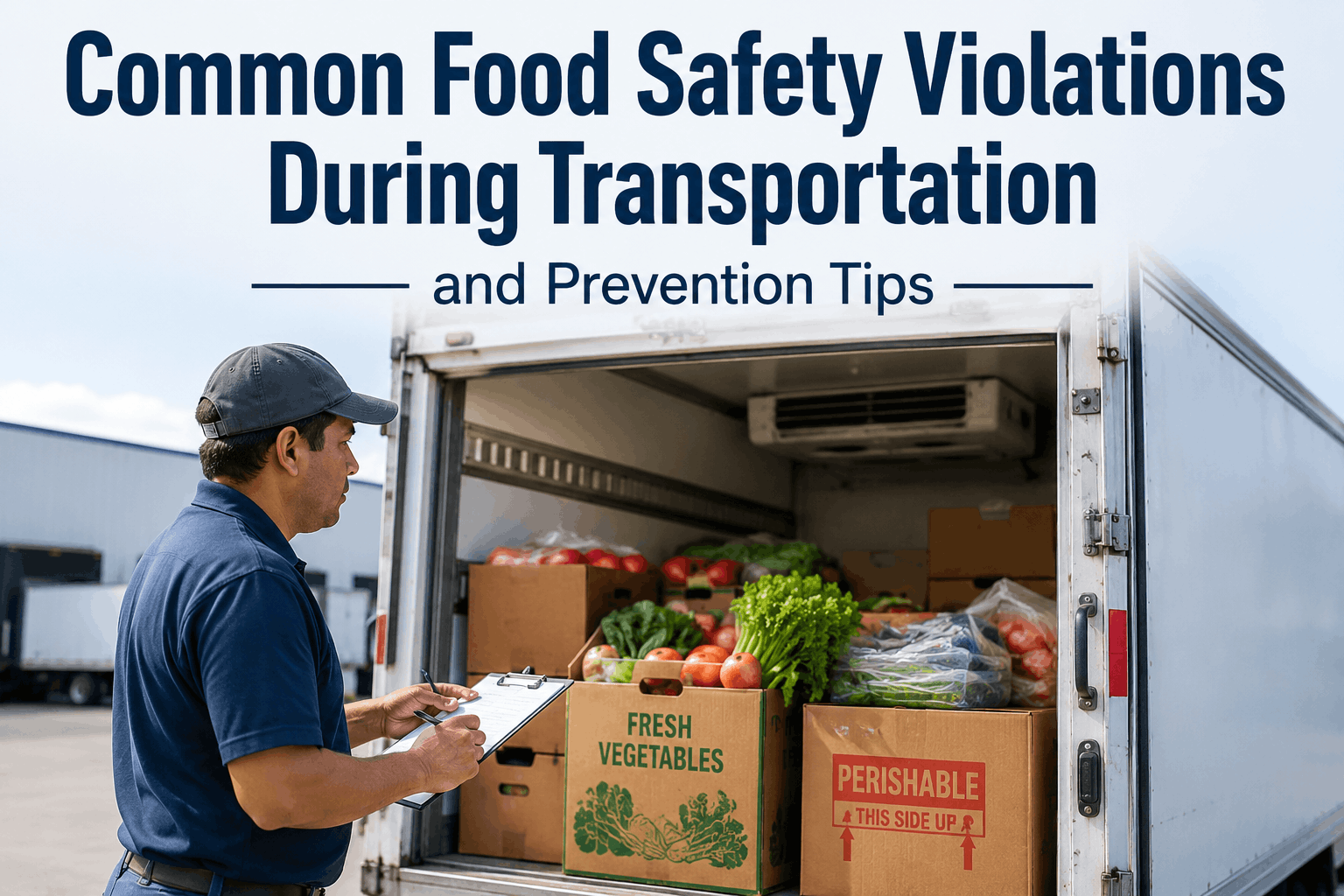
Common Food Safety Violations During Transportation and Prevention Tips
Uncover the top violations found in FDA audits and food safety inspections — and learn how digital fleet management tools, continuous temperature monitoring, and automated compliance records help food distribution fleets prevent every one of them.
68%Of transport food safety events caused by temperature exceedances
$35B+Annual US cold chain food loss linked to transport failures
<90sFleetRabbit threshold breach to dispatcher alert delivery
100%Routes with FSMA-compliant documentation generated automatically
The Top Food Safety Violations Found During Transportation Audits — and What Causes Them
FDA inspections under FSMA's Sanitary Transportation rule, major retailer food safety audits, and third-party food logistics compliance reviews consistently surface the same categories of violation across food distribution fleets of every size. Understanding precisely where these violations originate — and why manual systems consistently fail to prevent them — is the starting point for building a transport food safety programme that holds up under scrutiny.
01
Temperature Exceedances Without Detection or Response
The most frequently cited food safety violation in refrigerated transport is not equipment failure — it is the failure to detect and respond to temperature deviations while the vehicle is in transit. Reefer units that drift above setpoint during highway driving, door openings at multi-stop deliveries that raise compartment temperature by 8–12°F, and extended idle periods during driver rest breaks all produce temperature exceedances that manual logger tapes record but never alert on. By the time the tape is read, the product is already delivered and any intervention window has closed permanently. FleetRabbit's real-time IoT temperature monitoring detects every exceedance the moment it occurs — alerting the driver and dispatcher within 90 seconds with the affected zone, current temperature, and duration, enabling intervention before product integrity is compromised.
02
Incomplete or Missing Sanitation Records
FSMA's Sanitary Transportation rule requires carriers to document cleaning and sanitising events with specific detail — wash facility identity, chemicals and concentrations used, and completion timestamp. Paper wash certificates are the single most commonly incomplete element of food fleet compliance programmes: certificates are lost between the wash facility and the depot, completed retrospectively at week-end rather than at the point of the wash event, or simply absent for vehicles that were cleaned but not documented. FleetRabbit's digital sanitation log captures every wash event at the point of completion, with mandatory fields that cannot be bypassed — creating a compliant, searchable record linked to the vehicle's compliance profile the moment the wash is complete.
03
Driver Hygiene and Training Documentation Gaps
FSMA requires that carriers ensure personnel engaged in food transport are trained in sanitary transport practices commensurate with their duties — and that this training is documented. In high-turnover food distribution environments, driver training records maintained in spreadsheets or paper files consistently develop gaps: training periods expire without renewal alerts, new hires begin routes before their training completion is confirmed, and policy acknowledgements are obtained at onboarding but never at refresher intervals. FleetRabbit's driver compliance module stores training completion records, sends automated renewal alerts before expiry, and captures digital shift-start acknowledgements — linking each acknowledgement to the route record so every delivery has a documented confirmation that the assigned driver's training was current at the time of transport.
04
Cross-Contamination from Previous Load Failures
FSMA requires carriers to assess whether the previous load in a refrigerated compartment poses a contamination or allergen risk to the current load — and to document that assessment and any required cleaning before loading. In practice, previous load compatibility assessment is one of the most consistently missed pre-loading steps in food distribution operations, particularly when load assignments change late and the assessment step isn't embedded in a mandatory digital workflow. FleetRabbit's pre-loading inspection checklist enforces previous load compatibility confirmation as a mandatory field before the vehicle's dispatch status is enabled — preventing loads from departing without documented previous-load clearance.
FleetRabbit Prevention Capabilities for Every Major Food Safety Violation Category
Preventing food safety violations during transportation requires detection, documentation, and response working simultaneously — not as separate systems managed by different teams with different data. FleetRabbit's food safety compliance platform integrates all three into a unified operational system that captures compliance evidence automatically on every route, alerts on every deviation before it becomes a violation, and generates audit-ready documentation for every regulatory and customer audit requirement your fleet faces.
Continuous Temperature Monitoring
IoT sensors transmit compartment readings every 60 seconds to a live dashboard — alerting drivers and dispatchers within 90 seconds of any threshold breach. Multi-zone trailers monitored zone-by-zone with independent thresholds. Complete temperature logs stored immutably per route for FSMA two-year retention.
Digital Sanitation Log Capture
Every wash event captured digitally at the point of completion — facility identity, chemicals, concentrations, contact time, technician name, GPS-verified location, and timestamp. Mandatory field enforcement prevents partial records. Searchable by vehicle, date, and wash type in under 60 seconds for audit response.
Pre-Trip Digital Inspection Workflows
Mandatory digital checklists before every route — covering reefer pre-cool verification, door seal integrity, previous load compatibility, sensor calibration status, and sanitation confirmation. Photo capture required for flagged items. Failed items auto-generate maintenance work orders and block dispatch clearance until resolved.
Driver Training and Compliance Tracking
Training completion records, vehicle class authorisations, and refresher cycle dates stored per driver — with automated renewal alerts before expiry. Shift-start digital hygiene policy acknowledgements captured per route and linked to the compliance record. Every delivery documents that the assigned driver's training was current at transport time.
Cold Chain Analytics and Violation Trending
Fleet-wide analytics identify which vehicles, routes, drivers, and stops generate the highest frequency of temperature exceedances and sanitation compliance gaps. Trend data surfaces deteriorating compliance patterns before they become violations — enabling safety managers to intervene at root cause rather than managing individual incidents in isolation.
One-Click FSMA Compliance Reports
Complete compliance packages generated in under 60 seconds — temperature logs, sanitation records, pre-trip inspections, driver training documentation, and corrective action trails — per route, per vehicle, or per date range. PDF-formatted for direct FDA inspector submission and customer food safety audit response. No manual assembly, no paper search.
FleetRabbit Food Safety Compliance
Stop Discovering Food Safety Violations After the Auditor Finds Them. Start Preventing Every One in Real Time.
FleetRabbit's food transport compliance platform gives distribution fleets continuous temperature monitoring, digital sanitation logs, mandatory pre-trip inspections, driver training records, and automated FSMA documentation — on every route, across every vehicle, generated automatically without manual data entry.
Food Transport Violation Prevention Checklist by Audit Category
Audit 01
Temperature Record Completeness
FDA inspectors request continuous temperature records — not just loading and delivery readings. FleetRabbit's IoT monitoring generates a per-minute temperature log for every route, stored with timestamps and GPS, with zero manual compilation required.
Audit 02
Sanitation Procedure Evidence
Auditors verify that written sanitation procedures were actually followed — not just that procedures exist. FleetRabbit's pre-trip digital inspection captures procedure adherence at point of execution with operator identity, timestamp, and photo evidence.
Audit 03
Wash Event Documentation
Wash certificates must include facility identity, chemical products and concentrations, and completion timestamp. FleetRabbit's digital sanitation log enforces all required fields at the point of the wash event — not reconstructed later from memory or facility records.
Audit 04
Driver Training Currency
FSMA requires current sanitary transport training for every driver on every food route. FleetRabbit tracks training expiry dates, sends automated renewal alerts, and captures shift-start acknowledgements — so every route record confirms training was current at the time of transport.
Audit 05
Exceedance Response Documentation
When a temperature exceedance is detected, the response — who was notified, what decision was made, what action was taken — must be documented. FleetRabbit's alert workflow captures every response step with responder identity and timestamp, creating an auditable intervention record per exceedance event.
Audit 06
Two-Year Record Retention
FSMA requires a minimum two-year retention period for all sanitary transport compliance records. FleetRabbit stores every record in an immutable cloud archive with configurable retention periods — retrievable for any vehicle, route, or date range in under 60 seconds without any manual file retrieval.
From the Field
"
We had three FDA-related customer audit findings in an eighteen-month period — all three came down to the same root cause: we couldn't produce the documentation that the auditor needed. Once for temperature records with a gap in the middle of a route where the logger tape had been damaged. Once for a wash certificate that we knew had been completed but couldn't locate in our filing system. Once for a driver training record where the refresher had lapsed by six weeks. None of these were actual food safety events — the product was safe, the vehicles were clean, the driver was trained. But we couldn't prove it, and in a food safety audit, what you can't prove didn't happen. After implementing FleetRabbit, we had our first clean supplier audit in four years. The auditor reviewed six delivery records — temperature logs, sanitation records, pre-trip inspections, driver training confirmations — and found zero documentation gaps. Everything was in the system, timestamped, retrievable in seconds. That's the difference between a compliance programme and a compliance record.
Director of Food Safety and Compliance
·
Regional Fresh Produce and Dairy Carrier — 28 Refrigerated Vehicles — FleetRabbit Compliance Active
Frequently Asked Questions
QWhat are the most commonly cited food safety violations in FDA FSMA transport inspections?
FDA inspections under the FSMA Sanitary Transportation rule (21 CFR Part 1, Subpart O) most frequently cite the following violation categories: inadequate or absent temperature monitoring records that cannot demonstrate continuous temperature control throughout transit; missing or incomplete sanitation wash records that fail to include required elements such as chemical identity, concentration, and contact time; absence of documented written sanitation procedures or evidence that those procedures were followed; incomplete driver training documentation including expired certifications and missing refresher records; and failure to conduct or document previous load compatibility assessments before loading food commodities. FleetRabbit's compliance platform addresses every one of these violation categories through automated digital capture at the point of operation — not through retroactive record compilation.
QHow does continuous temperature monitoring prevent violations compared to paper logger tapes?
Paper temperature logger tapes generate a two-data-point record — temperature at loading and temperature at delivery — with a continuous graph line between that cannot be interrogated, searched, or alerted on in real time. When a temperature exceedance occurs during transit, the tape records it passively after the fact — providing no intervention opportunity. FleetRabbit's IoT monitoring generates one timestamped, GPS-tagged reading every 60 seconds, processes each reading against a configurable threshold the moment it is received, and delivers an alert to the driver, dispatcher, and fleet manager within 90 seconds of any breach. The operational difference is not incremental — it is the difference between a record of what went wrong and a system that prevents the outcome before product integrity is compromised. For compliance purposes, the difference is equally significant: FDA inspectors specifically look for evidence of continuous temperature maintenance, and a paper tape cannot demonstrate that continuous control was applied.
QCan FleetRabbit generate the compliance documentation a customer food safety auditor requests in the format they expect?
FleetRabbit generates compliance documentation in configurable formats that can be adapted to the documentation requirements of major grocery retailer and food service chain supplier audit standards. Temperature logs export with continuous data points, exceedance annotations, and alert response records. Sanitation records export with all FSMA-required fields. Pre-trip inspection records export with operator attribution, timestamp, and photo evidence. Driver training documentation exports with training completion dates, refresher history, and shift-start acknowledgement records. All documentation is exportable per route, per vehicle, or per date range in PDF format — in under 60 seconds from the compliance dashboard. For 3PL operations transporting product for multiple shipper accounts, report templates can be configured to match each shipper's specific documentation format requirements.
Schedule a demo to review the compliance report formats available for your specific audit requirements.
QHow does FleetRabbit handle temperature monitoring when a vehicle passes through cellular dead zones on a route?
FleetRabbit's onboard data logger buffers temperature readings locally when cellular connectivity is unavailable — maintaining the complete sensor reading sequence with timestamps throughout the coverage gap. When connectivity is restored, the buffered data syncs to the cloud database automatically and the full temperature record is reconstructed without gaps. The compliance record for the route notes the connectivity gap — start time, end time, and duration — with a distinction between a monitoring gap caused by connectivity loss and a monitoring gap caused by sensor failure. This is a material compliance distinction: FDA inspectors reviewing the record can see that monitoring was active throughout the route and that data transmission was temporarily interrupted by coverage conditions, rather than seeing an unexplained gap in the temperature record that implies the monitoring system was not functioning.
Sign up for a free account to explore FleetRabbit's offline data buffering capability for your specific route profiles.
FleetRabbit Food Safety Compliance
Every Violation Category Prevented. Every Route Documented. Every Audit Ready.
FleetRabbit gives food distribution fleets the continuous temperature monitoring, digital sanitation records, mandatory pre-trip inspection workflows, driver compliance tracking, and automated FSMA documentation they need to prevent every common food transport violation — before it surfaces in an audit finding.
Temperature Violation Prevention
Digital Sanitation Logs
FSMA Audit Documentation
Driver Training Records
Cold Chain Analytics
Two-Year Record Retention
May 26, 2026
By Taylor
All Posts