How much a single condemned load really costs your fleet
Cold chain fleet ROI conversations usually start with fuel and routing. The bigger number is almost always sitting in spoilage write-offs and reefer downtime from loads that drifted out of range and nobody caught until it was too late to fix.
You can sign up and see where your own excursions are happening before the next load gets condemned instead of after.
What actually gets written off when a load is condemned
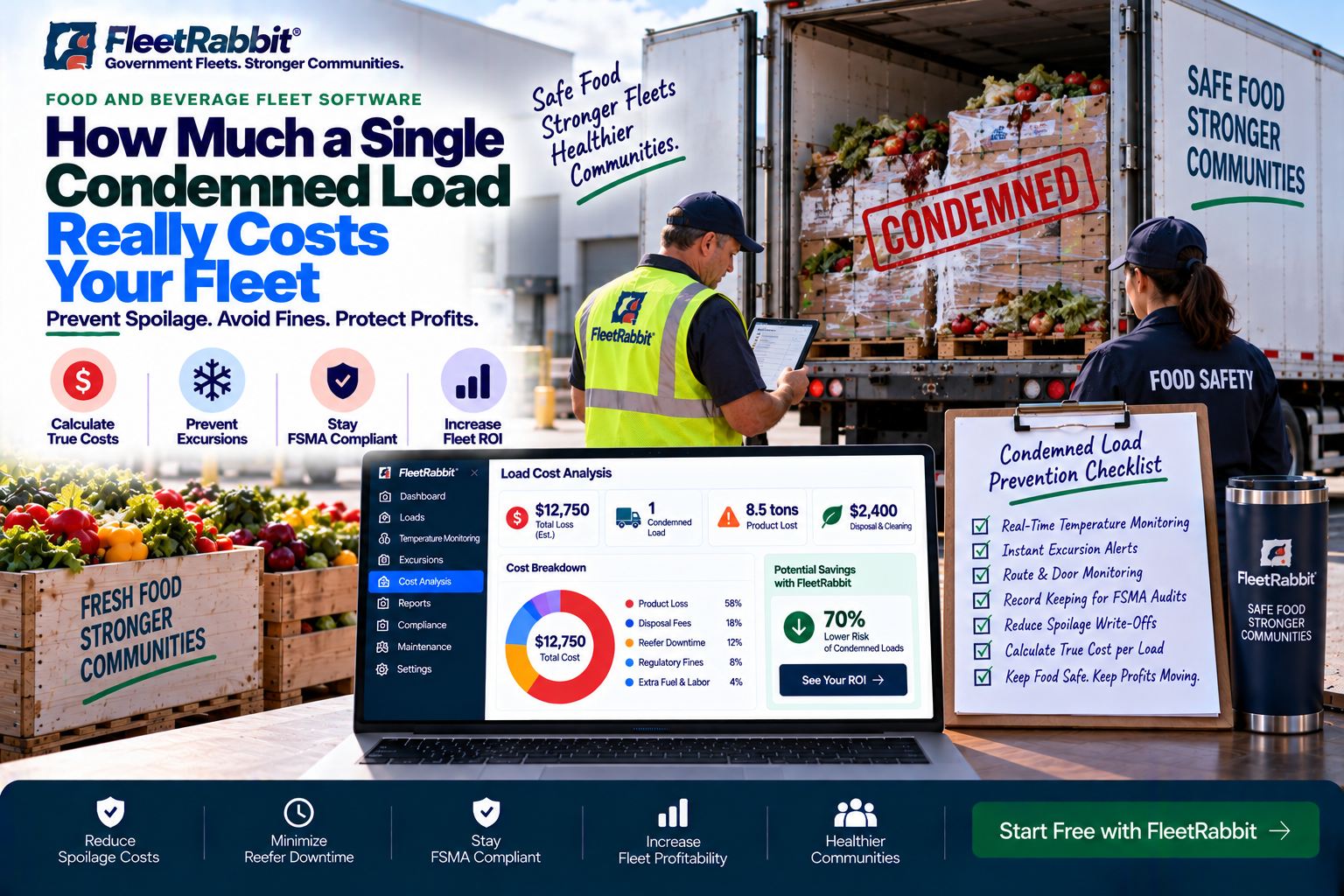
The rejected product is the visible number. The rest of the cost shows up on different lines, days apart, which is why it rarely gets added up as one event — sign up to see the full breakdown against your own load history.
| Cost | What triggers it |
|---|---|
| Product value | Full spoilage write-off on the rejected load, often the entire pallet or trailer |
| Reefer downtime | Unit held for inspection or recalibration before it can run temperature-sensitive freight again |
| Chargeback or claim | Receiver deducts the load value or files a claim against the carrier |
| Record request | A condemned load increases the odds of a customer or FDA request for the full temperature log |
| Route disruption | Downstream stops on the same route absorb the delay from the rejection and any reroute |
Catch the drift before it becomes a write-off
FleetRabbit flags a temperature excursion the moment it starts, not when the receiver opens the trailer door.
The FSMA paper trail a condemned load triggers
Under the FSMA Sanitary Transportation Rule, carriers moving temperature-sensitive food are expected to keep vehicles pre-cooled, monitor temperature through the trip, and hold onto those records — generally for at least twelve months, and available if a reviewer asks for them.
Reviewers commonly expect records to be produced within roughly 24 hours of a request — a window that's difficult to meet from a spreadsheet buried in someone's inbox, and straightforward from a system that already has the load's full temperature history on file.
A condemned load is exactly the kind of event that invites a closer look at your records. Teams that book a demo usually want to see how fast a single load's full temperature history can actually be pulled.
Reefer downtime: the cost that follows the write-off
A condemned load rarely ends with the rejected pallet. The trailer often needs to be pulled for inspection or recalibration before it's trusted with the next temperature-sensitive load, which turns one bad load into a delay for whatever was scheduled behind it.
Without excursion prevention
Drift goes unnoticed until delivery, load is rejected, reefer is pulled for inspection, and the next scheduled load slips behind it.
With excursion prevention
Drift triggers an alert in transit, the issue gets corrected or the load rerouted, and the reefer stays in rotation for what's next.
What actually prevents the excursion, not just documents it
A temperature log is useful after the fact. What keeps a load from being condemned in the first place happens earlier in the route — it's worth a book a demo look if your process still catches drift only at delivery.
Pre-cool verification
Confirming the unit hit the required temperature before loading, not assuming it based on the setpoint.
Live in-transit alerts
A drift toward the edge of the safe range flags a driver or dispatcher minutes into the excursion, not hours later.
Continuous, exportable logs
Every reading captured automatically for the whole route, ready for a receiver or reviewer without reconstructing it by hand.
The number worth tracking isn't the write-off — it's the drift
By the time a load gets condemned, the cost is already locked in. Cold chain fleet ROI comes from catching the excursion while there's still time to do something about it, and from having a clean record the moment anyone asks for one.
See where your own fleet's excursions are happening — sign up and connect a route, or book a demo and walk through a recent condemned load together.
Stop finding out about the excursion at the receiving dock
Start free and see your fleet's temperature performance today, or talk it through with our team first.
Common questions
What counts as a condemned load
Most commonly, a shipment a receiver refuses because it arrived outside the required temperature range for long enough to put the product's safety or quality in question.
How long do temperature records need to be kept under FSMA
Carriers handling temperature-sensitive food are generally expected to retain monitoring and sanitation records for at least twelve months from when each record was created.
Does a short temperature excursion always mean the load gets condemned
Not always — it depends on the commodity, how far out of range it went, and for how long. But a brief drift is exactly the kind of thing that's cheap to catch in transit and expensive to explain after delivery.
What's the biggest hidden cost in a condemned load
Reefer downtime tends to be underestimated — the trailer being pulled for inspection or recalibration affects every load scheduled behind it, not just the one that got rejected.
Can excursion prevention actually stop a load from being condemned
It can catch a drift early enough to correct the setpoint, address a door or seal issue, or reroute the load before it goes out of range for long enough to matter.
Is this only relevant for large cold chain fleets
No — a single condemned load can be a meaningful loss for a small fleet too, and smaller operations are often the ones with the least slack to absorb a surprise write-off.