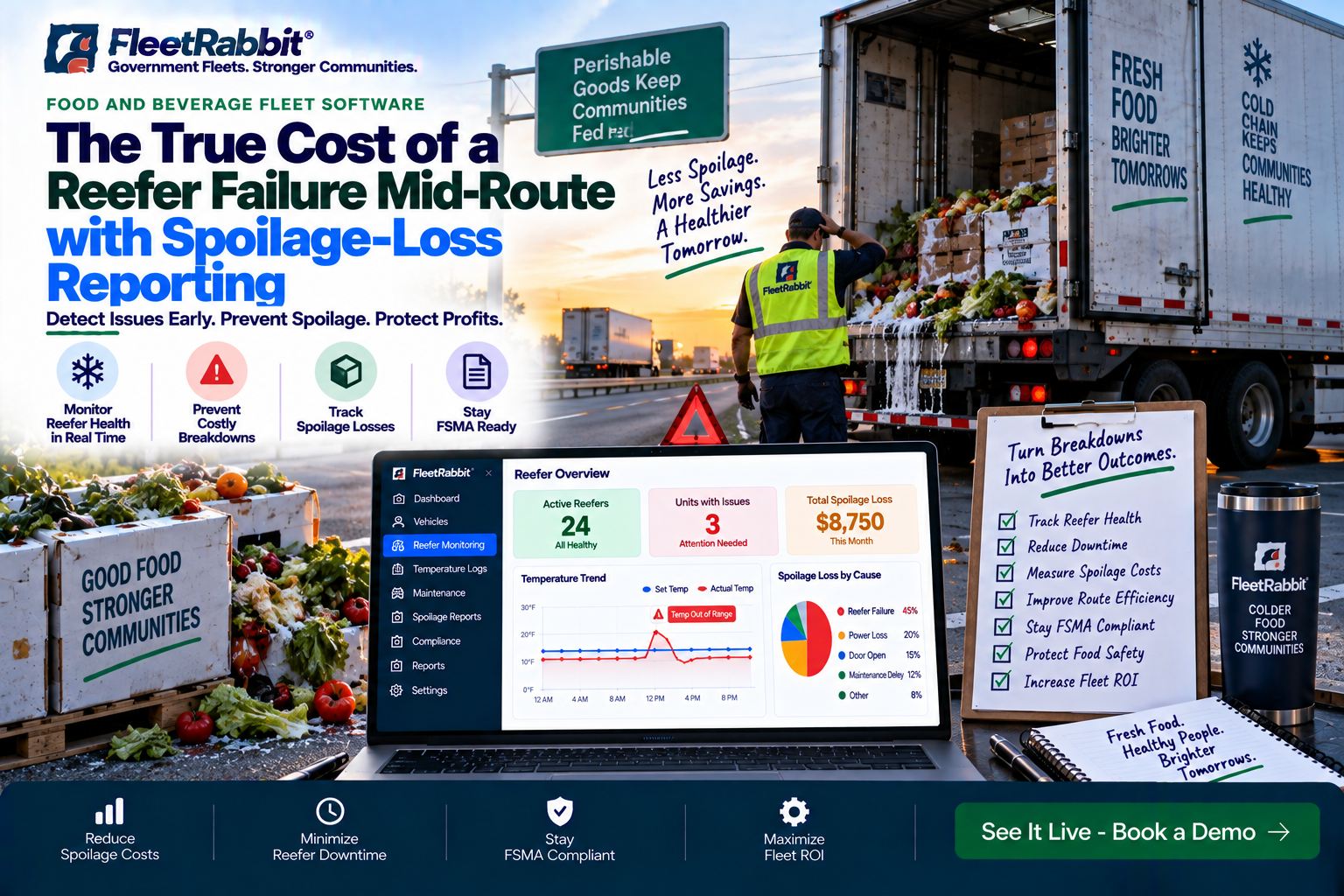
Ask a fleet manager what a mid-route reefer failure costs and most will name the spoiled load and stop there. That number is real, but it is also the smallest line on the actual invoice. A single failure typically triggers a redelivery scramble, a customer chargeback negotiation, hours of documentation work to answer the inevitable questions, and sometimes a repair bill on top of all of it. Add those up honestly and a failure that looked like a five-figure product loss often turns out to cost meaningfully more once everything downstream is counted. FleetRabbit exists to catch the failure early enough that most of that downstream cost never gets triggered in the first place. You can sign up to see what a similar incident would likely cost across your own routes and product mix.
Figures are illustrative ranges based on common industry cost categories and will vary by product value, contract terms, and route distance.
The Cost Most Fleets Only See the Tip Of
The spoiled product is the visible cost, the number that shows up immediately and gets reported up the chain. Almost everything else sits below the surface, absorbed quietly into administrative time, strained customer relationships, and repair budgets that never get traced back to the original incident. Fleets that sign up for FleetRabbit start seeing these hidden costs tied back to the incidents that actually caused them.
- Redelivery and expedited shipping arrangements
- Customer chargebacks and strained contract renewals
- Staff hours spent assembling documentation after the fact
- Repair and downtime on the reefer unit itself
- Increased scrutiny on the next customer or FDA audit
Catching It Early Versus Finding Out Late
The exact same temperature problem costs dramatically different amounts depending on when it gets caught. A pre-cool check that fails at the dock is an inconvenience. The same failure discovered by a customer after delivery is a very different conversation. You can book a demo to see where your own recent incidents would have landed on this scale.
A pre-cool or load-in check catches the issue before the trailer ever leaves the dock, limiting the cost to a short delay.
An in-transit alert allows a diversion or corrective action before the product reaches the customer, but the load itself may still be affected.
The customer finds the problem first, triggering the full chain of spoilage, chargeback, and relationship costs described above.
Fleets that sign up for FleetRabbit move more incidents from the right side of this comparison to the left.
Stop Paying the Full Cost of a Preventable Failure
Catch temperature problems before departure or in transit, instead of finding out when the customer does.
Core Features That Cut the Downstream Cost
Real-Time Temperature Alerts
Alerts fire the moment a reading drifts toward a critical limit, giving dispatch time to act before the load is lost.
Automated Incident Documentation
Every reading, alert, and corrective action is logged automatically, cutting the hours normally spent reconstructing what happened.
Dispute-Ready Delivery Records
A complete temperature and handling record for the shipment gives you a factual basis to push back on an unwarranted chargeback.
Pattern Detection Across Routes
Recurring failures on the same route or unit are surfaced early, preventing the same costly incident from repeating.
You can book a demo to see these features applied against your own recent incident history.
Where FleetRabbit Reduces Each Cost
You can sign up to see this same breakdown built against your own recent incident and chargeback history.
| Cost Category | How FleetRabbit Reduces It |
|---|---|
| Product spoilage write-off | Early alerts allow correction before the full load is affected |
| Redelivery and expedited shipping | Fewer late-stage failures mean fewer emergency reshipments |
| Customer chargebacks | Complete records support disputing chargebacks that are not warranted |
| Documentation and audit prep labor | Automatic logging removes most manual reconstruction work |
| Reefer repair and downtime | Pattern detection catches developing mechanical issues earlier |
Turn One Prevented Failure Into Real Savings
Real-time alerts, automated documentation, and dispute-ready records that add up to fewer costly incidents.
Frequently Asked Questions
What is usually the biggest cost in a reefer failure
The spoiled product write-off is typically the largest single line item, but redelivery costs, customer chargebacks, and documentation labor combined often add up to a comparable or larger amount once counted together.
Why does the timing of discovery change the total cost so much
A problem caught before departure or early in transit usually only costs a short delay or a diverted load, while the same issue discovered by the customer at delivery triggers the full chain of spoilage, chargeback, and relationship costs.
Can better documentation actually help dispute a chargeback
Yes. A complete temperature and handling record for the shipment gives a factual basis to challenge a chargeback that is not actually supported by the delivery data, rather than accepting it by default.
How does pattern detection reduce repeat failures
Recurring issues on the same route, trailer, or reefer unit are surfaced across incidents rather than treated as isolated events, making it possible to address a developing mechanical problem before it causes another loss.
Does reducing spoilage costs also reduce audit risk
Generally yes. Fewer temperature excursions mean fewer incidents requiring after-the-fact documentation, and the records that do exist are more complete, which tends to reduce both the frequency and the difficulty of audit-related follow-up.